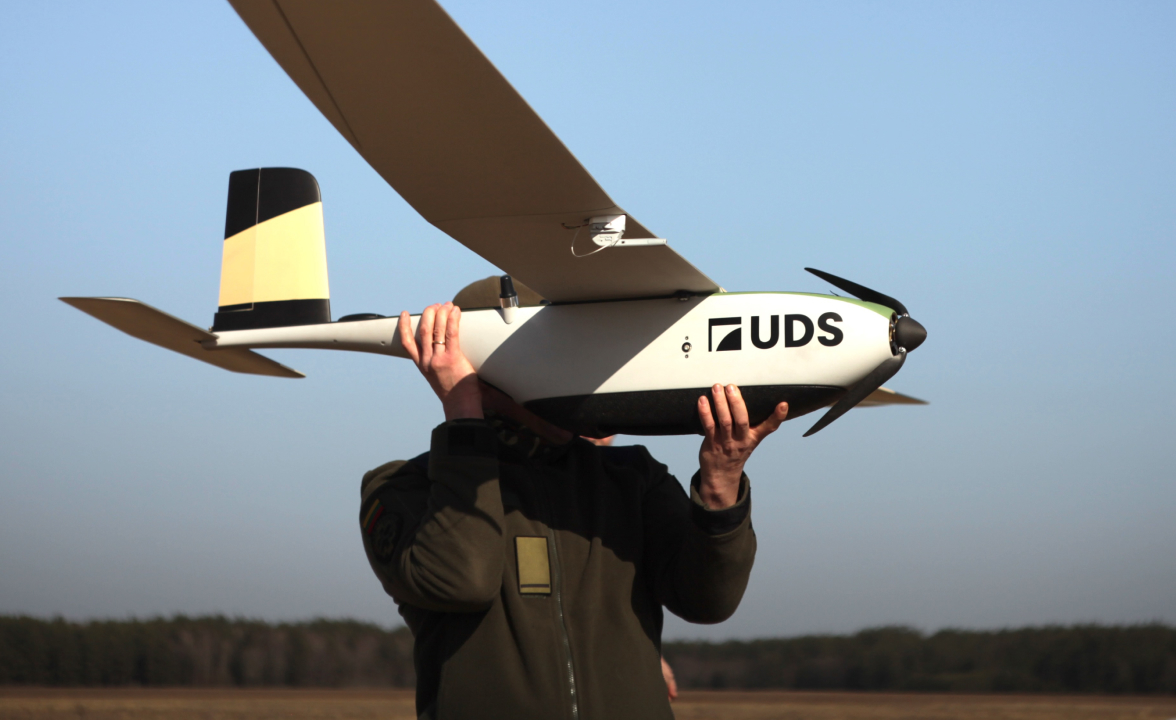
Lithuanian defense technology company Unmanned Defense Systems (UDS) has launched operations in Ukraine through a newly established joint venture, UDS Ukraine, the Vilnius-based drone maker announced from Kyiv on October 6, 2026. The venture gives UDS a permanent presence to support deployment of its systems, train Ukrainian operators and work directly with frontline units.
The move formalizes a relationship that predates the joint venture. UDS has supplied uncrewed systems to Ukrainian forces since at least 2024, and the company says its BLASTER 4 first-person-view (FPV) drone has completed serial qualification testing and is being delivered directly to Ukrainian units. Its FORECASTER reconnaissance drone and AVENGER 5 strike drone have also been tested in Ukraine, the company said at Poland’s MSPO exhibition in September 2026. “Ukraine has fundamentally changed the speed at which defense technology must evolve,” said Vytenis J. Buzas, co-founder and chief executive of UDS.
How Lithuanian Drone Maker UDS Is Structuring Its Ukrainian Venture
Stepan Veselovskyi leads UDS Ukraine as chief executive and co-owner. The company has not disclosed the ownership split, the identity of any other Ukrainian shareholders or the value of the initial investment. Veselovskyi said the venture is being built as a Ukrainian company working directly with the military, not a foreign vendor selling into the country.
The Ukrainian team’s stated mission covers three functions: product deployment, operator training and continuing cooperation with military units. The aim is to shorten the path from a requirement identified at the front to a fix delivered back to the unit. UDS says Ukrainian combat experience will feed directly into its development work, a loop that matters most for electronic warfare (EW) resilience, where Russian jamming and spoofing techniques shift in weeks rather than procurement years.
Inga Stanytė-Toločkienė, Lithuania’s ambassador to Ukraine, said that for defense companies, “a presence in Ukraine is no longer an option but a necessity.”
Manufacturing remains an open question. UDS markets a distributed production model built around sovereign manufacturing, but the announcement does not state that UDS Ukraine will build aircraft locally.
FORECASTER and AVENGER 5: Endurance, Range and Terminal Guidance
FORECASTER is a modular fixed-wing ISTAR (intelligence, surveillance, target acquisition and reconnaissance) aircraft in the mini-UAV class. Publicly available specifications list a maximum takeoff weight below 7 kg, a 3.3-meter wingspan and a 1.2-meter fuselage. UDS claims 270 minutes of endurance, a maximum speed of 26 m/s (about 94 km/h), a 60 km radio line of sight and wind tolerance up to 14 m/s. Retractable electro-optical and infrared gimbals make up the sensor payload. For contested airspace, the aircraft combines a dual-band radio with automatic frequency selection, dead-reckoning navigation when satellite signals are denied, and native integration with the SitaWare HQ and ATAK battle management systems.
UDS recently added RF-based drone detection to warn operators of approaching FPV interceptors, now a leading threat to reconnaissance aircraft over Ukraine, and remote mission operation via SwarmC2. Four and a half hours on station in a sub-7 kg airframe gives an artillery unit persistent target correction without tasking a larger, costlier UAV.
AVENGER 5, which UDS still lists as in development, is the strike component. The airframe weighs 12 kg without warhead and carries a modular warhead of up to 5 kg. Company figures give a maximum flight distance of 150 km, 90 minutes of flight time, a 280 km/h top speed and a 110 km/h cruise speed. Radio line of sight extends from 60 km to 100 km with a relay. A pneumatic launcher reduces visual, acoustic and thermal launch signatures. Terminal guidance uses proportional navigation and automatic target tracking based on sensor fusion. Once a target is acquired, the munition completes the attack without a radio link or GNSS, the decisive requirement where EW routinely severs a drone’s final kilometers of control.
SwarmC2 Kill Chain: Applying Satellite Systems Engineering to Drones
SwarmC2 ties the platforms into what UDS calls a complete kill chain, from detection to confirmed destruction. The software runs standalone or inside SitaWare HQ and ATAK, lets a single operator control multiple aircraft over a self-healing mesh network, and hands a mission automatically to a fresh UAV when another runs low on power. A NATO-standard synchronization matrix deconflicts flight times and areas through the operator’s battle management system. A predictive AI module remains in prototyping. The third airframe, HAULER, is a multi-payload carrier for logistics, ISR, communications relay and EW, rated for 5 kg payloads, 75 minutes of endurance and a 60 km line of sight.
The systems logic reflects the founders’ background. Buzas led LituanicaSAT-1, Lithuania’s first national satellite mission, and co-founded NanoAvionics, in which Norway’s Kongsberg acquired a 77% stake in 2022 at a €65 million valuation. Co-founder Žilvinas Kvedaravičius, a former interim CEO of NanoAvionics, said space taught the team that a platform only works when hardware, software, communications and mission control are engineered together.
Analysis: The joint venture matters less for the hardware than for the development model it institutionalizes. A supplier with engineers embedded alongside users captures battlefield feedback faster than one relying on periodic trials. For Lithuania, a NATO frontline state bordering Belarus and Russia’s Kaliningrad exclave, it is also industrial policy: drones hardened against Russian EW feed back into national forces already using UDS technology and into allied events such as Baltic Trust 2026 in Latvia, where UDS supported Canadian, British and Czech concepts under counter-UAS and EW pressure. Fellow Lithuanian firm Granta Autonomy is showing Ukraine-proven drones in London this week. The caveat is maturity: with AVENGER 5 and HAULER still in development, near-term output rests on FORECASTER, BLASTER 4 and SwarmC2.
UDS has given no staffing levels or procurement volumes tied to the launch. The next milestones are completion of AVENGER 5 development and qualification, any codification of FORECASTER and AVENGER 5 by Ukraine’s Ministry of Defense, which has not been announced, and a decision on local production. Progress on SwarmC2’s predictive targeting module will determine how far the one-operator, many-aircraft concept can be pushed at the front.