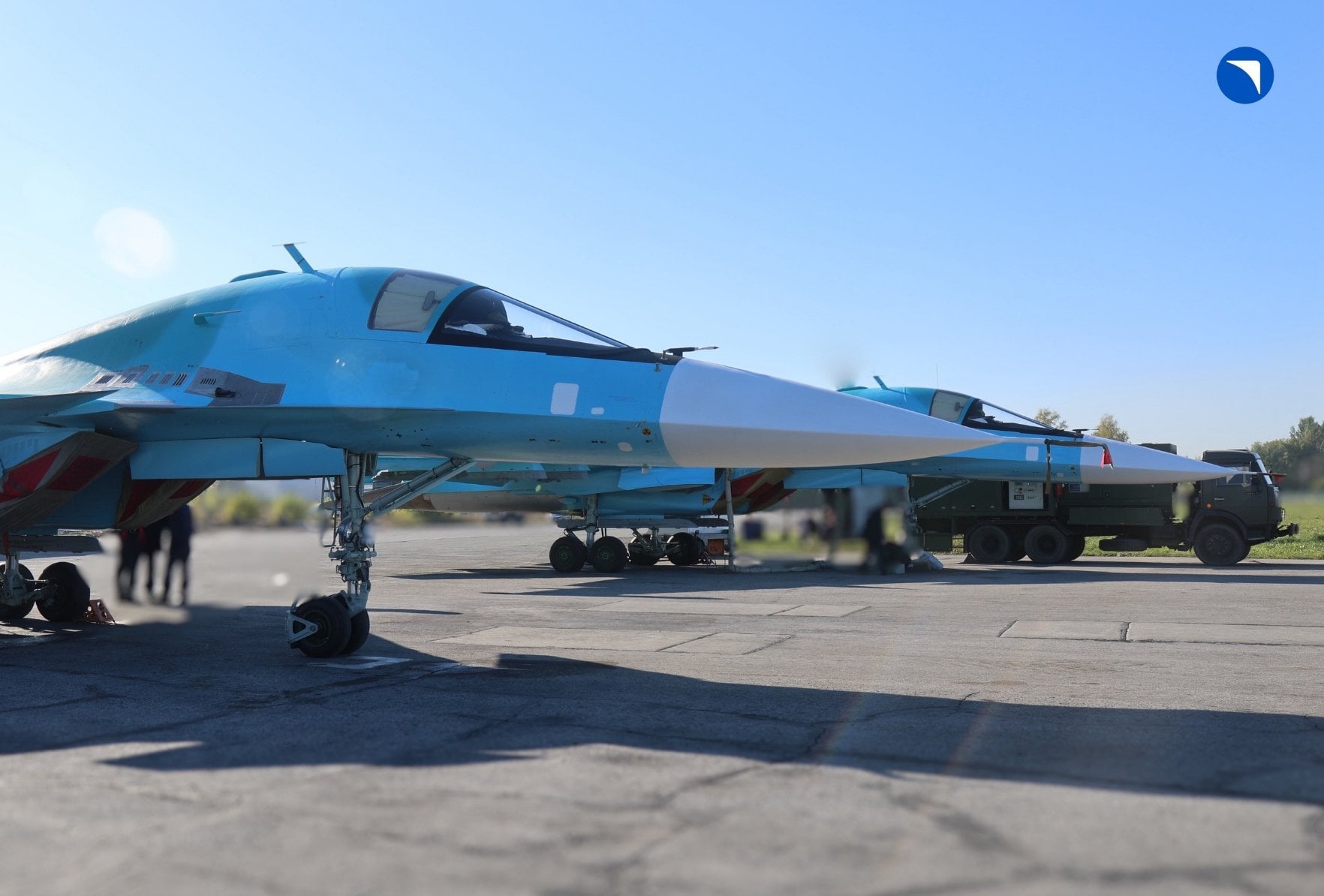
Russia’s United Aircraft Corporation (UAC) has delivered a new batch of Su-34 fighter-bombers to the Russian Aerospace Forces (VKS), the second Su-34 handover of 2026, parent company Rostec announced on October 7, 2026. Rostec did not disclose how many aircraft the batch contains, stating only that the jets completed the full cycle of ground and flight factory tests before departing for their units.
The delivery comes as the Su-34, known to NATO as Fullback, carries a disproportionate share of Russia’s air war against Ukraine. The type is the VKS’s main launch platform for general-purpose bombs fitted with UMPK (unified gliding and correction module) kits, which allow crews to release heavy ordnance from standoff range, beyond the reach of many Ukrainian short-range air defenses. That role has proved costly. Open-source loss tracking based on photographic evidence has documented more than 40 Su-34s destroyed since February 2022, placing the Fullback among the Russian combat aircraft lost most often in the war.
Su-34 Fighter-Bombers in 2026: Delivery Pace and Undisclosed Numbers
Photos and video released by UAC show at least two aircraft and possibly four, according to open-source analysts who track Russian aircraft production and point to differing weather conditions across the images. The October airframes carry blue bort (side) numbers, while the first 2026 batch, delivered on July 9, 2026, alongside Su-30SM2 multirole fighters, wore red numbers. UAC did not name the receiving regiments, so the color change may reflect a different unit assignment but cannot be confirmed.
As with the July batch, UAC’s release designates the aircraft simply as “Su-34” rather than Su-34M, the designation used for the modernized standard. Analysts read this as evidence of a further-improved production configuration, referred to in Russian sources as Su-34 NVO. Rostec said only that the aircraft continues to be upgraded based on combat use in Ukraine. The July airframes also showed a new dorsal fairing aft of the cockpit, first seen on in-service Su-34s in imagery released in May and June 2026 and assessed as a possible satellite communications installation. Whether the October jets carry the same fairing has not been confirmed.
Production data frame the delivery. Open-source tallies credit the VKS with 212 Su-34s received by the start of 2026, a count that includes seven prototype and pre-production aircraft and 18 jets delivered across seven announced handovers in 2025. No Su-34 delivery was announced between December 10, 2025, and July 9, 2026, and independent estimates put the July batch at two to four aircraft. By the end of September 2025, Rostec had already announced four Su-34 handovers. UAC has not explained the gap.
Fullback Design, Sensors, and Weapons Behind the Glide Bomb Campaign
Derived from the Su-27 family to replace the variable-geometry Su-24 frontline bomber, the Su-34 seats its two crew members side by side inside an armored cockpit capsule. Publicly available specifications indicate 17 mm of titanium armor around the crew compartment, a maximum takeoff weight of 45,100 kg, and twin Saturn AL-31F-M1 afterburning turbofans rated at roughly 13,500 kgf (132 kN) each, giving a top speed near Mach 1.8 at altitude. Combat radius is commonly cited at about 1,100 km and ferry range near 4,000 km, extendable by an in-flight refueling probe. The roomy cockpit underpins Rostec’s claim, attributed to an unnamed VKS crew commander, that the aircraft can fly nonstop sorties of up to 10 hours without degrading crew performance.
The sensor and weapons fit explains the type’s central role. The primary sensor is the Leninets V004 passive electronically scanned array (PESA) radar, backed by L175V Khibiny wingtip electronic warfare (EW) pods for self-protection. Manufacturer figures give 12 hardpoints and up to 8,000 kg of ordnance, plus an internal GSh-30-1 30 mm cannon. The weapons menu runs from UMPK-equipped FAB-500, FAB-1500 and FAB-3000 bombs to Kh-29 air-to-surface missiles, Kh-31P anti-radiation missiles and Kh-59-series cruise missiles. The Su-34M standard added the UKR-RL radar, UKR-OE electro-optical and UKR-RT signals reconnaissance pods, letting a strike airframe double as a tactical reconnaissance asset.
In role, the Fullback is closest to the US F-15E Strike Eagle, which seats its crew in tandem and has a lower maximum takeoff weight of about 36,700 kg. The heavier Russian airframe trades agility for fuel and payload. That suits standoff release profiles, but glide bomb release points still bring crews within reach of Ukraine’s long-range surface-to-air missiles.
Analysis: The handover confirms that Su-34 production continues, but the 2026 record points to a thinner flow than the 18-aircraft year that preceded it. Two batches of perhaps two to four jets each would give the VKS roughly four to eight new Fullbacks by early October, while Su-34 losses were reported in January and March 2026. At that rate, new production offsets attrition rather than growing the fleet, leaving Russia’s glide bomb campaign dependent on a force that is sustained, not expanded. The caveat is structural: Russian state defense order deliveries are habitually concentrated in the fourth quarter, and Rostec’s practice of withholding quantities means any annual total remains an estimate.
The next markers are a possible further handover before year-end, as occurred on December 10, 2025, and whether new imagery clarifies the dorsal fairing and the Su-34 NVO configuration. Rostec says additional batches are already in production at the Chkalov aircraft plant in Novosibirsk, the type’s only assembly line. Export work adds a further claim on that capacity, with Algeria reported as a Su-34 customer.