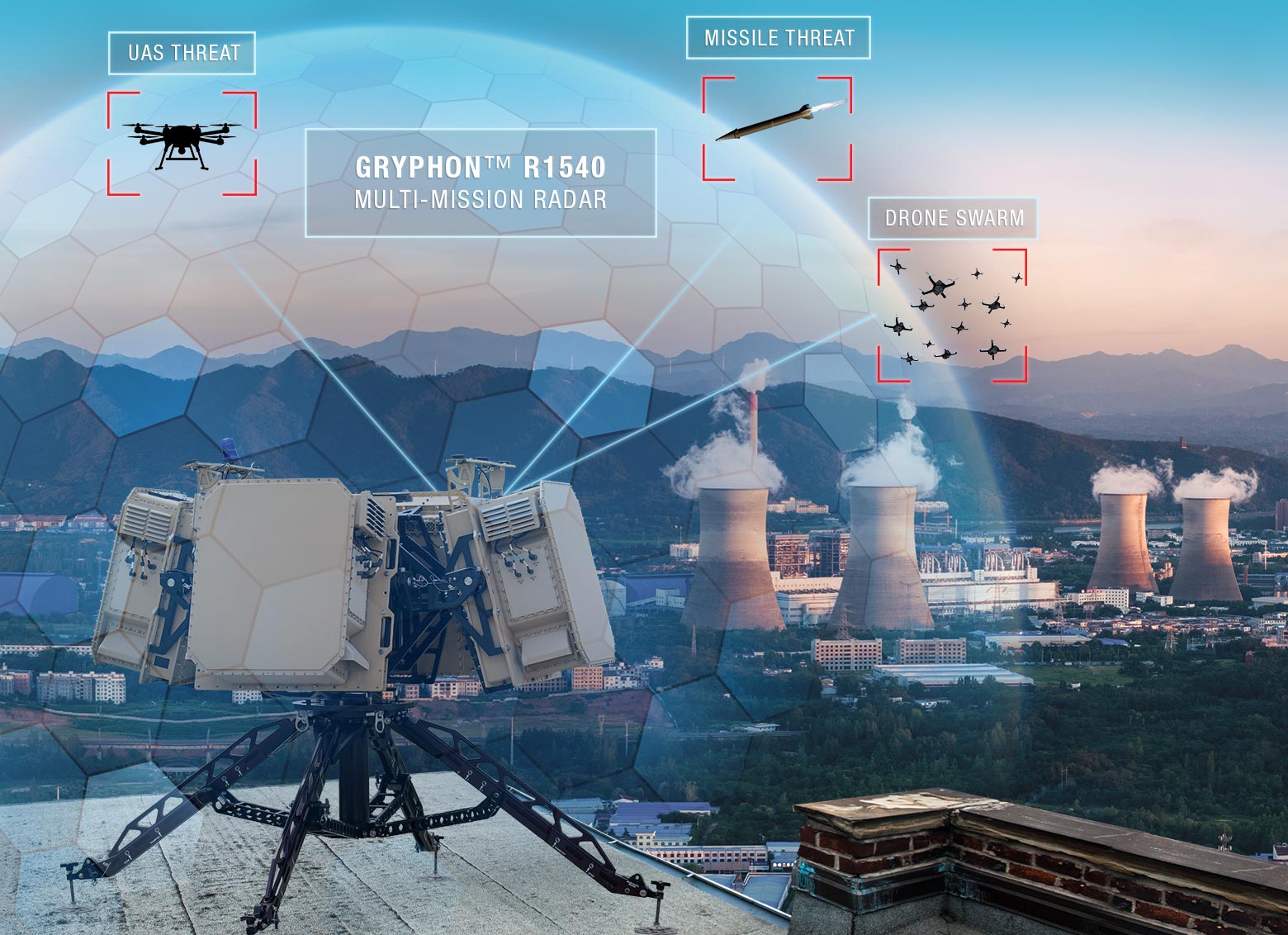
Joint Interagency Task Force 401 (JIATF-401) has awarded SRC Inc. a three-year indefinite-delivery/indefinite-quantity (IDIQ) contract with a $500 million ceiling for counter-unmanned aircraft systems (C-UAS) equipment and services under Domestic Shield, the Pentagon’s homeland counter-drone initiative, the Syracuse, New York-based company announced on October 6, 2026. A first delivery order worth $10.24 million covers one Gryphon R1440 radar, two Gryphon R1540 radars, and integration, installation and training support.
The award is one of ten base IDIQ contracts JIATF-401 announced on September 29, 2026, through Army Contracting Command to add capacity for Domestic Shield and other joint requirements. Secretary of Defense Pete Hegseth created the task force in an August 27, 2025, memorandum that dissolved the Army-led Joint Counter-small Unmanned Aircraft Systems Office (JCO) and gave its successor, reporting to the Deputy Secretary of Defense, its own acquisition authority against Group 1 to Group 3 drones. Domestic Shield was among its first efforts, aimed at a threat highlighted by repeated unidentified drone incursions over Joint Base Langley-Eustis, Virginia, in December 2023.
Inside the Domestic Shield IDIQ: Ten Awardees, One Marketplace
Domestic Shield protects military installations, critical infrastructure and other high-priority sites from small drones. Per the task force, it combines wider defensive perimeters, faster threat identification, interagency data sharing, trained contractor support and delegated protection authorities for high-risk facilities.
Seven companies received $500 million ceilings in the September round: Allen Control Systems, Digital Force Technologies, DroneShield, Napatree Technology, RADA Technologies, L3Harris WESCAM and SRC. Echodyne and PVP Advanced EO Systems each received $250 million, and SmartShooter $150 million. Army officials framed the package at $7 billion; the itemized ceilings total $4.15 billion, with more awards expected. AeroVironment separately holds a sole-source $500 million Domestic Shield IDIQ awarded in July 2026.
The vehicles span sensors, effectors and command-and-control systems, and they complement the JIATF-401 C-UAS Marketplace, the government’s central counter-drone buying platform, which already lists SRC’s Gryphon R1410, R1430, R1440 and R1540 radars. Open to state, local and tribal governments and to allies, the marketplace rests on an application programming interface (API) layer that Army leaders say lets multivendor sensors and effectors plug into common command and control. The IDIQ gives JIATF-401 a contract path to order equipment already vetted there.
Gryphon R1440 and R1540: Persistent Coverage Meets Fire Control
Both radars belong to SRC’s Gryphon family of X-band, air-cooled, three-dimensional active electronically scanned array (AESA) sensors, which share logistics and spares. Each pairs an extended Kalman filter tracker using interacting multiple models with an AI-based target classifier, according to company data.
The R1440 uses four fixed panels, each covering 120 degrees in azimuth and 90 degrees in elevation, to stare across a full hemisphere without a rotating positioner, which yields faster track updates. Each panel weighs 51.7 kg (114 lb) and draws 1.5 kW. Publicly available specifications indicate detection of small UAS at 7.7 km, large UAS at 18 km and a single person at 16.5 km.
The R1540 is the heavier, longer-reaching sensor. Its single panel weighs 78 kg (171 lb) against a listed 12.5 kW input power, and SRC quotes hemispherical detection of small UAS at 12.7 km, large UAS at 30.2 km and large manned aircraft at 93 km. It tracks more than 1,000 targets at once, operates on the move at highway speeds, and in fire-control mode follows both the threat and outgoing rounds to recalculate firing solutions for guns, missiles, loitering munitions or high-energy lasers. SRC delivered its 100th R1540 panel in October 2025.
The range gap matters operationally. Against a small drone flying at 100 km/h, the R1540’s quoted envelope buys roughly seven and a half minutes of warning, against about four and a half for the R1440. Both radars list integrations with Forward Area Air Defense command and control (FAAD C2), the Integrated Battle Command System (IBCS) and Anduril’s Lattice through ASTERIX and SAPIENT interfaces, matching JIATF-401’s open-architecture push. SRC does not publish the radar cross-section behind its small-UAS figures.
Radar First: Why Domestic Shield Starts With Detection
The initial order pairs one persistent-surveillance sensor with two fire-control-grade radars and bundles installation and training, a mix that points to site-level emplacement rather than spares. Neither SRC nor JIATF-401 has disclosed the sites, their number, or a delivery schedule.
Detection is also the least legally constrained layer of domestic counter-drone defense: defeat actions inside the United States depend on specific statutory authorities for designated facilities, while radar tracking never touches the aircraft or its control link. Domestic sites impose other demands, including spectrum coordination for X-band emitters near populated areas and urban clutter that punishes weak classification, which favors the clutter rejection and Doppler resolution SRC emphasizes.
JIATF-401 also ran a directed-energy counter-drone pilot in summer 2026 at Whiteman Air Force Base, Missouri; Fort Huachuca, Arizona; Fort Bliss, Texas; Naval Base Kitsap, Washington; and Grand Forks Air Force Base, North Dakota. High-energy lasers and high-power microwave weapons need precise cueing, which the R1540 is built to provide. As Brig. Gen. Matt Ross, director of JIATF-401, put it, “There is no silver bullet to defeating the threat of drones.”
Analysis: The $500 million figure is a ceiling, not a budget line. With eleven companies now holding counter-drone IDIQs that support Domestic Shield, cumulative capacity runs into the billions and the real competition moves to task orders. SRC enters that contest with radars already fielded by US forces, listed on the marketplace and integrated with FAAD C2 and IBCS. The $10.24 million opening order, about 2 percent of the ceiling, is the clearer signal: JIATF-401 is buying sensors first, tailoring them to each site, and paying for integration up front.
The next markers are further delivery orders on SRC’s vehicle, which runs into 2029, the additional awards JIATF-401 has promised, and disclosure of where the first Gryphon radars will stand. The open question is whether R1540 tracks end up cueing the directed-energy systems tested this summer, turning a detection buy into the front end of a layered homeland engagement chain.