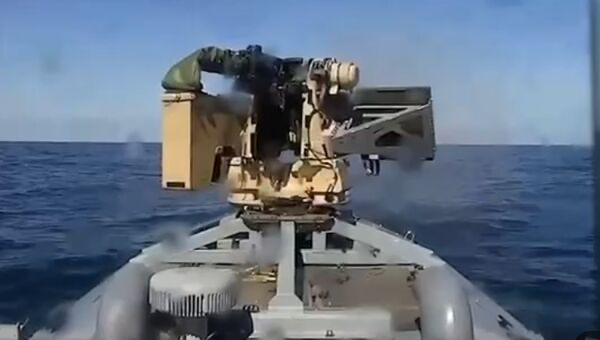
Britain’s Defence Intelligence, part of the UK Ministry of Defence, assessed on October 6, 2026 that a September 12 clash in the Black Sea was almost certainly the first direct engagement between Russian and Ukrainian uncrewed surface vessels (USVs), a judgment its probability yardstick places at 95 percent or higher. In that action, a Ukrainian Navy Sargan-3000 USV armed with a 12.7 mm remote weapon station destroyed a Russian one-way attack USV.
The engagement marks a turn in a maritime war Ukraine has fought largely with expendable explosive boats since October 2022. Russia came later: its USVs hit the Ukrainian Navy reconnaissance ship Simferopol in the Danube delta on August 28, 2025, and the sail training ship Druzhba in Odesa port in May 2026. Ukrainian forces have so far defeated these craft with first-person-view (FPV) drones and layered coastal defenses, including a June 23, 2026 action near the Tendra Spit that destroyed three Russian USVs. September 12 is the first known case of a drone boat doing the job.
How the Sargan-3000 USV Tracked and Sank a Russian Drone Boat
According to the Ukrainian Navy, units of Ukraine’s Defence Intelligence directorate (HUR) detected the Russian craft before the Sargan-3000 was vectored onto it. An 81-second Navy video combines the weapon station’s sight, a deck camera and an overhead view most likely relayed by an uncrewed aerial vehicle (UAV). The Sargan-3000 fires short bursts at the target’s hull, mast and antennas from a reported range of about 1 km, sustaining fire until the Russian boat sinks stern first.
Open-source analysts identify the target as an improved Orcan-type USV, called Zefir in some Russian sources. The Orcan is a small, jet-ski-derived craft with waterjet propulsion, comparable in size and concept to Ukraine’s early Magura V3 and V5, and was most likely fitted with a ramming charge. Defence Intelligence judged it “highly unlikely” the boat had any counter-drone capability, a 10 to 20 percent probability on its scale.
The Ukrainian craft carried a Kongsberg Protector remote weapon station (RWS) fitted with a 12.7 mm heavy machine gun. Publicly available specifications for the Protector family indicate a stabilized mount with day and thermal sights and a laser rangefinder, which allows accurate fire from a small hull pitching in a seaway. The Sargan-3000 also feeds Ukraine’s Delta situational awareness network with real-time target data, video and telemetry. The tactical point is that the shooter survives: a gun-armed USV is reusable, can patrol as a picket and can engage several contacts per sortie, where an explosive boat trades itself for one target.
Sargan-3000 Specifications, Variants and the Izumrud Strike
President Volodymyr Zelensky presented the Sargan-3000, also known as Seawolf, in April 2026 as a multipurpose platform that had completed testing and entered Ukrainian Navy service. The design combines a low-profile hull, waterjet propulsion and modular payloads. Figures reported by Ukrainian media, not confirmed officially, credit it with a top speed of 40 to 55 knots, a payload of up to 450 kg and a range of up to 1,600 km. Hull dimensions, displacement and engine output have not been disclosed.
The one-way attack variant has already been used against a crewed warship. On July 14, 2026, the Ukrainian Navy said a Sargan-3000 had sunk the Russian Federal Security Service (FSB) Project 22460 Rubin-class patrol ship Izumrud near Novorossiysk, causing casualties. Satellite imagery the Navy later released showed the 62.5-meter, 630- to 750-tonne vessel alongside a quay in Gelendzhik with a large breach in its starboard hull.
Other Sargan configurations reportedly carry electronic warfare payloads or the Sea Dragon air defense kit, which mounts AIM-9 Sidewinder or Soviet-era R-73 infrared-guided missiles. That modularity is the program’s core logic: one hull and one control architecture covering strike, air defense, electronic warfare and now surface escort, simplifying training, logistics and production.
From Ship Killers to Interceptors: Magura V7 and MV11
Defence Intelligence placed the engagement within a broader Ukrainian pattern of combining weapons on USVs, most visibly in the Magura family built by UFORCE and operated chiefly by HUR. Magura V5 boats armed with R-73 missiles shot down Russian Mi-8 helicopters on December 31, 2024, according to HUR. On May 2, 2025, three Magura V7 boats, two of which fired AIM-9 Sidewinders, downed two Su-30 fighters near Novorossiysk and over Crimea, according to HUR chief Lieutenant General Kyrylo Budanov. The V7 is a stretched V5 of roughly 7.2 to 8 meters and 3.4 tonnes, against 5.5 meters for the V5.
UFORCE unveiled the Magura MV11 on the Dnipro River in Kyiv during the August 24, 2026 Independence Day parade. The company says the MV11, the largest Magura yet, carries up to 2,200 kg of payload and operates for up to seven days. Its primary fit is a bank of 18 box launchers for vertically launched Sting interceptor drones from Wild Hornets, which says Sting interceptors destroyed more than 11,000 Shahed/Geran and Gerbera drones in the first eight months of 2026. Stationed offshore, an MV11 pushes Ukraine’s counter-UAS screen over the sea approaches, engaging long-range attack drones before landfall.
Analysis: The September 12 engagement shows the Black Sea drone war moving from pure strike toward contested sea control. A reusable, gun-armed USV that destroys expendable attack boats inverts the cost exchange, spending machine-gun ammunition against a purpose-built explosive craft that is lost either way. It also exposes the gap Defence Intelligence flagged: Russia’s attack USVs are built to strike, not to defend themselves. For NATO navies, especially Black Sea and Baltic littoral states, armed USV pickets now have combat evidence behind them as a counter-USV layer alongside crewed patrol craft, helicopters and FPV drones.
Several questions remain open. Russia’s options include escorting its USVs, arming them or saturating Ukrainian defenses with larger salvos. Kyiv has disclosed neither Sargan-3000 production rates nor how many gun-armed units are deployed, and the MV11 has not yet been confirmed in combat. The indicator to watch is whether USV-on-USV engagements become routine, which would confirm that the Black Sea now hosts a distinct uncrewed layer of naval combat.