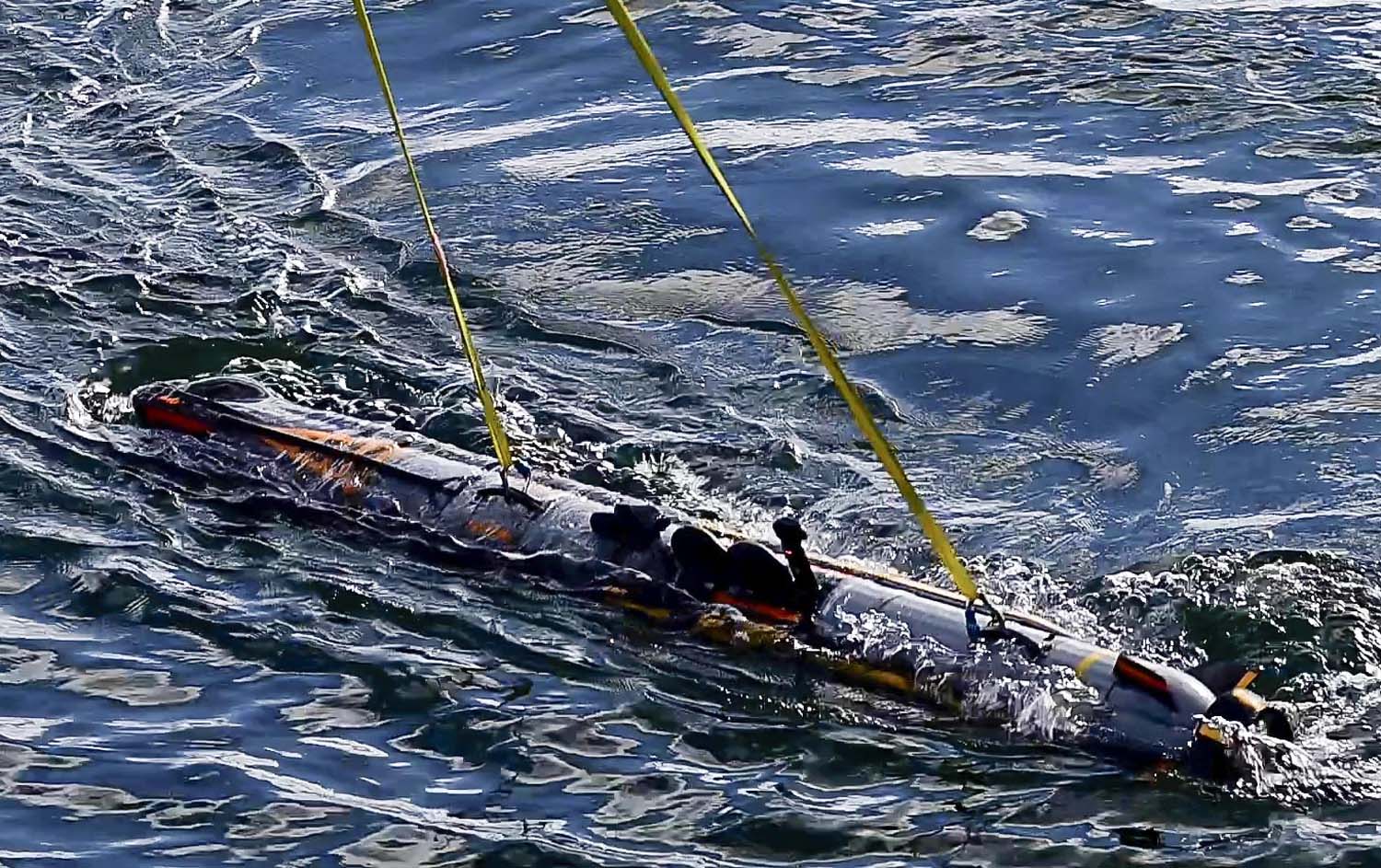
The U.S. Navy and its Australian and British partners opened the AUKUS Pillar II Maritime Big Play Pacific demonstration off Southern California on October 5, 2026, putting more than 40 government and industry technologies from the three nations to the test in an event that features live-fire scenarios and runs until October 25. The multi-domain event pairs autonomous, crewed and uncrewed systems in strike, contested resupply and undersea warfare scenarios, aiming to fold autonomous assets into conventional maritime formations.
The demonstration caps three years of trilateral work on common command-and-control (C2) solutions and secure communications spanning the stratosphere to the seabed. Pillar II is the AUKUS advanced-capabilities track, parallel to the Pillar I effort to deliver conventionally armed, nuclear-powered submarines to Australia. The Office of the Under Secretary of War for Research and Engineering, Critical Technologies, sponsors the event, while Naval Information Warfare Center (NIWC) Pacific, U.S. Pacific Fleet and the U.S. Marine Corps act as hosts. The timing matters: all three navies are now pushing to convert experimentation into fielded, interchangeable uncrewed fleets for the Indo-Pacific.
Inside Maritime Big Play Pacific: Strike, Resupply, and Undersea Scenarios
The live-fire serials cover three mission sets, each tied to a known allied gap in the Western Pacific. Strike scenarios test whether uncrewed surface and air systems can extend the reach of crewed combatants and absorb risk that would otherwise fall on high-value ships. Contested resupply targets a familiar U.S. planning problem: dispersed forces inside an adversary’s precision-fires envelope cannot depend on large, predictable replenishment groups. Undersea warfare remains the domain where the AUKUS partners hold their clearest advantage and where autonomous vehicles promise the largest multiplier, from persistent seabed surveillance to anti-submarine warfare (ASW) cueing.
Gerry Tighe, the U.S. lead for AUKUS Maritime Big Play, framed the objective as seamless integration of autonomous systems with the conventional fleet and, beyond that, with a combined partner force. He said organizers had placed systems from the shared industrial base directly in the hands of AUKUS warfighters and had “removed the technical barriers for integrating those advanced capabilities into no-kidding operations.”
The Navy has not published the list of participating technologies, the companies behind them, the specific ranges and operating areas off Southern California, or the munitions employed in the live-fire serials. It has also not said whether Japan, which observed earlier Maritime Big Play events and joined AUKUS underwater communications trials in 2025, is taking part.
From Jervis Bay to Talisman Sabre: Three Years of AUKUS Autonomy Trials
Maritime Big Play is a series of trilateral experiments meant to scale up maritime autonomy and improve interoperability among the three navies. Its first large-scale Indo-Pacific iteration took place during the Royal Australian Navy’s Exercise Autonomous Warrior 2024 at Jervis Bay, New South Wales, in October 2024, where the partners tested approximately 30 autonomous platforms. Australia fielded the Ghost Shark extra-large autonomous undersea vehicle, the Speartooth large uncrewed undersea vehicle, the Bluebottle uncrewed surface vessel and the OWL-B long-range loitering strike glider. The partners also tested software-defined acoustic modems, autonomous underwater and surface vessels, and low-cost attritable uncrewed surface vehicles.
The 2025 cycle moved from co-located trials to control across hemispheres. During Exercise Talisman Sabre 2025, operators at a remote operating center in Australia exercised control of the Royal Navy’s extra-large uncrewed underwater vehicle (XLUUV) Excalibur in UK waters, more than 16,000 km away. Publicly available specifications indicate Excalibur, built by MSubs under Project Cetus, measures 12 m and weighs 19 tonnes, the largest uncrewed underwater vehicle the Royal Navy has trialed. That serial validated the core Pillar II premise: one partner can task and hand off another partner’s asset over a shared C2 architecture.
In July 2026, the work extended to Exercise Rim of the Pacific (RIMPAC) off Hawaii, where Australian and U.S. personnel tested subsea and seabed warfare capabilities developed under Pillar II. The Royal Navy had said earlier this year that the 2026 program would prioritize ASW, maritime strike and seabed warfare, mirroring the scenarios now under way off California.
Why Common Command and Control Drives AUKUS Pillar II Interoperability
The California event is less a platform showcase than a test of connective tissue. The trilateral C2 and secure communications work aims to let a single combined force employ uncrewed systems regardless of which nation built or owns them. The Royal Navy has described three supporting lines of effort for 2026: shared C2 software for a growing and diverse uncrewed fleet, a common autonomy baseline across the three nations, and an AUKUS test and reference environment for simulating real-world operations.
Those efforts carry direct operational weight. A shared autonomy baseline cuts the integration burden each time a new vehicle enters service, while a common test environment lets partners verify software behavior before systems reach the water. For contested logistics, interchangeable C2 means an Australian uncrewed vessel could, in principle, resupply a U.S. Marine Corps unit operating under a different national chain of command. The Marine Corps’ role as co-host fits its Force Design emphasis on distributed littoral operations and sustainment of stand-in forces.
Analysis: Maritime Big Play Pacific shows that software integration, not hardware novelty, now sets the pace of AUKUS Pillar II. Hosting by NIWC Pacific, Pacific Fleet and the Marine Corps ties the experimentation directly to the commands that would employ these systems in a Western Pacific contingency. Pillar I submarine deliveries to Australia remain years away; Pillar II uncrewed capabilities offer the partnership a nearer-term, lower-cost path to adding mass and persistence in the undersea and littoral domains. The test for Pillar II is whether demonstration results translate into funded acquisition programs across three national defense budgets.
The demonstration runs through October 25, 2026. Hosts have not said when results will be released or which technologies, if any, are slated for transition to fleet use. Indicators to watch include whether the partners publish a common C2 standard, whether Japan formalizes a role in Maritime Big Play, and how the findings shape upcoming uncrewed maritime budget requests in Washington, Canberra and London.