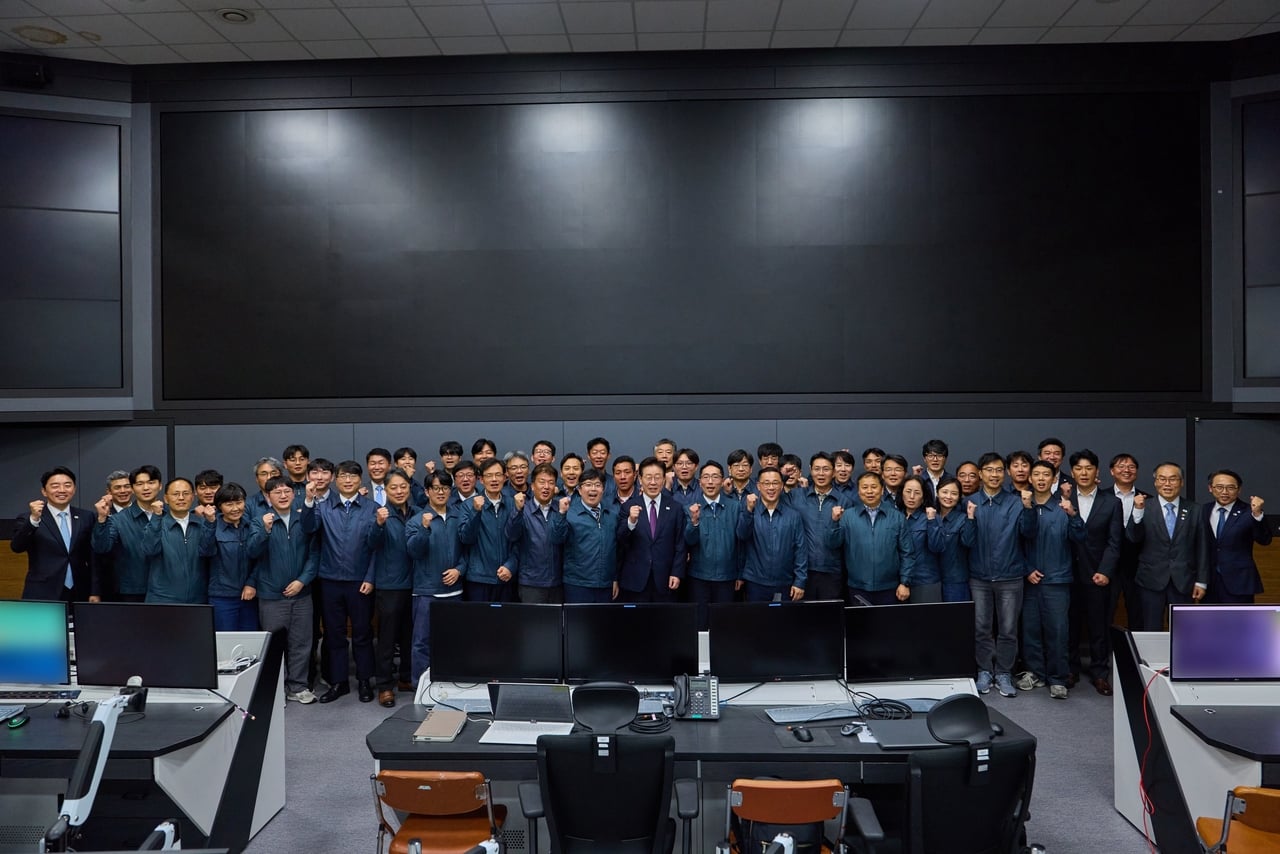
South Korea flight-tested its first indigenously developed hypersonic glide vehicle (HGV) on October 8, 2026, with President Lee Jae Myung observing. The glider separated from its booster, completed its planned hypersonic flight, then descended and maneuvered vertically and laterally before striking its designated target, according to the presidential office. The state-run Agency for Defense Development (ADD) conducted the launch.
The presidential office confirmed the vehicle was launched from a barge but did not name the test site; South Korean media reports placed it at an ADD test center in Taean, about 130 kilometers south of Seoul. The test followed North Korea’s October 3 intermediate-range missile launch and the September 21 landmine blasts south of the Military Demarcation Line that injured three South Korean personnel. It also serves Seoul’s push to lead combined defense once wartime operational control (OPCON) transfers from the United States, which Lee has pledged to complete by 2030.
What the First Korean Hypersonic Glide Vehicle Test Verified
Chief presidential spokesperson Kang Yu-jung said the flight was designed to verify the HGV’s core technologies for the first time, describing a weapon built around an unpredictable flight path and overwhelming speed. She named three specific test objectives: ultra-high-temperature thermal protection materials under hypersonic flight conditions, the vehicle’s guidance and control system, and irregular maneuvering at low altitude.
Those objectives map onto the hardest problems in boost-glide design. An HGV rides a rocket booster into the upper atmosphere, separates, and glides unpowered toward its target above Mach 5, using aerodynamic lift to extend range and shape its path. Sustained glide in denser air exposes leading edges and control surfaces to extreme heating, hence thermal protection’s priority. Guidance and control must stay stable through a thermal and plasma environment that degrades sensor and datalink performance. Low-altitude maneuvering is the operational payoff: a glider that flies below the engagement altitudes of exo-atmospheric interceptors and turns in both pitch and azimuth compresses the defender’s detection, tracking and fire-control timeline.
Seoul released no performance data. The vehicle’s designation, booster type and staging, peak and glide altitudes, range flown, terminal speed, warhead type and mass, terminal guidance mode and launch platform remain undisclosed. Officials did not say whether the booster is new or derived from a Hyunmoo-series motor, and no imagery shows whether the glider is wedge-shaped or conical. The presidential office framed the mission as striking critical targets across the Korean Peninsula theater, implying a range envelope covering North Korea from launch positions in the South, though no figure was given.
How the HGV Complements Hyunmoo-5 and Hycore in the Kill Chain
After the launch, Lee inspected the Hyunmoo-5, the heavy surface-to-surface ballistic missile built to defeat deeply buried North Korean command and weapons facilities. Publicly available estimates credit the Hyunmoo-5 with a launch weight of about 36 tonnes and a conventional penetrating warhead of 8 to 9 tonnes, carried on a nine-axle transporter-erector-launcher and cold-launched before its two solid-propellant stages ignite. South Korean military assessments put its range above 300 kilometers with an 8-tonne warhead and beyond 3,000 kilometers with a reduced payload. Frontline deployment reportedly began in late 2025, with full fielding planned by 2030.
Showcasing both weapons on the same day underscores a division of labor. The Hyunmoo-5 delivers mass against hardened, fixed targets on a largely ballistic trajectory. The HGV trades payload for speed and an unpredictable path, suiting it to time-sensitive, heavily defended targets such as mobile missile launchers, air defense nodes and command posts. The spokesperson described the weapon as a core strategic asset able to strike key targets by surprise, a role that falls under the Kill Chain preemptive-strike pillar of South Korea’s three-axis deterrence framework, alongside Korea Air and Missile Defense and the Korea Massive Punishment and Retaliation plan. The Strategic Command, activated in October 2024, integrates those strike assets.
The HGV also runs parallel to Hycore, the scramjet-powered hypersonic cruise missile the ADD has pursued with industry partners since 2018. ADD figures for the Hycore demonstrator describe an 8.7-meter, 2.4-tonne airframe reaching Mach 6.2, with deployment targeted for the early 2030s. Seoul is developing both branches of hypersonic strike at once.
How North Korea’s Hwasong-11Ma Program Shapes Seoul’s Hypersonic Push
Pyongyang has flown boost-glide payloads since September 2021, when it tested the liquid-fueled Hwasong-8 with a wedge-shaped glide vehicle. It paired a similar vehicle with the solid-fueled Hwasong-16B intermediate-range ballistic missile in 2024, then unveiled the Hwasong-11Ma in October 2025, mating a KN-23-class short-range missile body with a glide vehicle. North Korean state media imagery linked a September 20, 2026 launch to an upgraded Hwasong-11Ma-1 variant.
On October 3, Kim Yo Jong said the intermediate-range strategic missile fired that morning could change its flight path at low altitude and incorporated artificial intelligence. South Korea’s Joint Chiefs of Staff (JCS) tracked the missile flying more than 700 kilometers from the Wonsan area, and Seoul’s defense ministry assessed it as well within allied detection and interception capabilities. North Korean claims about glide maturity remain unverified. South Korean media reports characterized Seoul’s October 8 launch as a countermeasure to the mine blasts, while JCS Chairman Gen. Jin Young-sung said the military was weighing physical and nonphysical responses without elaborating.
The regional picture extends beyond the peninsula. Japan placed its Type 25 glide projectile, developed as the Hyper Velocity Gliding Projectile (HVGP), into service with the Japan Ground Self-Defense Force at Camp Fuji on March 31, 2026, and plans additional units in Hokkaido and Kyushu during fiscal 2026. China has paraded the DF-17, which pairs a solid-fueled booster with the DF-ZF glide vehicle, since 2019. South Korea now joins its neighbors in flight-testing a domestic boost-glide weapon, though its system remains in development rather than fielded.
Analysis: The HGV gives Seoul a sovereign answer to the problem North Korea’s gliders pose to allied defenses: compressed warning time against mobile targets. It also feeds the capabilities the JCS told lawmakers on October 8 it is accelerating for a South Korean-led defense posture after OPCON transfer, including high-yield missiles. A domestic conventional glider strengthens Seoul’s case to carry the Kill Chain mission with its own assets. The trade-off is escalation risk: a glider framed by its own government as a surprise-strike tool shortens Pyongyang’s decision time as much as Seoul’s targeting cycle.
The October 8 flight opens what must be a multi-test qualification campaign. Seoul has published no development schedule, initial operational capability date, prime contractor or program cost. Indicators to watch include a formal designation, a dedicated line in the 2027 defense budget, and whether the HGV joins the Hyunmoo-5 under the Strategic Command. A North Korean response is the most immediate variable.