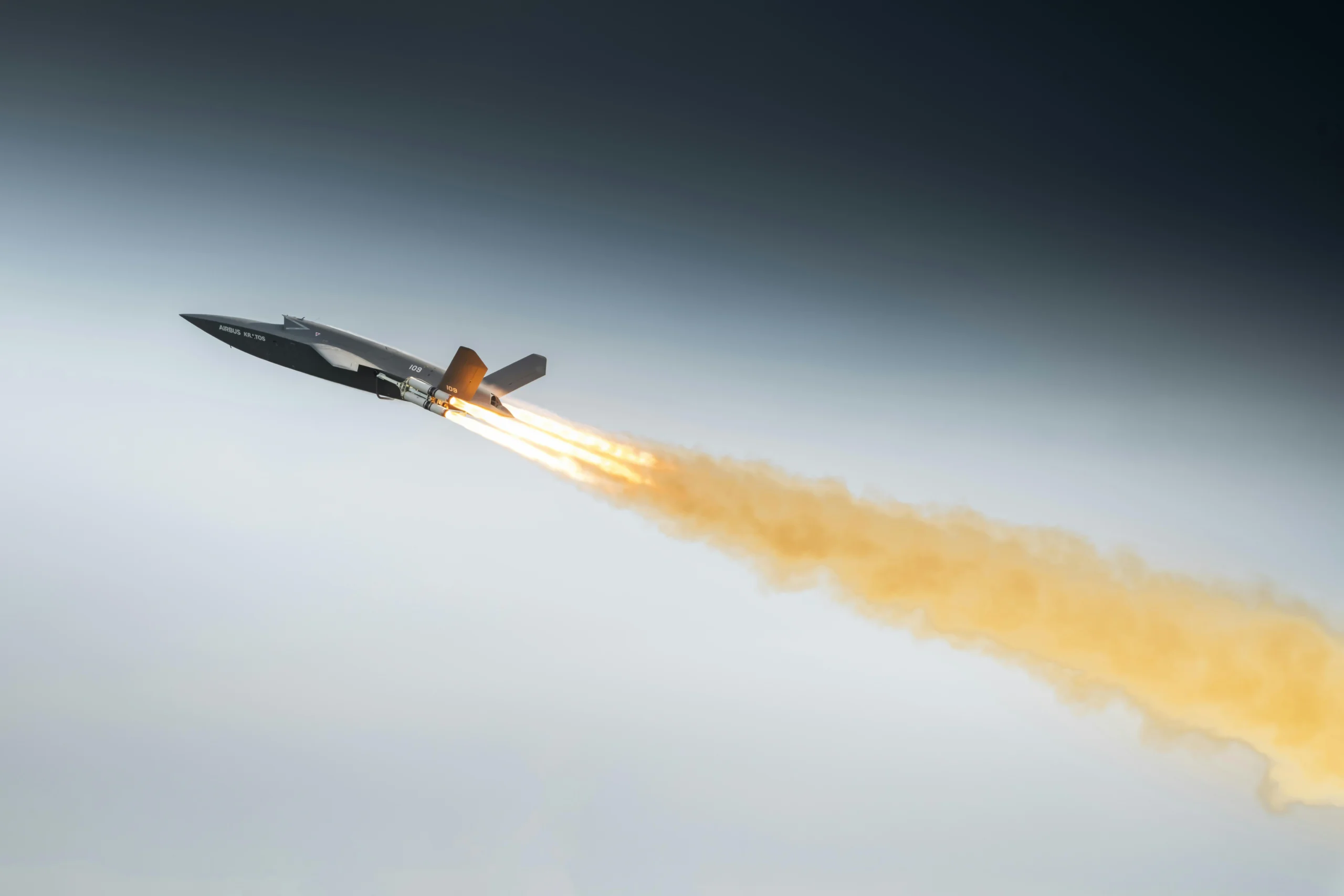
Airbus Defence and Space and Kratos Defense & Security Solutions have flown the U740 Valkyrie uncrewed combat aircraft in Europe for the first time, the companies announced on October 12, 2026. The flight, conducted at an undisclosed test facility in Northern Europe, keeps the partners on track to deliver a combat-ready Collaborative Combat Aircraft (CCA) to the German Air Force by 2029.
The sortie follows the companies’ July 16, 2025, teaming agreement and Airbus’ March 2026 disclosure that it was preparing two Valkyrie airframes acquired from Kratos in Manching, near Munich. Berlin wants an uncrewed wingman flying alongside the Eurofighter Typhoon by 2029, the year by which German Defense Minister Boris Pistorius has warned Russia could be capable of attacking NATO.
U740 Valkyrie Flight Profile: Rocket Launch, Mach 0.8, In-Flight Retasking
According to Airbus, the flight achieved all test objectives. The aircraft lifted off without a runway using rocket-assisted take-off (RATO), maneuvered at various altitudes at speeds up to Mach 0.8, and accepted mission adjustments in flight. Airbus did not disclose the flight’s duration, the specific range used, or the recovery method.
The U740 designation folds the Kratos airframe into Airbus’ own uncrewed product family, alongside the larger U760 Ravenstorm shown as a full-scale model at ILA Berlin in June 2026. Per Airbus, the U740 measures 9.1 m long with an 8.2 m wingspan, has a maximum take-off weight (MTOW) of approximately three tonnes, a range exceeding 5,000 km, and a service ceiling of 45,000 ft. Weapons are carried in an internal bay and on underwing payload stations. Airbus offers both rail launch and conventional runway take-off and landing.
Publicly available specifications for the baseline XQ-58A, which first flew on March 5, 2019, at Yuma Proving Ground, Arizona, indicate a single turbofan of roughly 2,000 lbf of thrust, a cruise speed of Mach 0.72, and a payload of 600 lb (272 kg) internally plus 600 lb on the wing stations. The internal bay accommodates at least two GBU-39 Small Diameter Bombs and has released an ALTIUS-600 small drone in testing. For the Luftwaffe, range is the operationally relevant figure: it allows launch from dispersed sites well behind the front line, while the low-observable shaping and internal carriage let the aircraft operate ahead of a crewed Eurofighter in defended airspace.
Airbus’ MARS Mission System and the European Sovereignty Case
Airbus describes its Multi-platform Autonomous Reconfigurable and Secure (MARS) mission system as the aircraft’s “European brain.” MARS gives a German or European operator full control over software, mission applications, data and system hardware, removing dependence on the U.S. airframe supplier for operational use. AI-enhanced software flies missions autonomously and coordinates entire mission groups, while a strict control hierarchy keeps a human on the loop so that critical decisions comply with rules of engagement and legal standards. An AI-supported MARS component, MindShare, is designed to run distributed across crewed and uncrewed platforms.
Airbus said this first flight opens the way to more sophisticated tests with MARS but did not specify which MARS functions were active on the sortie.
The crewed side is changing too. Airbus and Rafael Advanced Defense Systems are adding a connectivity capability to the Litening 5 advanced targeting pod already contracted for the Eurofighter fleet; combined with minor avionics updates, the change is intended to let the fighter serve as a command aircraft for uncrewed wingmen.
“By pairing Kratos’ proven airframe as a ‘program of record’ with Airbus’ sovereign European mission system, we are able to offer a robust, sovereign, affordable, and combat-ready CCA system by the end of the decade,” said Mike Schoellhorn, CEO of Airbus Defence and Space. The program-of-record reference points to the U.S. Marine Corps, which moved the Valkyrie into a formal acquisition program in 2025 and has since brought Northrop Grumman onto the effort.
Valkyrie, Ghost Bat and CA-1 Europa in Germany’s 2029 CCA Competition
Maturity is the Valkyrie’s core argument in Berlin. The baseline aircraft has flown with the U.S. Air Force and Marine Corps since 2019, and Airbus is offering an existing airframe rather than a clean-sheet design. “First flights typically include plenty of learning opportunities, but with the maturity of the Valkyrie system and the well-integrated Airbus and Kratos team, this flight was an amazing success,” said Eric DeMarco, President and CEO of Kratos.
Rheinmetall and Boeing make the same case for the MQ-28 Ghost Bat, which has logged more than 150 flights in Australia. Under a partnership announced on March 31, 2026, Rheinmetall would serve as system manager for the Ghost Bat in Germany, integrating it with Bundeswehr command and weapon systems. Munich-based Helsing is offering the CA-1 Europa in a kinetic CA-1KA variant, targeting first flight in early 2027, and a CA-1EA electronic attack variant. General Atomics Aeronautical Systems displayed its Gambit at ILA, from the same family as the YFQ-42A built for the U.S. Air Force CCA program.
Industrial content will weigh on the outcome. Rheinmetall CEO Armin Papperger has argued that production must start by 2027 for Germany to field aircraft by 2029. The Airbus offer pairs a European prime and mission system with a U.S.-designed airframe, and Airbus’ announcement did not address where series production for a German order would occur.
Analysis: The flight turns a teaming announcement into a flying European test article, but it does not settle Berlin’s core question: whether sovereignty resides in the airframe or in the software. Airbus is betting that MARS control of code, data and hardware meets the sovereignty test, while a U.S. airframe with seven years of flight history meets the 2029 deadline. Rheinmetall’s offer places more of the industrial footprint on German soil. If lawmakers weight domestic production over schedule risk, the Valkyrie’s head start narrows.
Next come flight tests exercising MARS autonomy and crewed-uncrewed teaming with the Eurofighter. Open questions include the test schedule, the initial mission role Airbus is prioritizing for Germany, and whether Berlin awards a contract in time for 2027 production. The Federal Ministry of Defence has not said when it will decide.