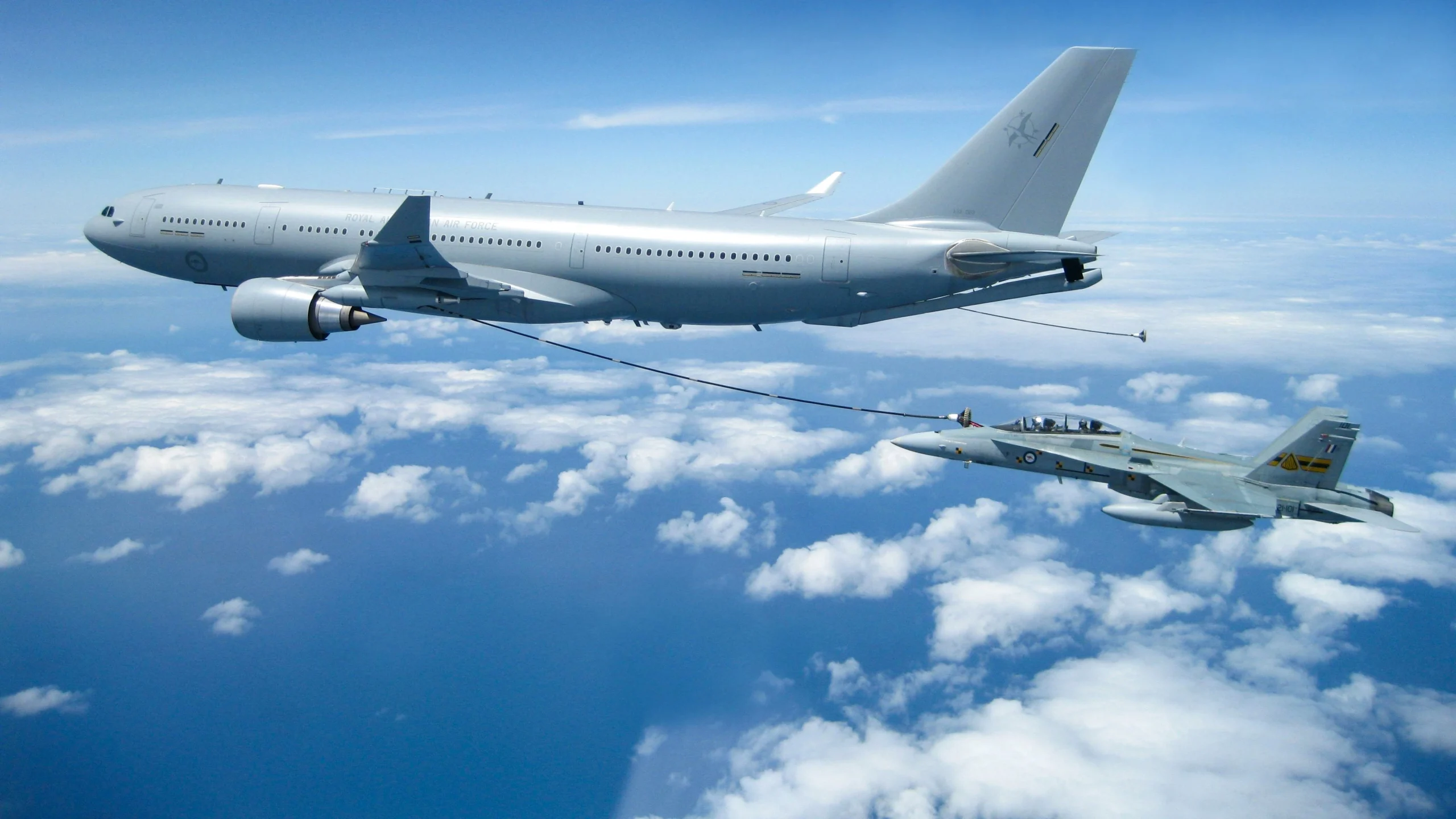
Spain, Germany and Belgium on October 8, 2026, launched the second phase of a European Defence Agency (EDA) research project to automate hose-and-drogue refueling, with autonomous aerial refueling of unmanned aircraft as the end goal. Phase Two, led by Spain and estimated at €8 million, moves the work from piloted fighters to several drones refueling from a single tanker at once.
The new phase doubles the €4 million budget of Phase One, which Spain and Germany launched in December 2022 under the EDA’s aerial systems technology area. Its target is a method the agency describes as largely unchanged for 70 years: the receiver pilot flies a probe into a drogue trailing behind the tanker, and a missed contact can scrub a mission or damage aircraft. Remove the pilot, and that workload problem becomes a hard technical barrier.
From Tornado Trials to Multi-Drone Autonomous Aerial Refueling
Phase One applied to the hose-and-drogue system the automatic air-to-air refueling (A3R) concept Airbus had already proven with the boom, where the A330 Multi Role Tanker Transport (MRTT) became the first tanker certified for automatic boom contacts in July 2022. The drogue is the harder case. A boom is flown by the tanker; a drogue is a passive basket on a flexible hose, buffeted by turbulence and the receiver’s bow wave, and the receiver must close the final meters itself.
Flight tests paired an A330 MRTT with a German Tornado and a Spanish F-18. According to the EDA, the campaign proved the automation technically feasible, developed camera-based tracking of the drogue and the receiver, and tested ways to stabilize the drogue in flight. At launch, the agency had also flagged open gaps in sensors, onboard computing, all-weather performance, and the latency and integrity of the tanker-to-receiver datalink.
Phase Two attacks those gaps with unmanned receivers, and with several at once. The core enabler is relative navigation, which lets an aircraft compute its position and motion with respect to another aircraft rather than to a fixed reference such as GPS. That is an operational requirement, not a refinement: airspace along NATO’s eastern flank has seen sustained satellite navigation jamming, and a GPS-dependent drone could not safely complete a contact there. Image sensors, inter-aircraft connectivity and the hardware running the tracking algorithms complete the scope, which unfolds in three stages:
- simulated multi-aircraft refueling operations with several receivers at once;
- laboratory tests in which robotic arms reproduce the relative motion between hose and receiver;
- ground and flight tests collecting data from tanker and receiver aircraft.
Airbus has already rehearsed the formation piece. In March 2023, its Auto’Mate demonstrator, an A310 MRTT testbed, autonomously guided DT-25 target drones to a pre-contact position over the Gulf of Cadiz, at a minimum recorded separation of about 150 feet (46 meters), and a second campaign later that year controlled multiple drones. Probe-to-drogue contact by an unmanned receiver remains the unsolved step.
A330 MRTT Tanker, DLR Receiver and the Phase Two Industrial Team
Airbus Spain will supply the A330 MRTT tanker for flight tests, with an experimental aircraft owned by the German Aerospace Center (DLR) acting as receiver. The EDA has not identified the DLR airframe or said whether it will carry a safety pilot, a detail that will determine how close the flight phase comes to genuinely unmanned contacts.
Publicly available specifications indicate the A330 MRTT, converted from the A330-200 airliner at Airbus’s Getafe site near Madrid, carries up to 111 metric tons of fuel without auxiliary tanks. Its two under-wing 900-series pods provide simultaneous hose-and-drogue refueling at a rate Airbus quotes at 1,300 kilograms (420 US gallons) per minute, alongside an optional fuselage refueling unit and a boom. Two wing stations give the multi-receiver problem a concrete geometry: drones queuing on both sides of the tanker while contacts are sequenced.
The consortium keeps Phase One’s industrial core: Airbus Defence and Space and GMV in Spain; Airbus Defence and Space, DLR and AES Technology in Germany. Belgium brings avionics specialist ScioTeq and the von Karman Institute for Fluid Dynamics, whose wind-tunnel expertise bears on the aerodynamic interaction between tanker wake, drogue and receiver. The EDA acts as contracting authority, coordinating technical requirements and risk management across the three nations, but has not disclosed individual work shares.
Madrid’s motive is explicit. Spain’s Defence Technology and Innovation Strategy (ETID 2026) lists air-to-air refueling as a priority, and the government aims to raise the technology readiness level of the hose-and-drogue system to consolidate what it considers a global leadership position in the field.
Analysis: At €8 million, this is technology maturation rather than a capability program, but the stakes lie in standards. Hose-and-drogue is the common method for probe-equipped NATO aircraft, and the A330 MRTT anchors European tanker fleets, including NATO’s Multinational MRTT Fleet, in which Germany and Belgium participate. Whoever defines the relative-navigation, datalink and control interfaces for unmanned receivers will shape how future remote carriers and collaborative combat aircraft connect to allied tankers. The US Navy’s MQ-25 Stingray addresses the inverse case, an unmanned tanker serving crewed receivers. This project positions Europe to own the receiver side with European technology.
The EDA has not published a Phase Two schedule, target technology readiness level or flight test dates. Near-term markers include results from the multi-receiver simulations, commissioning of the robotic-arm laboratory rig, identification of the DLR receiver aircraft, and whether other EDA member states join before flight testing begins.