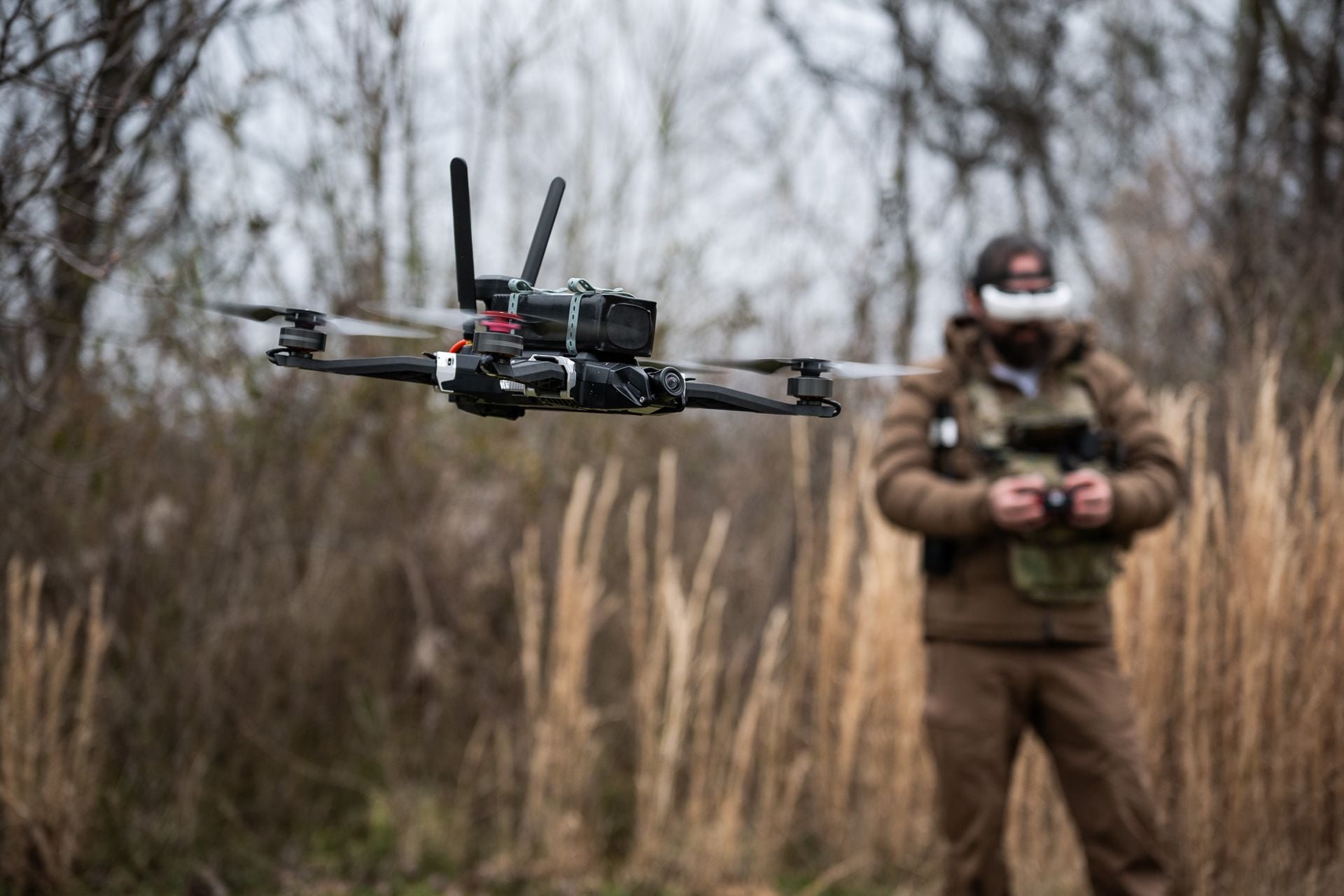
Performance Drone Works (PDW) is integrating Booz Allen Hamilton’s new mission autonomy software, powered by Shield AI’s Hivemind, onto its AM (Attritable Multirotor) Group 1 unmanned aircraft system, the Huntsville, Alabama, manufacturer announced on October 9, 2026. PDW will also adopt Booz Allen’s secure over-the-air (OTA) fleet update product across its aircraft portfolio. The combined package entered controlled testing on September 30 and is slated for general availability in the first quarter of 2027.
The deal links relationships built since March 2025, when Booz Allen partnered with Shield AI to adapt Hivemind for military uncrewed systems. Booz Allen made a strategic investment in PDW on April 30, 2026, and on July 31 the Department of War’s Office of Strategic Capital (OSC) signed a conditional loan commitment of up to $820 million with PDW for domestic drone component production. The backdrop is Pete Hegseth’s July 10, 2025, Unleashing U.S. Military Drone Dominance memorandum and the Drone Dominance Program that followed, which aims to field more than 200,000 small drones by 2027.
PDW AM Drone Architecture: One Airframe for ISR and Strike
PDW describes AM as a multi-mission Group 1 system bridging reusable and attritable roles. Operators can recover and reuse it for intelligence, surveillance, and reconnaissance (ISR) or payload delivery, then configure it for attritable strike with anti-personnel or anti-materiel effects. Derived from the AM-FPV unveiled at SOF Week in May 2025, itself rooted in Drone Racing League airframes, AM entered production in April 2026 at Drone Factory 01, PDW’s 90,000-square-foot Huntsville plant.
Company specifications list interchangeable 5-, 7-, and 10-inch arm configurations around a universal electromechanical payload interface, a 5-pound (2.2 kg) maximum payload, and a 10 km point-to-point range that exceeds 20 km when PDW’s larger C100 acts as a command-and-control relay. Earlier PDW datasheets rate the 10-inch variant at 35 minutes of endurance unloaded and 18 minutes with the full 5-pound payload, with toolless assembly in under two minutes; updated figures for the production configuration have not been published.
Those numbers define the problem the autonomy layer targets: with endurance roughly halved at maximum payload, every minute of manual piloting and target search saved becomes usable time on station.
Inside Booz Allen’s Hivemind-Based Mission Autonomy Software
Customers can fly AM in its base configuration or add Booz Allen’s software, which combines autonomy-assisted perception and operator-authorized effects delivery in a single mission workflow. The aircraft executes portions of the mission with reduced manual control, while the operator retains decision authority over engagements, an approach aligned with the human-judgment standard of DoD Directive 3000.09 on autonomy in weapon systems.
Hivemind, Shield AI’s autonomy stack, has been operational since 2018 and is designed to pilot platforms ranging from one-way attack drones to the F-16, built to operate when GPS and communications are jammed. Booz Allen, which made its largest corporate venture investment to date in Shield AI’s F-1 round, supplies the mission engineering that turns those behaviors into a product a Group 1 manufacturer can ship. “The Department of War needs autonomy that works at the pace of the mission,” said Randy Yamada, a Booz Allen vice president and autonomy lead.
The companies plan to extend the software to the C100 in 2027. That 21.4-pound (9.7 kg) Group 2-class quadcopter carries up to 10 pounds (4.5 kg), flies 74 minutes with an ISR payload, and has been bought by the Army under its Company-Level small UAS Directed Requirement and by the Air Force. A common autonomy baseline across the relay aircraft and the strike airframe would simplify paired operations, though neither firm has described teaming behaviors.
Secure Over-the-Air Fleet Updates for Contested Environments
Booz Allen’s OTA product gives authorized teams a single control point to deploy software, manage configurations, and monitor aircraft across a distributed fleet. It is built for denied, disrupted, intermittent, and limited (DDIL) connectivity and preserves deployment integrity when links degrade. The tool records fleet status, configuration state, and deployment history, and supports approved applications from payload integration to mission autonomy.
By replacing aircraft-by-aircraft software changes with a managed fleet workflow, Booz Allen says the product is designed to cut approved update cycles from weeks or months to hours. PDW’s existing toolset already includes a Windows-compatible updater for remote updates and flight log downloads; the Booz Allen layer scales that function fleet-wide and adds verification.
Combat in Ukraine drives the requirement: electronic warfare and counter-drone adaptations have unfolded over weeks, degrading aircraft running outdated software. An authenticated, auditable channel also answers the security risk inherent in OTA delivery: any path that can push code to an armed aircraft is itself a target.
Analysis: PDW is competing on a different axis than the one the Pentagon’s flagship small-drone effort currently rewards. The company flew in Drone Dominance Gauntlet I but was not among the 11 vendors awarded initial orders for 30,000 one-way attack drones, nor among the 19 firms advanced to Gauntlet II. Instead of chasing the cheapest expendable, PDW is pairing a recoverable multi-role airframe with a prime integrator’s autonomy and lifecycle software, backed by stated capacity of 100,000 drones a year. The wager is that as small drones proliferate, the decisive variable moves from airframe unit cost to how fast a fielded fleet can be reprogrammed. If the services adopt that metric, software currency becomes a procurement criterion; if they keep buying drones strictly as ammunition, autonomy priced on top of the airframe will meet resistance.
General availability of the AM package is planned for the first quarter of 2027, followed by the C100 integration and additional autonomous software options later that year. Neither company has disclosed pricing for the autonomy option, named a launch customer, or released results from the controlled testing that began on September 30. The OSC loan commitment remains conditional, with no financial close announced. Gauntlet III, expected roughly six months after Gauntlet II, will test whether software-defined multi-mission designs can reach the program’s leaderboard.