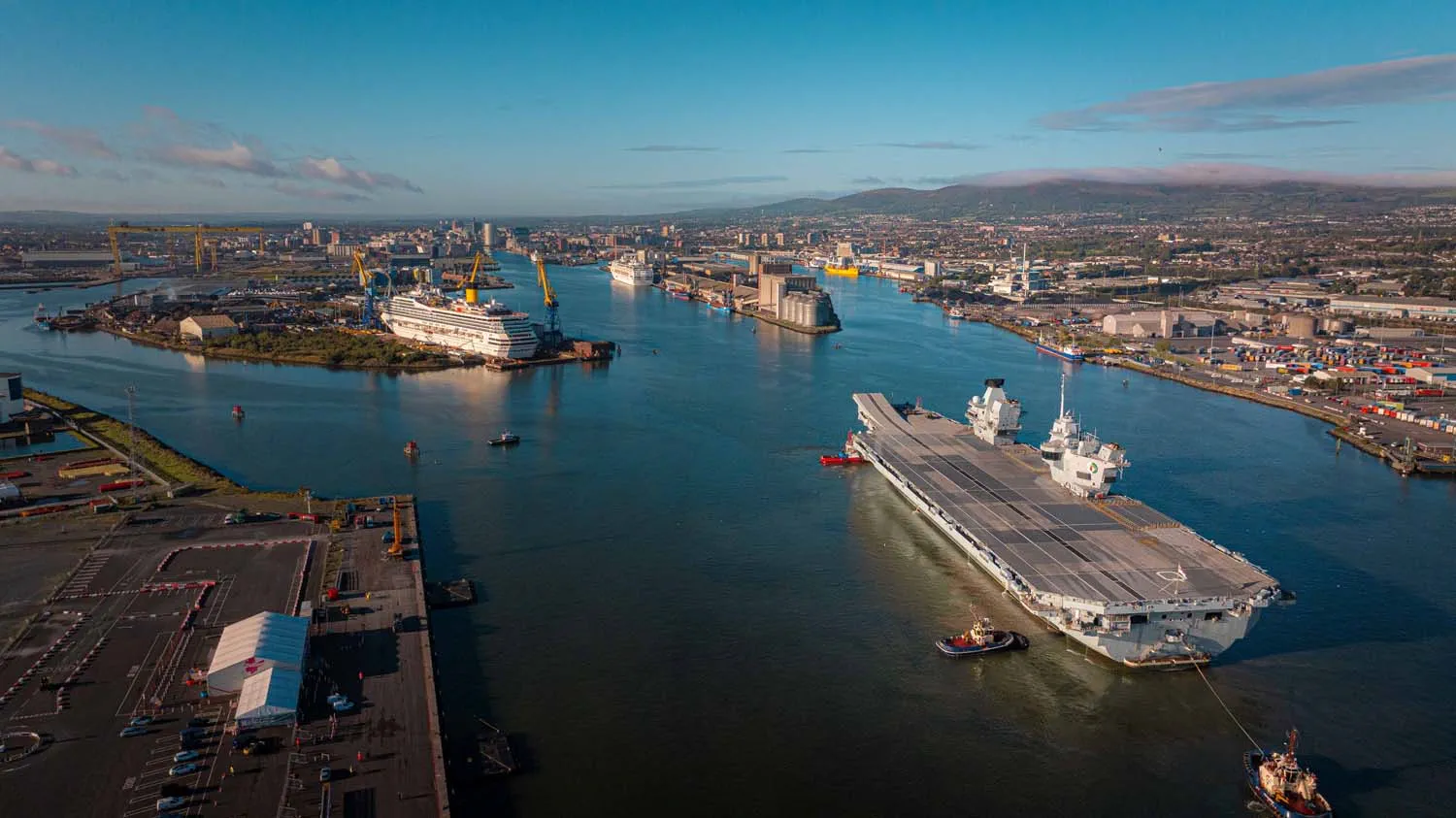
HMS Queen Elizabeth sailed from Belfast on October 12, 2026, ending the first visit by a Royal Navy aircraft carrier to the Northern Ireland capital since HMS Centaur in 1965, and the first by a Queen Elizabeth-class carrier. The 65,000-tonne ship paused her autumn training program for the stop while on standby as command ship for the maritime component of NATO’s Allied Reaction Force.
The call comes midway through the carrier’s return to service. Queen Elizabeth entered dry dock at Rosyth on August 29, 2025, for her second planned docking period, which ran until March 2026, and sailed from Portsmouth on September 5 for three months of training in UK waters and the eastern Atlantic. In July she became the first ship of her class to serve as NATO’s Afloat Command Platform, a role she holds until mid-2027, before relieving sister ship HMS Prince of Wales as the Royal Navy’s flagship and very high readiness strike carrier in late 2027.
HMS Queen Elizabeth Regains Rotary-Wing Certification After Rosyth Docking
The central task this autumn is to turn a ship that spent seven months in dock back into a working aircraft carrier. Before any aircraft landed, the ship’s company had to clear two emergency serials: a simulated crash on deck with recovery of the pilot, and a major fire with casualties in one of the engine rooms.
A Commando Wildcat AH1 of 847 Naval Air Squadron (NAS) then became the first aircraft back on deck since the docking period. Wildcat HMA2s of 815 NAS, Merlin HM2s of 814 NAS and Commando Merlin HC4s of 845 NAS joined it for repeated launch and recovery cycles and rotors-running refuels, in which aircraft take on fuel without shutting down. Three pilots earned deck landing qualifications.
The result is certification for daytime rotary-wing operations, which the Royal Navy describes as the first major building block toward a hybrid air wing of F-35B Lightning stealth fighters, helicopters and drones. Night flying and fixed-wing operations have not yet been certified, so the ship’s NATO value currently rests on command capacity rather than strike power. Gunnery teams also ran night firings over the English Channel. Around 800 personnel are aboard.
Queen Elizabeth-Class Specifications Behind the NATO Command Ship Role
Publicly available specifications describe a carrier 284 meters long with a 73-meter beam and an integrated electric propulsion system built around two Rolls-Royce MT30 gas turbine alternators of 36 megawatts each and four Wärtsilä diesel generators, driving two shafts for more than 25 knots and a range of about 10,000 nautical miles. The class can embark an air group of up to 40 aircraft. Sensors include the BAE Systems Type 997 Artisan 3D medium-range radar and the S1850M long-range volume search radar; point defense rests on three Phalanx close-in weapon systems, miniguns and general-purpose machine guns.
The twin-island layout separates navigation in the forward island from flight control in the aft island, and the forward island now carries the NATO crest. An embarked multinational battle staff has spent several weeks rehearsing how it would command an allied naval force from the ship if the Allied Reaction Force were activated, a function that leans on command spaces, communications and endurance as much as on the flight deck.
The autumn program also lays the groundwork for NATO’s Steadfast Defender exercise in 2027. Queen Elizabeth was due to lead the UK carrier contribution to Steadfast Defender 2024 but was withdrawn in February 2024 after pre-sailing checks found a fault in a coupling on her starboard propeller shaft, and HMS Prince of Wales sailed in her place.
How Harland & Wolff Anchors the Fleet Solid Support Program in Belfast
The choice of port carried industrial weight. The ship hosted cadets, the Royal Navy Association and families from the Army’s 38 (Irish) Brigade, and Captain Claire Thompson, the commanding officer, called the stop “a real proof of concept for future visits.” Belfast’s Harland & Wolff yard built carriers including HMS Glorious and HMS Formidable, as well as the cruiser HMS Belfast.
The yard is now the final assembly site for the Royal Fleet Auxiliary’s (RFA) three Fleet Solid Support (FSS) ships under a £1.6 billion contract held by Team Resolute, which groups Navantia UK, BMT and Harland & Wolff. Navantia UK took over the yard in January 2025. The first ship, RFA Resurgent, had her keel laid at Appledore on September 3, 2026, when the Ministry of Defence (MoD) named her sisters RFA Reliant and RFA Resourceful. Final assembly, integration and trials will take place in Belfast.
At 216 meters, the FSS ships will be the largest vessels in UK service after the carriers, delivering ammunition, spares, food and stores to task groups at sea. The MoD expects Resurgent to enter service in the early 2030s, and Navantia UK is investing about £98.5 million in the Belfast yard. For the carrier force, solid stores and munitions resupply is what lets a strike group sustain high-tempo flying far from a home port.
Analysis: The Belfast call shows the Royal Navy’s carrier model in miniature. Britain is fielding NATO’s maritime command platform from a ship so far certified only for daytime helicopter flying, while the very high readiness strike role stays with Prince of Wales until late 2027. That works because the Allied Reaction Force command task prizes staff capacity and communications over embarked firepower. The risk lies in the margins: a two-carrier fleet with one hull in regeneration leaves little slack if the other suffers a defect, as Queen Elizabeth did in 2024, and dedicated solid support shipping will not arrive until the next decade.
Next come the rest of the autumn deployment and, in 2027, Steadfast Defender. Queen Elizabeth hands back the command ship role in mid-2027 and is scheduled to relieve Prince of Wales as flagship later that year. The key unknown is fixed-wing regeneration: the Royal Navy has not said when F-35B jets will return to her deck or how large an air wing she will embark.