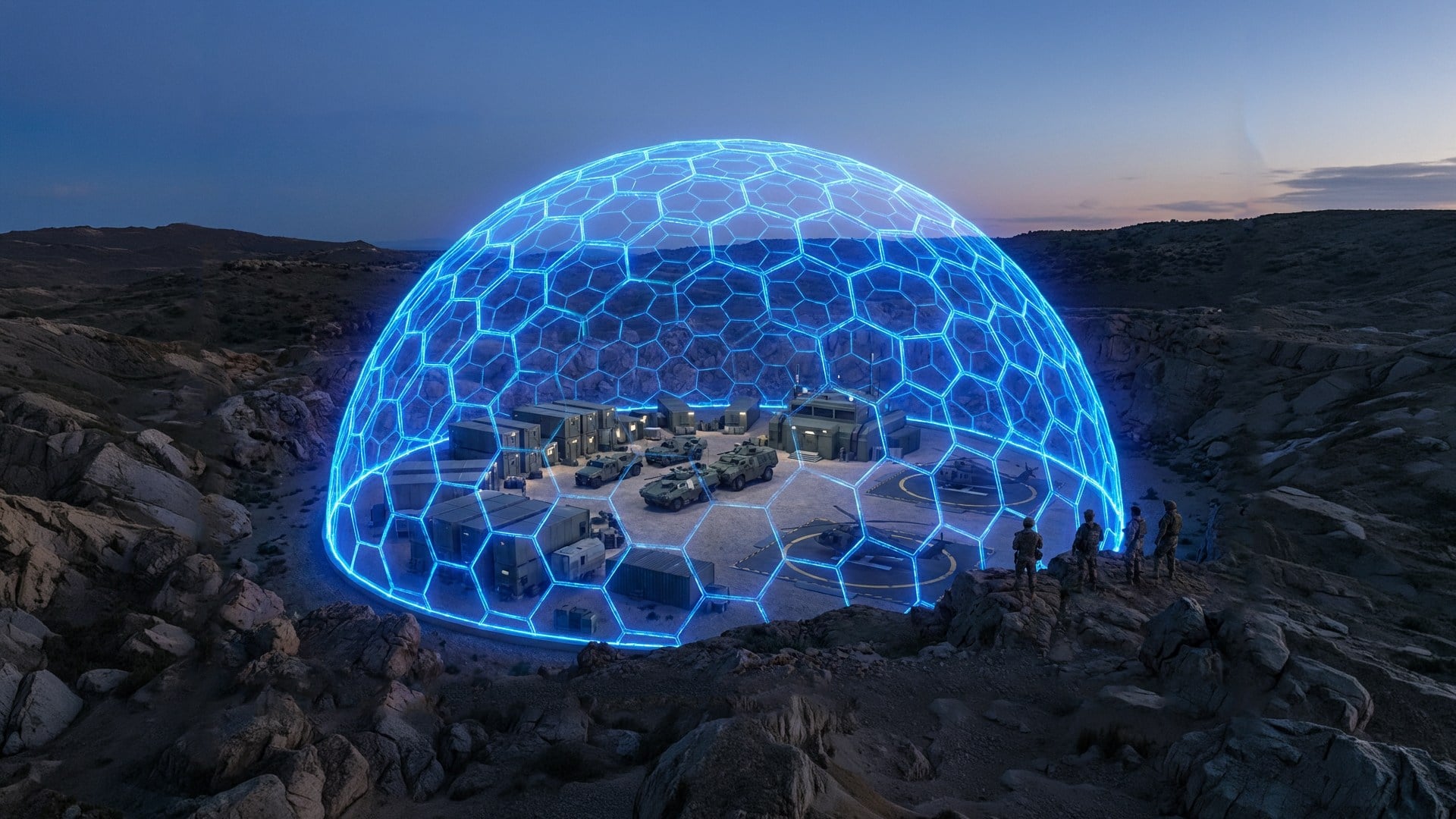
AeroVironment (AV) is pitching its Halo_Shield counter-unmanned aircraft system (C-UAS) as a distributed decision architecture rather than another standalone weapon, following its participation in the Department of War’s Technology Readiness Experimentation (T-REX) 26-3 in North Dakota. In an essay published October 12, 2026, Mary Clum, president of AV’s Space, Cyber and Directed Energy segment, said the system performed strongly at the event, while acknowledging that official results will not be released until late October.
Clum builds the case on John Boyd’s Observe, Orient, Decide, Act (OODA) loop, a lineage she claims directly: her grandfather, Harry J. Hillaker, known as the father of the F-16, worked alongside Boyd in the reformist circle dubbed the Fighter Mafia. Her argument is that cheap drones arriving in numbers and from multiple axes impose two problems at once. The first is speed. The second is economics: firing an interceptor that costs many times more than its target cannot scale, and no single sensor or effector fits every threat.
How Halo_Shield Builds an OODA Loop Architecture for C-UAS
Clum’s core claim is that the OODA loop must shift from a process run by one operator on a fixed-point system to an architecture that runs many loops in parallel across sensors, software, operators, networks and effectors. In that model, Observe means multiple sensors covering different aspects of the battlespace; Orient means artificial intelligence and machine learning (AI/ML) fusing those feeds into a usable threat picture; Decide means weighing which response fits and at what cost; and Act means orchestrating several effectors rather than firing one. Electronic warfare may suit one target and a kinetic interceptor another, while directed energy changes the cost-per-engagement and magazine-depth equation against swarms.
AV unveiled Halo_Shield on April 28, 2026, at Modern Day Marine. The company describes a modular, tile-based C-UAS built to detect, track, identify and defeat Group 1 to 5 unmanned aircraft systems (UAS), coordinated swarms and subsonic cruise missiles. Its Sentinel, Terrestrial, Nautical, Aerial and Celestial tiles are managed through AV_Halo Command software and draw on in-house effectors including the LOCUST laser weapon system, Switchblade loitering munitions and the Titan 4 and Titan MS radio frequency (RF) defeat systems. It ships as fly-away kits, and AV says tiles are already deployed at select critical sites.
Clum mapped four orchestration features onto the loop: managing the limits of IP-based radios in distributed operations (Observe), redundant transport-layer pathways for contested conditions (Orient), readiness for anti-access/area denial (A2/AD) environments (Decide), and decentralized mission command so units can execute C-UAS courses of action locally (Act). Halo_Shield operates at the tactical level and passes battlefield data to command-and-control (C2) systems such as the Army’s Integrated Battle Command System-Maneuver (IBCS-M). AV has not published detection ranges, engagement envelopes, latency figures or track capacity.
T-REX 26-3 Results: What AV Claims Ahead of Official Data
T-REX 26-3 ran from August 16 to 28, 2026, under the Under Secretary of War for Research and Engineering’s Mission Capabilities office, at the GrandSKY UAS park near Grand Forks and at Camp Grafton near Devils Lake. It focused on contested logistics and low-cost short-range air defense, with the Air National Guard’s 184th Wing Point Defense Battle Lab flying threat-informed small UAS as the red team. T-REX is built around joint operational problems rather than a single service, and is designed to expose capability gaps and collect warfighter feedback before systems are fielded.
Clum framed the real test as integration under friction: several sensors reporting, different threats appearing and multiple effects coordinated in one kill chain at speed. She described her findings as anecdotal and said the fundamentals worked as intended, though the system is not yet mature; it kept operating as scenario complexity grew; it resolved context-heavy situations quickly; AI-enabled decision support simplified key kill chain steps and reduced operator workload; and it cycled through engagements fast enough to manage more threat UAS than traditional C-UAS approaches. She gave no probability of kill, engagement count, threat mix or baseline.
The more telling observation concerns the operator. Once fused data arrived quickly and in usable form, Clum wrote, the question shifted from whether a threat could be detected to which threat deserved priority and which response preserved options. She cautioned against treating machine speed as license to remove human judgment, favoring human-on-the-loop control for consequential actions. The most valuable output, in her words, may be “the information required to know whether to shoot at all.”
Analysis: The essay is as much market positioning as doctrine. The Army selected Anduril’s Lattice software in November 2025 as the fire-control backbone for IBCS-M, so AV is not contesting the top C2 node. It is pitching the tactical orchestration layer beneath it, where its own lasers, RF defeat systems and loitering munitions compete for engagements. That layer is where cost per kill is decided, in line with the Department of War’s push for cheaper defeat options, including a four-site C-UAS pilot program, Grand Forks Air Force Base among them, built around high-power microwave and laser systems. The weakness is evidentiary: every T-REX claim so far is vendor-reported.
The next milestone is the official T-REX 26-3 data release expected in late October 2026. Open questions include whether IBCS-M integration has been demonstrated or remains planned, the cost per engagement across Halo_Shield’s effector mix, and whether any service moves the system toward a program of record. Further T-REX events are planned in North Dakota.