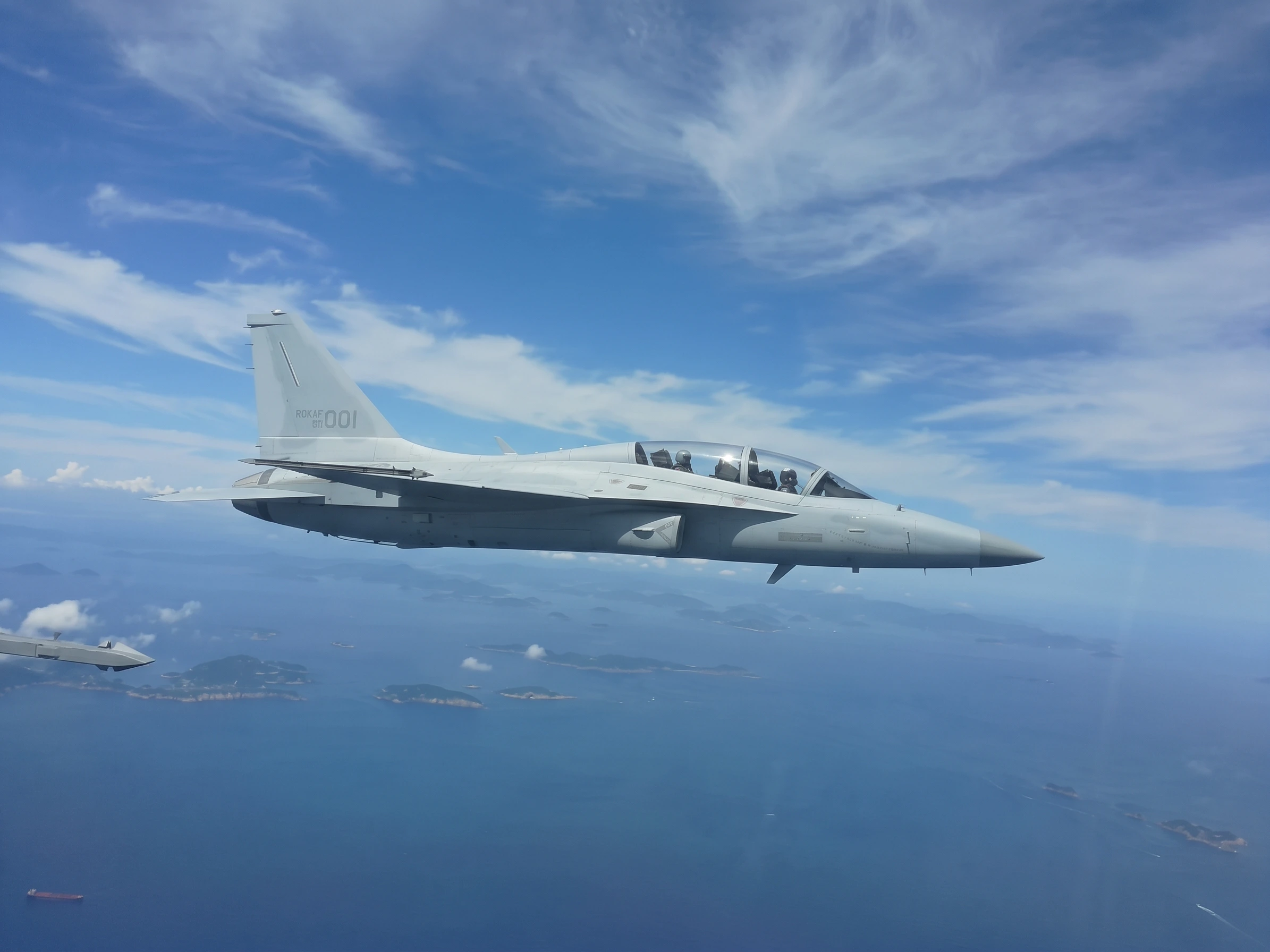
Korea Aerospace Industries (KAI) signed a memorandum of understanding (MoU) on October 8, 2026, at the Marrakech Air Show with Moroccan maintenance, repair and overhaul (MRO) providers Maintenance Aero Maroc (MAM) and SABCA Maroc, setting an industrial framework for a potential T-50 family offer to the Royal Moroccan Air Force (RMAF). MAM said the agreement focuses on “the T-50 aircraft market opportunity with the Royal Moroccan Air Force.” No order, quantity or contract value has been announced.
The signing positions KAI in the race to succeed the RMAF’s Dassault/Dornier Alpha Jets. Morocco took delivery of 24 of the subsonic jets between 1979 and 1981, and a fatal crash near Fès on July 28, 2025, sharpened the replacement question. KAI has worked the file since February 2026, when a delegation led by Abdeltif Loudiyi, Minister Delegate in charge of the National Defense Administration, was briefed on the FA-50 at the World Defense Show in Riyadh. At Marrakech, KAI exhibited for the first time, as the only South Korean company, with a dedicated FA-50 display built around the RMAF’s advanced trainer acquisition.
KAI FA-50 Offer Anchored in Morocco’s F-16 and C-130 MRO Base
The MoU is a framework document. It commits the three companies to explore business and industrial cooperation in Morocco around the FA/T-50 family, which spans the T-50 advanced trainer, the TA-50 lead-in fighter trainer and the FA-50 light combat aircraft. It is not a procurement decision, and no RMAF requirement, fleet size or delivery schedule has been made public.
The partner choice is deliberate. Both companies are tied to Belgium’s Orizio group, already embedded in RMAF sustainment. MAM stems from an April 14, 2022, agreement between the Moroccan state and Sabena Engineering, with Lockheed Martin as strategic partner, to build a 15,000-square-meter maintenance, repair, overhaul and upgrade center at Benslimane airport; it broke ground on an 8,000-square-meter heavy maintenance hangar for C-130 Hercules and F-16 work on October 15, 2025, a facility Lockheed Martin ties to Morocco’s goal of becoming a regional MRO hub. SABCA Maroc has operated in the Kingdom since 2012 and runs a 16,000-square-meter aerostructures plant in Nouaceur. The group supported the RMAF’s Mirage F1 and Alpha Jet upgrades in 2006 and 2010.
Industrial terms remain undisclosed. Neither KAI nor its partners have said whether the teaming would cover local final assembly, component manufacturing, depot maintenance or in-service support only. KAI has precedent: under Malaysia’s $920 million contract for 18 FA-50 Block 20 aircraft, signed in February 2023, 14 airframes are slated for final assembly in Malaysia. Rabat, for its part, has framed its defense industrial policy around Law 10-20, which regulates the manufacture and maintenance of military equipment in the Kingdom.
FA-50 Block 20 Avionics and the RMAF F-16 Training Pipeline
Co-developed with Lockheed Martin, the T-50 airframe carries F-16-derived aerodynamics: a blended wing-body, leading-edge root extensions and digital fly-by-wire controls. Publicly available specifications indicate a length of 13.14 m and a wingspan of 9.45 m. A single General Electric F404-GE-102 afterburning turbofan rated at about 17,700 lbf (78.7 kN) gives a top speed of roughly Mach 1.5, a clean break from the Alpha Jet’s two Larzac turbofans, subsonic envelope and roughly 2,500 kg of stores on five hardpoints.
The FA-50 Block 20 ordered by Malaysia, and Poland’s FA-50PL configuration, integrate Raytheon’s PhantomStrike active electronically scanned array (AESA) radar, first delivered to KAI on October 20, 2025, along with Link 16, a helmet-mounted display, Sniper or Litening targeting pods, an aerial refueling probe and a 20 mm cannon. Weapons include the AIM-120 AMRAAM, AIM-9X Sidewinder, GBU-12 Paveway II and Joint Direct Attack Munition (JDAM).
That inventory overlaps with the RMAF’s own. Morocco’s 2019 US-approved F-16 package included 40 AIM-120C-7 missiles and 26 AN/AAQ-33 Sniper pods, and the first of 25 new-build F-16 Block 72s for the RMAF flew on October 6, 2026, carrying the AN/APG-83 AESA radar. An AESA-equipped trainer using the same weapons family lets student pilots rehearse sensor management and beyond-visual-range tactics before the Viper, the logic Poland applied in buying the FA-50 to prepare pilots for its F-16 and F-35 fleets.
Local press reported in December 2024 that the RMAF was weighing the Hongdu L-15 Falcon, and Leonardo stepped up its campaign for the M-346 Master in April 2026. A Chinese L-15 is unlikely to be cleared for US-controlled weapons and datalinks; the M-346 offers a European supply chain but remains a transonic design. The FA-50’s US-origin engine and weapons need US re-export approval, eased by Morocco’s major non-NATO ally status since 2004.
Analysis: The MoU matters less as a sales signal than as industrial positioning. By teaming with the Orizio group firms anchoring RMAF sustainment, including the Lockheed Martin-backed F-16 and C-130 center at Benslimane, KAI frames the T-50 family as an extension of Morocco’s US-centric support chain rather than a new logistics island. If the RMAF weights F-16 pipeline commonality and local workshare, the FA-50 starts with a structural edge; if acquisition cost and a European training ecosystem dominate, the M-346 remains credible.
No request for proposals or decision date has been published. Watch for a formal RMAF requirement, any assembly or depot workshare disclosed under the MoU, US licensing for the F404 engine and associated weapons, and in-service results from Poland’s and Malaysia’s PhantomStrike-equipped fleets. F-16 Block 72 delivery timing, still undated by Lockheed Martin, will also set when the RMAF needs a new lead-in trainer.