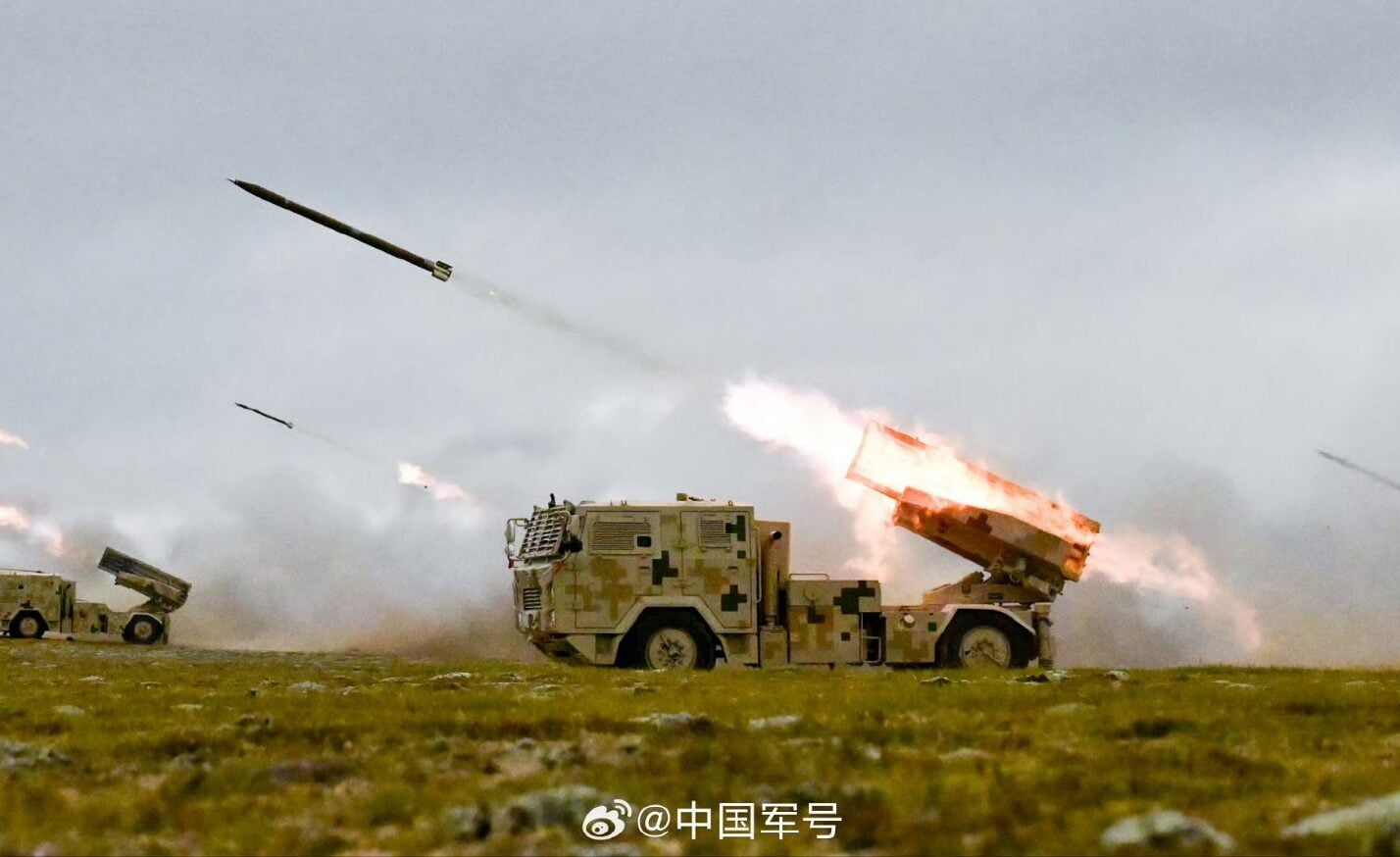
China has shown a new light rocket launcher built on an upgraded FAW MV3 4×4 high-mobility truck, carrying a single 20-round modular pod that, according to an accompanying description, fires guided or unguided 122mm rockets to a maximum range of 40 kilometers. Images of the system firing in salvo, bearing the watermark of an official People’s Liberation Army (PLA) social media account, were shared online on October 13, 2026, with that description posted by a Chinese military commentator. The PLA has released no designation, unit assignment, or official specifications.
The launcher appears to extend a multiyear effort by the PLA Ground Force (PLAGF) to push lighter wheeled fires into its combined arms brigades, particularly on the high plateau facing India. The same MV3 4×4 chassis already carries the PCL-161 122mm truck-mounted howitzer, first seen in Tibet in 2020 and since reported with the Xinjiang and Tibet military commands and the 78th Group Army. In July 2021, footage aired by Chinese state television showed a 4×4 launcher with a 20-tube pod of what appeared to be 122mm rockets, on what looked like the same truck, with a combined arms brigade of the Tibet Military Command. Whether the system now shown is a new design or a matured version of that launcher remains unconfirmed.
How the Upgraded MV3 Carries a 122mm Rocket Launcher
The MV3 is the third-generation tactical truck family developed by First Automobile Works (FAW) and adopted as the PLA’s standard military truck in 2011, in both 4×4 and 6×6 configurations. The 4×4 double-cab variant is designated CTM-133. What the upgraded chassis changes has not been disclosed; protection level, powertrain output, and combat weight all remain unknown.
The images show a single box-shaped pod mounted at the rear, elevated for firing, behind an enclosed cab. The description calls it a modular launch pod, a design in which crews typically swap a spent pod for a loaded one rather than reloading tubes individually, shortening time in the firing position. At 20 rounds, the load is half that of the PLA’s in-service PHL-11, which mounts two 20-round 122mm pods on a heavier truck. Carrying a single pod helps keep the system within a 4×4 truck’s capacity, but it also halves the salvo each launcher can deliver before resupply.
The single-pod layout resembles the SR7 shown by China North Industries Group Corporation (Norinco) at IDEX 2017, a lighter launcher on a 6×6 chassis designed to carry either 20 122mm rockets or six 220mm rockets in one pod. Some open-source references link the PLA version of that concept to the designation PHL-20, which Beijing has not confirmed. Whether the new launcher is related to the SR7 or accepts a 220mm pod is not stated; the available description mentions 122mm munitions only. The manufacturer, crew size, fire control architecture, and any dedicated reload vehicle have not been shown.
Guided and Unguided 122mm Rounds Out to 40 Kilometers
The stated 40-kilometer ceiling aligns with Norinco’s existing 122mm family. The company lists unguided 122mm rockets with ranges of up to 40 and 50 kilometers, as well as the Fire Dragon 40 guided rocket, also designated BRE7, which combines inertial and satellite navigation. Norinco claims a circular error probable of 25 meters at ranges between 20 and 40 kilometers, and says the round is compatible with its Type 81, Type 90B, SR4, and SR5 launchers as well as BM-21 class systems. The rockets visible in the images have not been identified, and the PLA’s own designations for guided 122mm rounds are not public.
Unguided 122mm salvos are area weapons that rely on volume to compensate for dispersion, which grows with range. A satellite-aided round with the claimed 25-meter accuracy would allow a single launcher to engage command posts, air defense radars, or artillery positions with a handful of rockets instead of a full pod. Standard Grad-class 122mm rockets carry warheads of about 18 kilograms, according to publicly available specifications, which limits effects against hardened or dispersed targets.
Light 122mm Launcher vs HIMARS: Range, Payload, and Mobility
Comparisons with the M142 High Mobility Artillery Rocket System (HIMARS) hold for the concept, a wheeled truck carrying one swappable pod, but not for the mission. HIMARS rides on a 5-ton Family of Medium Tactical Vehicles 6×6 chassis, carries six 227mm Guided Multiple Launch Rocket System (GMLRS) rounds or one Army Tactical Missile System (ATACMS) missile, and is transportable by C-130. Publicly available specifications indicate a GMLRS range of about 70 kilometers with a unitary warhead of around 90 kilograms.
The Chinese launcher trades that reach and warhead mass for more rounds per pod and a smaller 4×4 carrier. In role it appears closer to brigade and battalion close support than to the deep strike mission HIMARS performs for US and allied forces. Within the PLA, the long-range modular role belongs to the PHL-16, which fires 370mm rockets and 750mm missiles from interchangeable pods. The new launcher’s weight, and therefore its compatibility with Y-20 transport aircraft or helicopter lift, has not been released.
Analysis: The significance lies less in the launcher than in where it pushes precision fires. Sharing the MV3 truck family with the PCL-161 would give light and high-altitude brigades a common truck for guns and rockets, simplifying maintenance and spares in terrain where tracked and heavy 6×6 systems struggle. Modular pods and a small footprint support the shoot-and-move tactics that counter-battery radar and persistent drone surveillance now demand, a lesson reinforced throughout the war in Ukraine. If the system is fielded with guided rounds in quantity, brigades on the high plateau, including those facing India along the Line of Actual Control, could gain organic precision strike to 40 kilometers without calling on group army assets.
Key unknowns remain: the official designation, the manufacturer, whether the system has entered service and with which units, the guided-to-unguided munition mix, and how the launcher is cued by drones and counter-battery sensors. Airshow China, scheduled for November 10 to 15 in Zhuhai, could provide the first confirmed details.