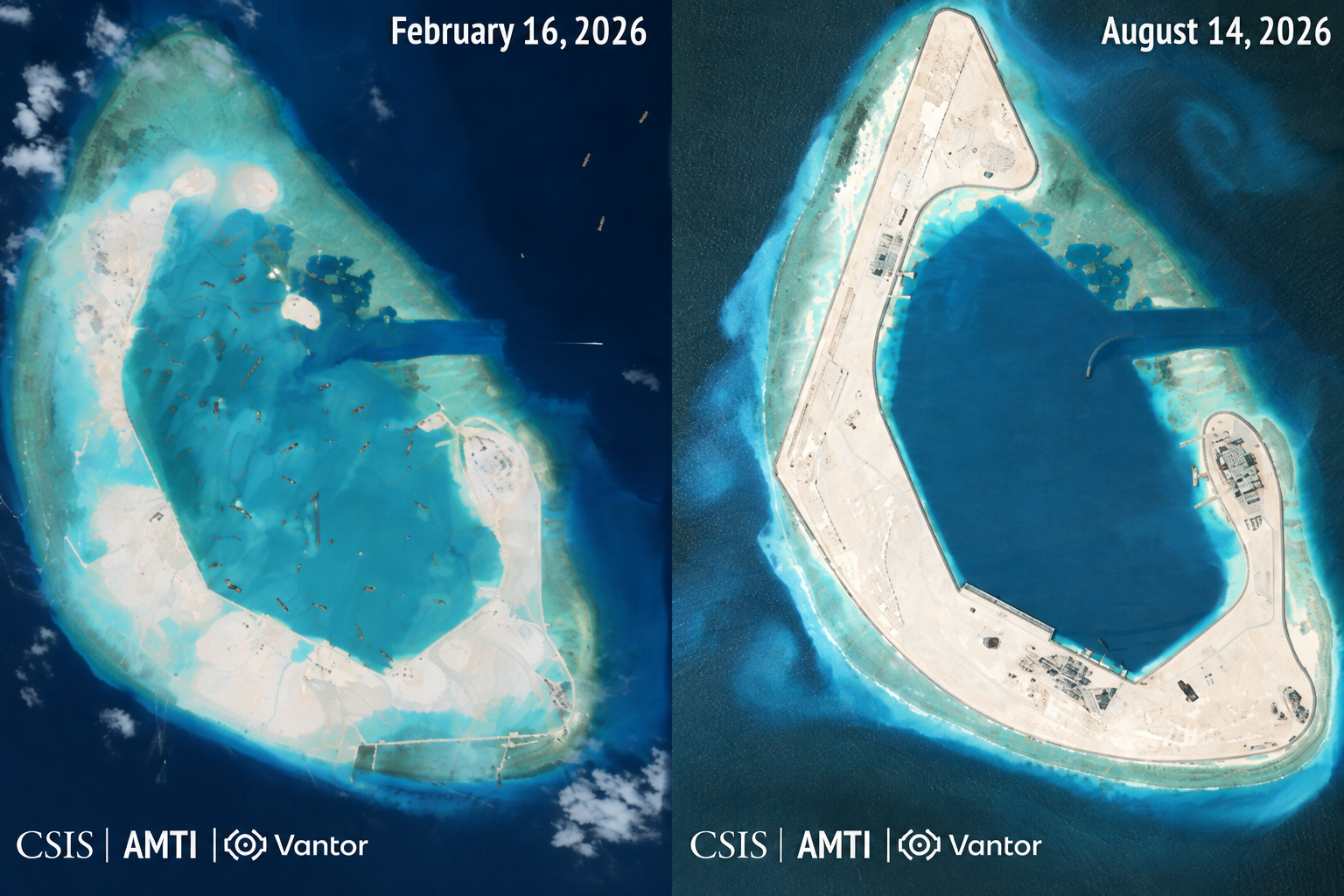
China’s construction of a runway on Antelope Reef in the Paracel Islands has moved into heavy groundwork, with commercial satellite imagery captured on September 25, 2026, showing grading, stockpiles of gravel and concrete, and compaction cranes in operation. Open-source analysts now estimate the runway could be paved in the first half of 2027, with a first aircraft landing by mid-2027.
Antelope Reef, known as Lingyang Jiao in China and Đá Hải Sâm in Vietnam, lies in the Crescent Group of the western Paracels, about 300 kilometers (162 nautical miles) from Sanya on Hainan Island. Dredging was first flagged publicly in early January 2026, and reclamation wrapped up in August. The Asia Maritime Transparency Initiative (AMTI) at the Center for Strategic and International Studies describes the project as Beijing’s first major island-building campaign in the South China Sea since 2017. China has not acknowledged a military role; state media present the outpost as a civilian hub for weather forecasting and maritime and scientific research.
Antelope Reef Runway Construction Moves From Grading to Compaction
The September 25 imagery, collected by commercial provider Vantor, also shows a fully loaded gravel barge heading for a newly built wharf. Vantor imagery analysts and open-source intelligence tracker Damien Symon identified the cranes as the type used to compact reclaimed or loose fill into foundations ahead of paving. That step matters: dredged coral sand must be consolidated before it can bear the repeated wheel loads of heavy aircraft without subsidence.
The geometry points to a full-length military airstrip. Earthworks run along the reef’s northwestern edge, the only straight stretch on the roughly 6-kilometer island long enough for a 3,000-meter (10,000-foot) runway. According to AMTI, the area being shaped matches the 55-meter (180-foot) width of China’s runways at Fiery Cross, Subi and Mischief reefs in the Spratlys and at Woody Island in the Paracels. Final runway length has not been confirmed.
Ben Lewis, founder of the open-source platform PLATracker, uses Fiery Cross as the benchmark. China built its 3-kilometer runway there in 2015 and landed its first aircraft in January 2016. Lewis expects Antelope to be paved in the first half of 2027 and to receive a first landing by mid-2027, possibly sooner. “They’ve had 10 years to get faster at this,” he said. A runway in this class can handle fighters, airborne early warning aircraft, transports and H-6 series bombers; publicly released imagery showed an H-6K landing on Woody Island in May 2018.
Port, Hangar, and Radar Infrastructure Across the Crescent Group
At roughly 1,458 acres (590 hectares) after dredging ended, according to AMTI measurements, Antelope is already the largest feature in the Paracels. It dwarfs Woody Island, at about 890 acres, and nearly matches Mischief Reef, China’s largest Spratly outpost, at 1,504 acres. The former lagoon now forms a sheltered harbor, and publicly available imagery analysis indicates a quay exceeding 600 meters (2,000 feet), enough to berth several major surface combatants at once.
AMTI has also identified foundation work for at least one structure measuring 61 by 61 meters (200 by 200 feet), matching the larger hangars at China’s other South China Sea airfields. At Fiery Cross, Subi and Mischief, hangar complexes accommodate 24 combat aircraft and four larger aircraft each, per publicly available imagery assessments, a possible template for Antelope.
On Yagong Island, a smaller islet nearby, construction that began in March and April 2026 has produced three-pronged structures that Vantor said resemble military radar and early warning installations elsewhere in the South China Sea. Their function has not been confirmed.
Key gaps remain. Lewis has not yet observed excavation for ammunition and fuel storage, which a base of this scale would need to sustain combat sorties. At the Spratly bases, underground storage for fuel, water and munitions was added as the airfields matured; the same sequence at Antelope would be the clearest indicator of operational intent.
What an Antelope Base Means for Hainan’s SSBN Bastion
Location drives Antelope’s value. In the northern South China Sea, the base would extend the reach of People’s Liberation Army Navy (PLAN) ships and military aircraft while covering the approaches to Hainan Island, where Yulin Naval Base near Sanya hosts China’s Type 094 Jin-class nuclear-powered ballistic missile submarines (SSBNs), according to publicly available assessments. Singapore-based security scholar Collin Koh has argued the outpost could support efforts to create protected bastions for those submarines.
Lewis has described Antelope as larger than Woody Island and easier to defend than the Spratly network further south, since it sits within reach of mainland air cover and resupply from Hainan. Paired with Woody Island’s airfield and the suspected sensor sites on Yagong, Antelope would give the PLA a mutually supporting air, naval and surveillance complex in the Paracels, complicating US and allied anti-submarine warfare and intelligence, surveillance and reconnaissance (ISR) missions near Hainan.
Vietnam and Taiwan both claim the Paracels. China expelled South Vietnamese forces in a brief 1974 battle and has held the archipelago since over Hanoi’s objections; Vietnam formally protested the Antelope reclamation in March 2026. The buildup also coincides with Beijing’s confirmation this week of a new joint military support facility in neighboring Laos.
Analysis: The speed and scale of the Antelope buildout show that Beijing’s island-building capacity remains fully intact a decade after the Spratly campaign. Once paved, a 3-kilometer-class runway 300 kilometers from Sanya, backed by deep-water berths and adjacent sensors, would layer air and maritime defenses around China’s sea-based nuclear deterrent and raise the risk profile of every US and allied ISR sortie flown in the northern South China Sea.
Indicators to watch over the next nine months include runway paving, hangar superstructures, excavation for fuel and munitions storage, activation of the Yagong sites, and air defense deployments of the kind seen on Woody Island since 2016. Beijing has issued no statement on the base’s military purpose, and whether it keeps the civilian framing once combat aircraft arrive remains the key political unknown.