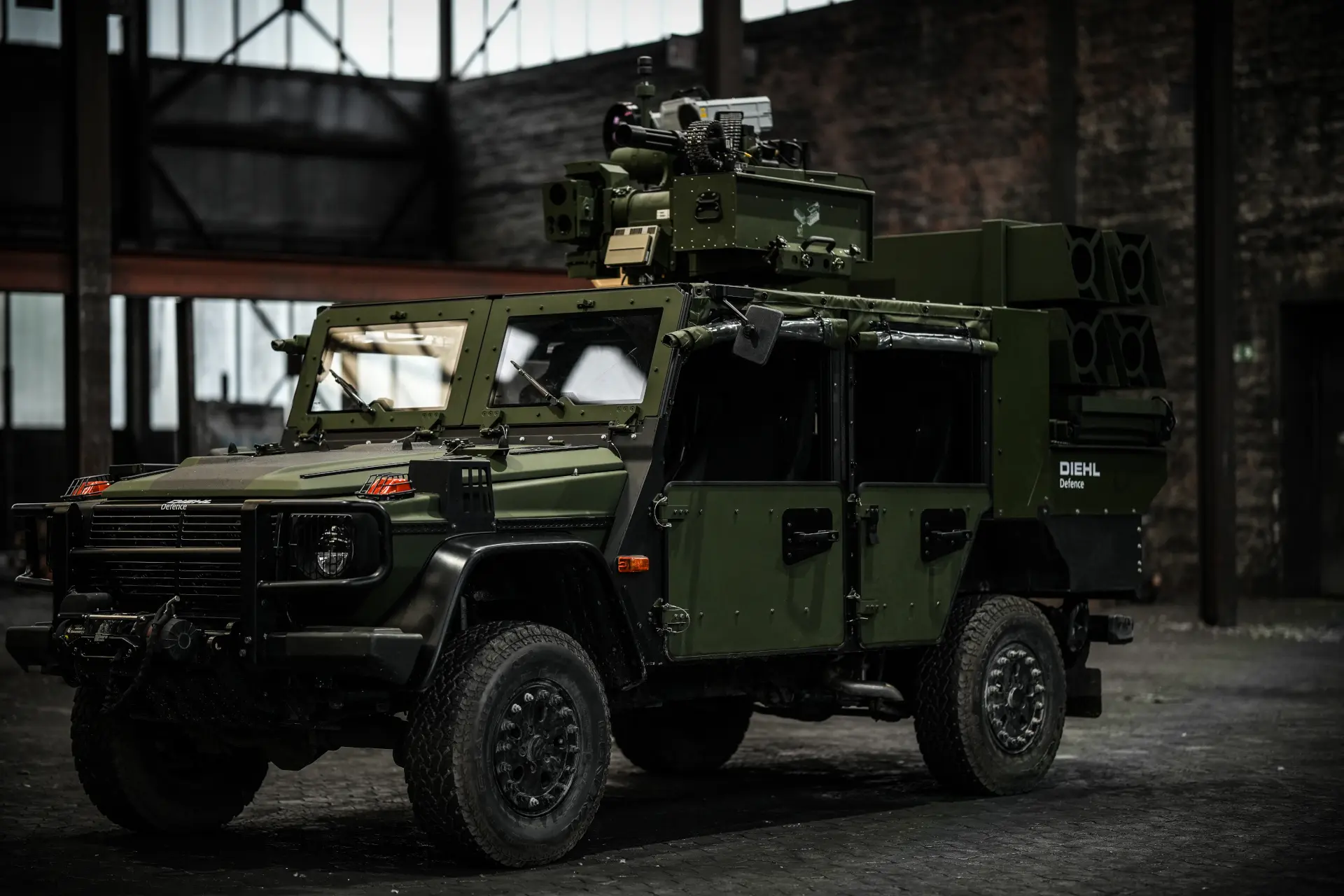
The Bundeswehr is preparing a larger procurement of the GARMR mobile counter-drone system from Diehl Defence, starting with a small batch mounted on the Mercedes-Benz G-Class to equip Panzerbrigade 45 before its permanent relocation to Lithuania, German defense outlet hartpunkt reported exclusively on October 12, 2026, citing sources familiar with the plans. The initial purchase will reportedly stay below the 25 million euro threshold that triggers a submission to the Bundestag budget committee and serves to qualify the system for German service. A larger follow-on program, possibly in an international framework, is being prepared in parallel and could move GARMR onto a heavier platform protected against ballistic threats.
The timing is driven by Panzerbrigade 45 “Litauen,” formally established on April 1, 2025, and due to reach full operational capability with roughly 4,800 personnel by the end of 2027 at its main base in Rūdninkai, about 30 km from the Belarusian border. Lieutenant General Christian Freuding, Chief of the German Army, told reporters on October 1, 2026, during the Land 2026 experimentation series, that the brigade would receive a drone defense capability before it relocates. He repeated the commitment on October 7 at the parliamentary evening of the Förderkreis Deutsches Heer.
GARMR Drone Defense System Procurement: Qualification First, Scale Later
“On drone defense, we are working hard to provide Panzerbrigade 45 with its initial equipment before its relocation, with a capable interim solution that we will continue to use when our target systems arrive,” Freuding said. He did not name the system, but his remarks are understood to refer to GARMR. The Army has not identified what those target systems will be.
Observers expect the first vehicles to enter service on the G-Class because the platform shares many components with the Wolf 2, the Bundeswehr’s long-serving G-Class variant. That commonality should cut qualification effort.
The initial configuration is expected to pair the MG6 machine gun with Diehl Defence’s Cicada interceptor drone. The MG6 is the Bundeswehr designation for the Dillon Aero M134D-H, a six-barrel 7.62 x 51 mm rotary gun firing about 3,000 rounds per minute; procurement authorities have described it as a weapon for fast-moving soft targets out to 1,200 m, so far used mainly by German special forces. The Cicada is currently the only interceptor whose full integration into GARMR is publicly known, though other interceptors are not ruled out for later buys. Diehl Defence has said integrating a new interceptor takes a few months.
Sensors, Guns, and Interceptors on the GARMR SRS Vehicle
The version on offer is the GARMR SRS (Short Range System), built on the latest 464-series G-Class with an extended wheelbase. Behind the driver’s cab sits a second enclosed cabin for two operators and the counter-drone control console, protecting crews in cold weather. Diehl Defence designed the vehicle for minimal manning: with automated subsystems and AI-assisted detection and classification, a single operator can defend a fixed site in an emergency. Engagements on the move require a separate driver.
Detection relies on two Echodyne EchoShield radars mounted on roof rails above the driver’s cab. Publicly available specifications indicate a Ku-band metamaterial electronically scanned array with a 120-degree azimuth field of view per panel, optimized for small, low-flying targets. A sensor mast with integrated optronics adds electro-optical confirmation.
The gun sits on a stabilized R400 remote weapon station from Australia’s Electro Optic Systems, marketed in Europe by Diehl Defence, which allows accurate fire while driving. An integrated weather sensor improves accuracy at longer range. With the MG6, the system reaches a maximum engagement range of 1,000 to 1,200 m, with an effective range of roughly half that distance.
The rear module carries up to 15 Cicada interceptors. The Cicada uses a 300 mm diameter, 700 mm long fuselage with four folding delta wings in an X configuration and engages targets beyond 5 km, either with a warhead or a net that brings the target down in a controlled crash.
From Kinetic Defence Vehicle to Networked GARMR Fire Units
GARMR is the upgraded successor to Diehl Defence’s Kinetic Defence Vehicle, which has been in service in Ukraine for some time. The company relaunched it under the new name at Enforce Tac 2026 in Nuremberg in February 2026. The Cicada and the vehicle were tested together at the Grafenwöhr training area in late November 2025.
Diehl Defence also offers a GARMR MRS (Medium Range System), which replaces the Cicada module with four canisters for the Destinus Hornet Block 2, an electrically powered interceptor with a stated range above 70 km and a 3 kg explosive payload. That variant is not part of the reported initial buy.
Several GARMR vehicles can be combined into a networked fire unit, and Diehl Defence has previously stated that the system includes an interface for integration into higher-level air defense networks. How that interface would connect to German Army air defense command and control has not been disclosed.
Analysis: The two-track approach treats counter-drone protection as an immediate force protection requirement rather than a long-cycle program. Keeping the first batch below the parliamentary threshold and on a platform close to the Wolf 2 lets the Army field a capability within the brigade’s 2027 window. The trade-off is protection: an unarmored G-Class operating near the Belarusian border would be exposed to the artillery, loitering munitions and first-person-view drones that dominate the front in Ukraine, which explains why the larger program reportedly looks at a ballistically protected carrier. The open interceptor architecture matters as much as the hardware: in Ukraine, counter-drone effectors lose relevance within months as threats adapt.
Key details remain undisclosed: the number of vehicles in the qualification batch, contract timing, delivery dates, the heavier platform under consideration and the identity of any international partners. The next markers to watch are a contract award for the initial systems and a 25 million euro submission to the Bundestag budget committee for the larger program, both of which would need to land well before Panzerbrigade 45 reaches full operational capability at the end of 2027.