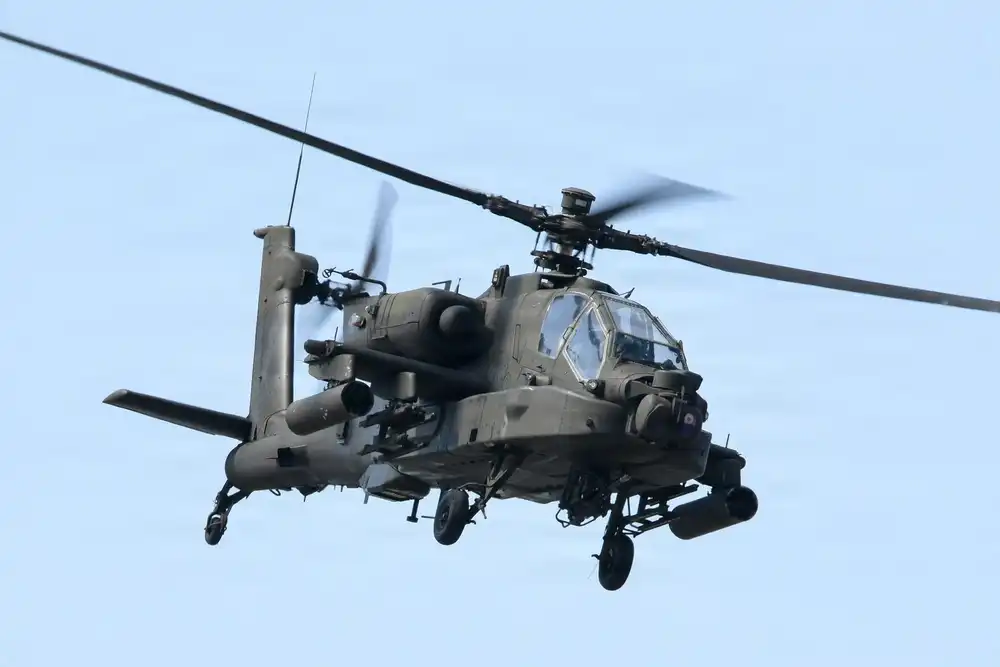
Lockheed Martin has won a $117,118,040 contract from the US Army for post-production support of the Generation II radar frequency interferometer (RFI) on the service’s Apache attack helicopters, the Pentagon announced on October 13, 2026. The indefinite-delivery/indefinite-quantity (IDIQ) vehicle, awarded to the company’s Owego, New York, site, combines cost-no-fee, cost-plus-fixed-fee and firm-fixed-price terms and runs to an estimated completion date of October 12, 2031.
The Generation II system is the AN/APR-48B Modernized Radar Frequency Interferometer (M-RFI), the passive emitter-locating sensor standard on the AH-64E Apache Guardian. The award marks the shift from buying the sensor to sustaining it: the most recent publicly announced production order, worth $60,539,401 and announced on August 30, 2023, scheduled M-RFI work in Owego through October 31, 2026. It also comes as the Army consolidates on the E model under the Army Transformation Initiative (ATI); Army aviation officials said in April 2026 that nearly 60 percent of the AH-64D fleet had already been divested.
Inside the Apache Radar Frequency Interferometer: AN/APR-48B Passive Targeting
The AN/APR-48B passively detects, identifies and locates radar emitters, then ranks them by threat priority. That output serves two missions. For targeting, it cues the mast-mounted AN/APG-78 Longbow fire control radar onto an emitter’s bearing, so the crew radiates briefly and only in the right direction. For survivability, it warns of radar-directed anti-aircraft threats and serves as the controller for the helicopter’s integrated aircraft survivability equipment (ASE).
Manufacturer specifications put the system at 39 pounds: a 15.1-pound antenna, a 9.1-pound receiver, a 13.6-pound processor and 2.1 pounds of cabling, dissipating 250 watts. Two four-element interferometer arrays provide precision direction finding across a 120-degree field of view, while coarse arrays give instantaneous 360-degree coverage for initial acquisition and radar warning. An additional antenna group extends frequency coverage against modern threats; the exact bands are not public. Dedicated algorithms fed by rotor blade position data preserve direction-finding accuracy beneath the spinning rotor.
At its core sits a fully channelized digital receiver pairing wideband detection with narrowband sensitivity, built to isolate signals in a congested spectrum and under deliberate interference. The threat library resides in a removable, reprogrammable User Data Module, and Lockheed Martin developed, under Army contract, the organic toolset the service uses to build and validate those mission data loads. The system connects to the aircraft over a dual-redundant MIL-STD-1553B data bus.
Against the first-generation AN/APR-48A, which entered service on the AH-64D Longbow in the 1990s and passed 330 deliveries by 2006, the digital M-RFI’s main gains are sensitivity and reprogrammability. Detecting a radar before the aircraft enters its engagement envelope is what lets a crew choose to mask, evade or attack.
Sole-Source IDIQ Bridges Gen II Support to the Gen 3 RFI
The Army solicited one bid and received one. Army Contracting Command at Redstone Arsenal, Alabama, is the contracting activity under contract W58RGZ-27-D-A007. Work locations and funding will be set with each order, so the $117.1 million figure is a ceiling for future task orders rather than money committed today. The announcement does not say how the value divides among the three pricing types or whether Foreign Military Sales (FMS) customers can order through the vehicle.
That FMS question matters. Earlier Generation II production orders included FMS requirements for the United Kingdom, Qatar, Saudi Arabia and South Korea, and a separate hardware order supported India, Morocco and the Netherlands. The single-bid outcome reflects three decades of incumbency: Lockheed Martin developed both fielded Apache RFI generations and holds the design data and test infrastructure a competitor would need.
A successor is already in development. On October 15, 2024, Lockheed Martin announced a contract from the Apache Attack Helicopter Project Management Office, with the Apache Sensors Product Office managing the effort, to develop the Gen 3 RFI and radar warning receiver. The company cites better sensor performance in a smaller, lighter package with room for new functions, built around the first use of Radio Frequency System on a Chip (RFSoC) technology in the APR-48B line. The long-term plan is to replace every fielded Gen II unit. The value of that development award was not disclosed.
No Gen 3 production decision or fielding schedule has been published. Until a retrofit is complete, Gen II sensors will need repairs, spares and engineering support, which explains the five-year horizon of the new vehicle.
Analysis: The contract is a bridge, but it shows where the Army places value in its manned attack helicopter as ATI trims formations and leans harder on uncrewed systems. An Apache survives modern layered air defenses by emitting less and detecting first, and the M-RFI is the sensor that makes that possible. The decisive variable is the threat library rather than the hardware: a passive sensor is only as good as the emitter data loaded into it, and the cost-reimbursable portion of the vehicle leaves room for the engineering needed to keep that data current. The trade-off is continued reliance on a single facility for a core survivability component.
The first task orders will show how quickly the Army commits money to the vehicle and whether allied fleets use it. Gen 3 qualification and a production decision are the next milestones to watch; their timing will determine whether Gen II support can wind down before October 12, 2031.