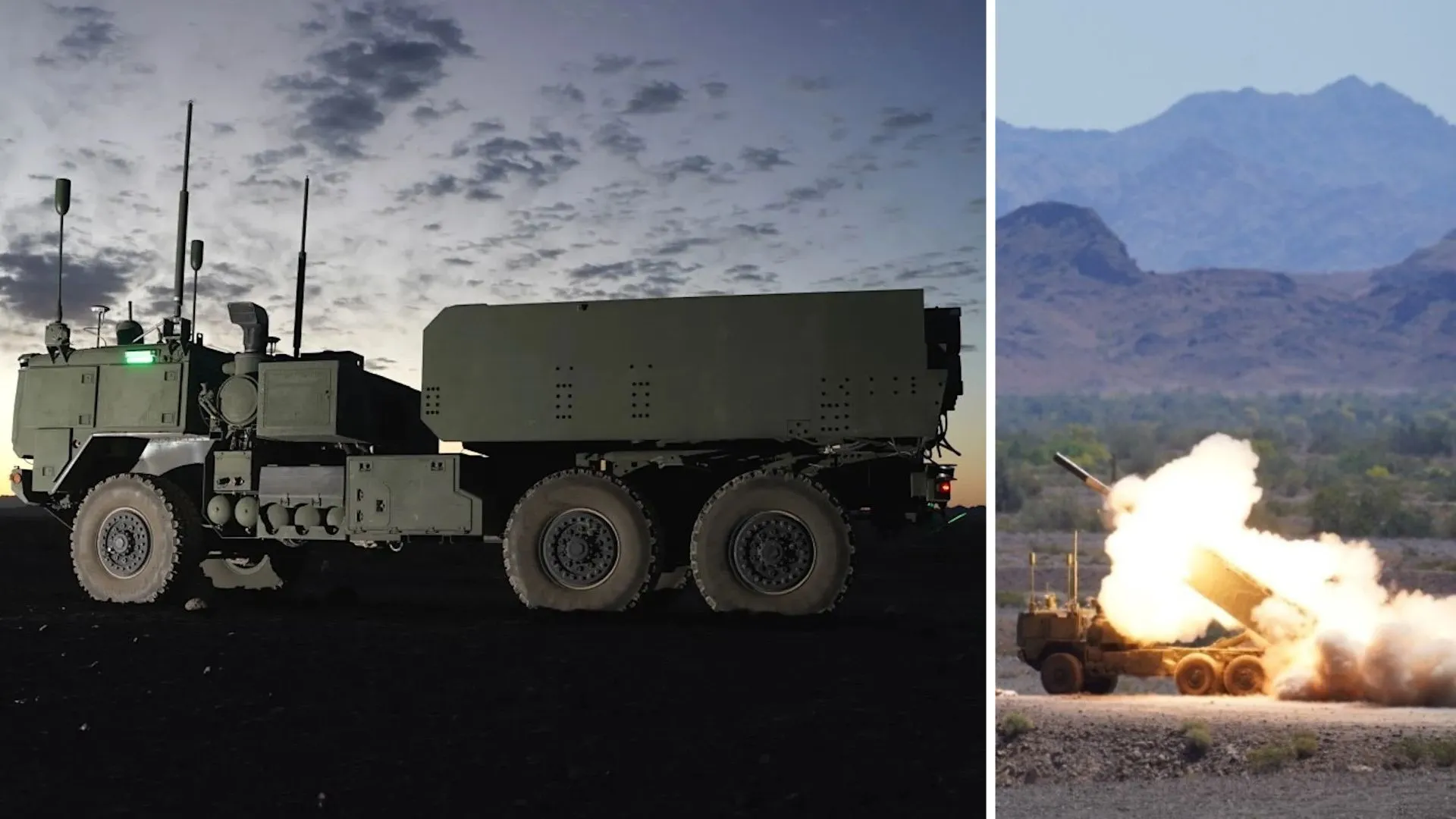
The U.S. Army expects to award its Common Autonomous Multi-Domain Launcher (CAML) Medium platform contract within roughly 30 days, Lt. Gen. Frank Lozano, Portfolio Acquisition Executive (PAE) Fires, said October 14, 2026, at the Association of the U.S. Army (AUSA) annual meeting in Washington. “We just finished our source selection effort,” Lozano said, adding that the service will open a CAML Light effort with Australia in 2027 and a CAML Heavy initiative around 2028 or 2029.
Today nearly every Army missile rides on its own launcher; Lozano said the goal is to “collapse down to a maximum of three” common designs. CAML descends from the Autonomous Multi-domain Launcher (AML), a Combat Capabilities Development Command (DEVCOM) effort that turned a HIMARS-derived truck into a cab-less, unmanned launcher. After the AML fired six reduced range practice rockets at Yuma Proving Ground, Arizona, in April 2024, three of them in a ripple, it moved to the Rapid Capabilities and Critical Technologies Office, since merged into PAE Fires, and took the CAML name.
CAML Medium Sized Around a 36,000-Pound Gross Weight Ceiling
The Army originally planned medium and heavy variants in parallel. A 2025 Army description placed Tomahawk Land Attack Missiles and Patriot Advanced Capability-3 Missile Segment Enhancement (PAC-3 MSE) interceptors on a heavy launcher using a 15-ton class chassis, while a medium launcher on the Family of Medium Tactical Vehicles (FMTV) would fire Multiple Launch Rocket System (MLRS) munitions and Indirect Fire Protection Capability (IFPC) interceptors based on the AIM-9X.
Industry demonstrations changed that plan. Lozano said the platforms proposed were heavier than the Army wanted, and once his team defined interceptor loadouts with the combatant commands, a 60,000-pound gross vehicle weight design was “just going to be too heavy.” The service settled on a top-end gross vehicle weight rating of 36,000 pounds, roughly 16,330 kilograms.
Publicly available specifications put the combat weight of the M142 High Mobility Artillery Rocket System (HIMARS) at about 35,800 pounds, a load that rolls on and off a C-130 Hercules. Holding CAML Medium to the same envelope keeps it inside the tactical airlift footprint that expeditionary fires in the Pacific depend on.
Within that ceiling, Lozano said CAML Medium should carry Tomahawk, PAC-3 MSE, “probably” the Army’s future low-cost interceptor, the Lockheed Martin-built MLRS family of munitions and IFPC interceptors. The Medium variant has therefore absorbed the strike and air defense missiles once reserved for the heavy launcher, a scope that places hard demands on pallet design, power and data interfaces, and reload kinematics. The Army has not disclosed magazine depth by munition type.
How Georgia Tech and PAE Fires Are Assembling CAML Increment Zero
The pending award follows the Army’s decision to buy CAML as separate modules rather than as a turnkey launcher. In August 2026, the service awarded the Georgia Tech Research Institute (GTRI) a prototype Other Transaction Agreement with a maximum value of $33,399,920 to serve as Weapon Systems Integrator. Over an estimated 36-month period of performance, GTRI will handle systems engineering, interface integration, modeling and simulation, and integrated testing, culminating in CAML Increment Zero prototypes. The Army describes the effort as a prototype demonstration, not a production decision.
The architecture separates an Autonomous Mobility Platform (AMP), a munitions pallet with launcher electronics, and the integration layer. Army requests for information called for an AMP able to operate in convoy-following, waypoint-navigation and optionally piloted modes, a convoy leader vehicle able to lead more than two AMPs, and a vehicle autonomy command and control system, all deliverable within 12 to 18 months. Each AMP must load and unload payloads with no human intervention, either through a dedicated resupply vehicle or an inherent self-reload capability.
The Army has not named the offerors or the award value. Known industry concepts include the optionally crewed DeepFires launcher unveiled by Raytheon, Oshkosh Defense and Forterra at AUSA 2025, and Lockheed Martin’s uncrewed HIMARS.
CAML Light Prototypes Could Fire at Talisman Sabre 2027
Lozano said Acting Army Chief of Staff Gen. Christopher LaNeve directed PAE Fires to run CAML Light with Australia “to help the Australians meet some of their capability requirements.” A request for information is ready for release and will be followed by an industry day. Prototyping selections could come in spring 2027, supporting a potential live-fire demonstration during Exercise Talisman Sabre in June or July 2027, after which the Army would make a downselect award.
The timing tracks Canberra’s own long-range fires buildup. Under Project LAND 8113 Phase 1, the Australian Army acquired 42 HIMARS launchers for its first long-range fires regiment. On April 28, 2026, the government selected additional HIMARS armed with the Precision Strike Missile (PrSM) for a second regiment at the Edinburgh Defence Precinct in South Australia, an investment of A$2.3 billion over a decade. Australian HIMARS fired a PrSM at Talisman Sabre 2025, two years ahead of plan, and the U.S. Army fired a Standard Missile-6 from its Typhon Mid-Range Capability launcher in the Northern Territory during the same exercise. The Army has not released CAML Light weight, munitions or crewing requirements.
Analysis: The 36,000-pound ceiling is the program’s central bet. By folding Tomahawk and PAC-3 MSE into a HIMARS-class, C-130-transportable vehicle, the Army trades per-vehicle magazine depth for dispersal, airlift and crew reduction, the variables that matter most against massed long-range precision fires in the Western Pacific. Government-owned interfaces also guard against single-vendor lock-in. Bringing Australia in at the Light tier extends that logic to coalition logistics, since a shared launcher standard would let U.S. and Australian units exchange pallets and reloads in theater. The risk is concurrency: three variants and an allied program will run before Increment Zero has fired.
The next milestone is the CAML Medium award, which could come by mid-November 2026, followed by the CAML Light request for information and industry day. CAML Heavy would then carry larger missiles, potentially the Long-Range Hypersonic Weapon (LRHW), stacked Tomahawks, or a system Lozano called Leviathan that the Army has not publicly detailed. Lozano said the timeline will shift as the Army learns what industry can deliver.