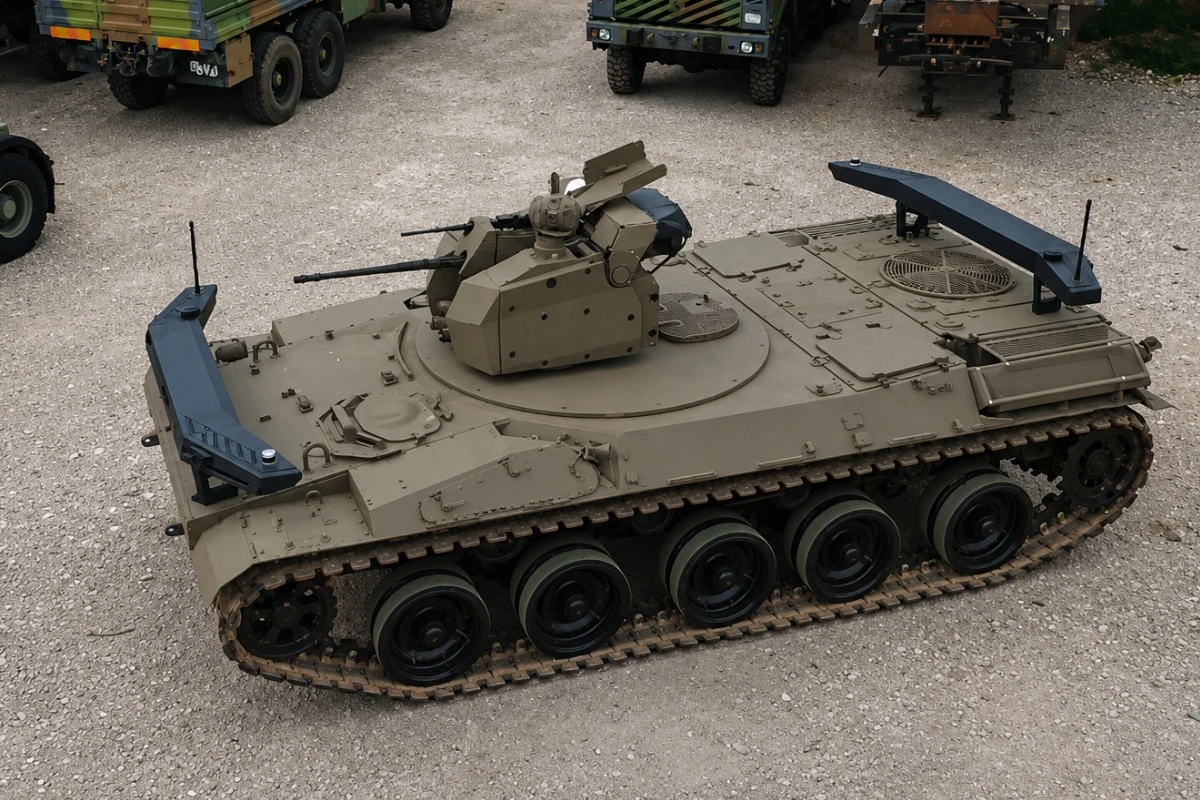
KNDS presented a package of infantry modernization systems at the 2026 National Infantry Days in Draguignan, France, on October 14, 2026, pairing a vehicle-mounted drone kit, a robotized AMX-32 tank and a new software-defined radio for uncrewed platforms. The Franco-German land systems group framed the lineup around high-intensity warfare, with tactical connectivity, robotics and drone systems as the three pillars of the KNDS offer.
Draguignan hosts the French Army’s infantry school, making the event a direct pitch to the branch that will field squad-level robots and loitering munitions. KNDS arrives with commercial momentum: the group reported €4.4 billion in 2025 revenue and an order backlog of €33.1 billion as of December 31, 2025. Its MX-10 Damoclès loitering munition, developed with drone maker Delair under the French short-range loitering munition program, has already entered French Army service. KNDS did not announce any new contract or French Army order at the event.
KNDS Robotics Range From NERVA-LG Micro-Robot to REFURBOT Heavy Platform
The most visible exhibit was REFURBOT, a project developed with French firm S2M to modernize and robotize an AMX-32 tank. According to KNDS, the uncrewed platform allows remote control of all the tank’s functions and integrates artificial intelligence modules to support autonomous mobility. Publicly available records indicate the AMX-32 was a 1970s export-oriented derivative of the AMX-30 main battle tank that never entered series production, which makes this hull a demonstrator rather than a fleet template. First shown at Eurosatory in June 2026 with the KNDS TOXO robotization kit, the concept targets surplus AMX-30 hulls, of which open-source figures put production at 3,571.
REFURBOT carries the ARX25 remotely operated turret. Publicly available specifications indicate the ARX25 is built around the 25M811 automatic cannon firing 25 x 137 mm ammunition, with open-source reports citing 280 ready rounds and the ability to engage light ground targets, drones and helicopters. Trading a 105 mm gun for a 25 mm dual-purpose cannon turns the hull into an expendable armored escort that can absorb fire and counter small drones without risking a crew.
At the light end, the NERVA-LG tactical micro-robot can be reconfigured in under a minute without tools for reconnaissance, detection and observation across all terrain. The CENTURIO X20 is a heavy tactical robot on a 2- to 3-tonne platform that combines autonomous mobility with a 20 mm cannon operated over what KNDS calls an ultra-secure radio link. KNDS did not disclose the cannon’s designation, ammunition capacity or the platform’s endurance. The Tusker platform completes the range for logistics, cargo carriage and combat group support.
Dronised Function Kit, MT-10 and PHORIO Connect Vehicles to Drones
The Dronised Function Kit (Kit Fonctions Dronisées, KFD) adds intelligence, neutralization and hybrid communications capabilities to existing vehicles. It comprises a storage unit, hybrid communications equipment and an open, modular command and control (C2) system, and KNDS says it fits any type of land platform. KNDS did not name its co-development partners.
KNDS also showed a generic C2 station, developed with Impact, for operating loitering munitions such as the MT-10. Part of the MATARIS range, the MT-10 is a short-range munition with a folding counter-rotating twin-rotor layout. It carries a 550-gram incendiary explosive warhead out to 10 km with 30 minutes of endurance and launches from a tube or in vertical take-off and landing mode. KNDS product data lists a 3.8 kg weight, 70 cm span and electric propulsion. Tube launch is the operationally relevant feature, since it allows integration on armored vehicles and links the munition directly to the KFD concept.
Tying the uncrewed systems together is PHORIO, a software-defined radio (SDR) first unveiled at DSA 2026 in Malaysia. Designed for uncrewed ground and air platforms, it carries C2 data, voice and real-time video simultaneously, using frequency hopping and anti-jamming to hold links under electronic attack. Because the waveform lives in software, KNDS says new functions, improved anti-jamming algorithms and customer-specific protocols can be added without hardware changes. KNDS did not publish frequency bands, data rates or link range.
Analysis: The common thread is the link, not the platforms. Combat in Ukraine has demonstrated that robots and loitering munitions are only as effective as the radio path controlling them under jamming, and KNDS is positioning PHORIO and an open C2 layer as the connective tissue for every uncrewed asset it sells. Converting surplus hulls and retrofitting fielded vehicles with drone kits also offers European armies a cheaper path to mass than buying new platforms.
None of the systems shown at Draguignan is tied to an announced French procurement. The decision points to watch are whether the French Army trials REFURBOT or the KFD, whether the MT-10 finds a launch customer alongside the in-service MX-10, and whether PHORIO is qualified on French uncrewed programs.