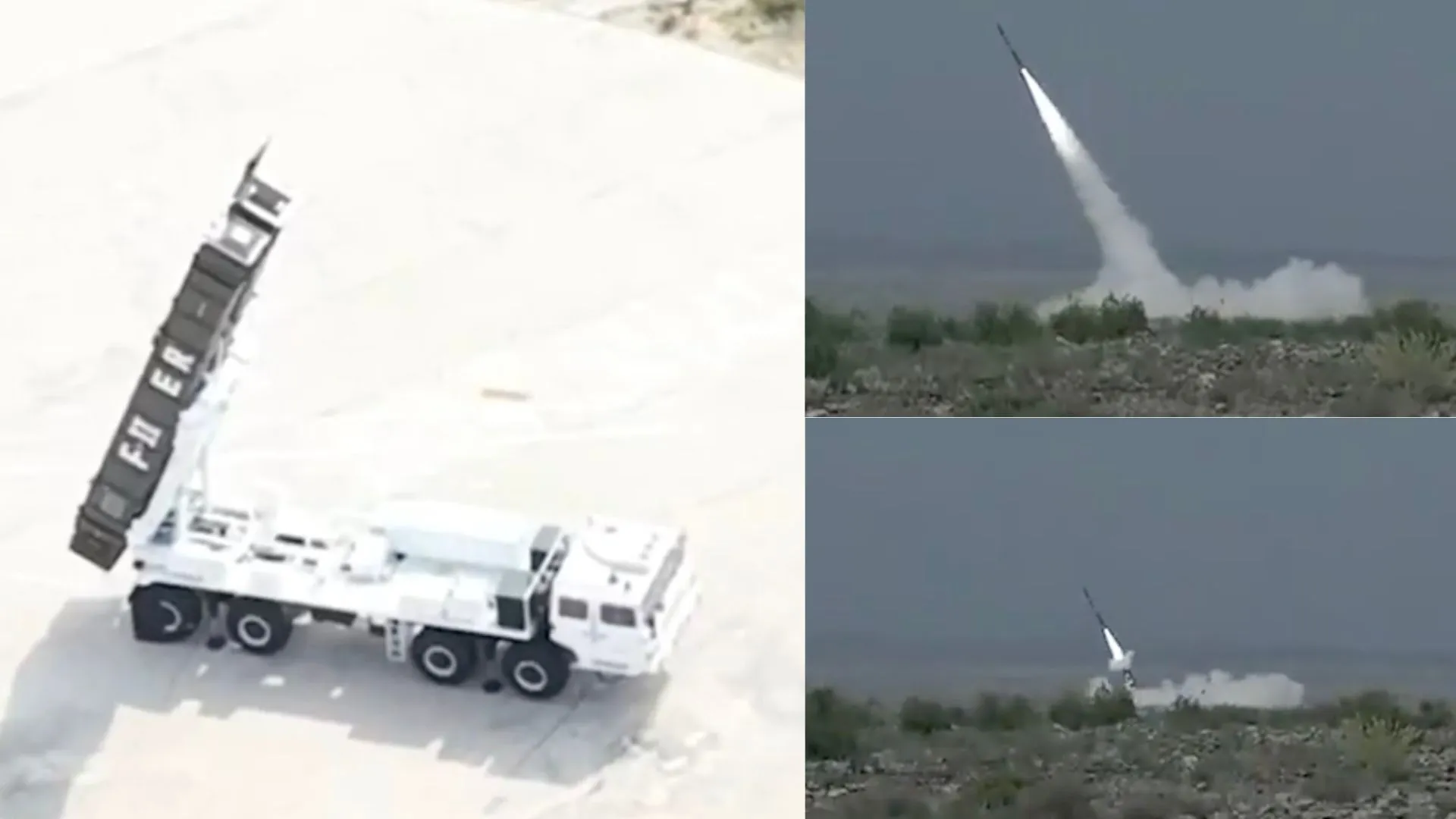
The Pakistan Army test-fired the Fatah-2 Extended Range (ER) on October 13, 2026, an upgraded variant of its Fatah-2 surface-to-surface missile that Inter-Services Public Relations (ISPR), the military’s media wing, designates a hypersonic ballistic missile. ISPR said the weapon carries advanced navigation and avionics and can defeat missile defense systems through its trajectory and maneuverability. It released no range, speed, payload or test-site figures for the new variant.
The launch, witnessed by the commander of the Army Rocket Force Command (ARFC), identified in Pakistani reporting as Lieutenant General Nauman Zakaria, was the command’s second extended-range test in eight days. On October 6, 2026, Pakistan fired an extended-range version of the Fatah-4 ground-launched cruise missile (GLCM), also without disclosing its reach. Prime Minister Shehbaz Sharif announced the ARFC on August 13, 2025, three months after the May 2025 conflict with India exposed the army’s limited long-range conventional strike options. The command operates conventionally armed rockets and missiles, separate from the Army Strategic Forces Command, which handles the army’s nuclear-capable missiles.
Fatah-2 ER Builds on a 400 km Quasi-Ballistic Baseline
Developed by the National Engineering and Scientific Commission (NESCOM) and marketed abroad by Global Industrial and Defence Solutions (GIDS), the baseline Fatah-2 first flew in December 2023. Publicly available specifications describe a 600 mm-diameter missile roughly 7.5 m long, powered by a single-stage dual-thrust solid rocket motor with indigenous thermal protection. Guidance combines inertial and satellite navigation (INS/GNSS), and manufacturer data cites a circular error probable (CEP) below 50 m with a 365 kg unitary blast or blast-fragmentation warhead.
Pakistan states a domestic range of 400 km. The export version is capped at 290 km, below the 300 km threshold of the Missile Technology Control Regime (MTCR). The missile flies a quasi-ballistic profile with maneuver capability across all phases of flight, and GIDS material cites a terminal speed above Mach 2. The hypersonic label likely reflects peak velocity earlier in flight; neither figure has been independently verified.
The Fatah-2 belongs to a different class from the 301 mm Fatah-1 guided rocket, which reaches 70 to 140 km and was employed during the May 2025 conflict. The ARFC conducted a Fatah-2 training launch on April 28, 2026. ISPR footage of the ER test shows a white eight-wheeled transporter-erector-launcher elevating a canister-style launch pod marked “FII ER,” a road-mobile setup that supports rapid dispersal and shoot-and-scoot employment.
Range remains the central unknown. Some open-source compilations list roughly 450 km for the ER, but Pakistan has confirmed no figure, and the footage does not establish whether the airframe, the motor or both were modified.
How the Army Rocket Force Command Is Layering Conventional Strike
The Fatah-2 ER slots into a tiered portfolio. The Fatah-1 covers targets out to 140 km and the Fatah-2 out to 400 km. The Fatah-4, a Mach 0.7 cruise missile derived from the Babur family, carries a reported 330 kg warhead to 750 km. Extended-range variants of both the Fatah-2 and Fatah-4 now sit above those baselines at undisclosed distances.
Pairing a maneuvering quasi-ballistic missile with a terrain-hugging cruise missile complicates defense planning. The first stresses upper-tier and terminal interceptors with a short time of flight and an irregular trajectory; the second demands low-altitude radar coverage and persistent airborne surveillance. Forcing an opponent to cover both threats from a single interceptor inventory is the core logic of the ARFC.
At 400 km or more, the Fatah-2 family reaches air bases, logistics hubs and corps-level headquarters well beyond the forward edge of the battle area. India is pursuing a comparable capability: publicly available data credits its Pralay quasi-ballistic missile with a 150 to 500 km range, intended for a planned Integrated Rocket Force.
Analysis: Two extended-range tests in eight days indicate that the ARFC is prioritizing range growth on proven airframes over new missile types, a faster and cheaper path to deep strike. The trade-off is ambiguity. The ARFC was created partly to separate conventional from nuclear missile forces, yet the Fatah-2 ER now reaches beyond the nuclear-capable Ghaznavi, credited in open sources with about 290 km, while the Fatah-4 series overlaps the Shaheen-I at roughly 750 km. An early-warning operator observing a launch during a crisis cannot identify a payload from its trajectory, which raises the risk that a conventional strike is read as a nuclear one.
Pakistan has not said when the Fatah-2 ER will enter ARFC service or whether a troop-operated training launch will follow, as one did for the baseline Fatah-2. Indicators to watch include an official range figure, any GIDS export offer, and whether the next Fatah-4 ER launch discloses that missile’s new reach. Further Indian Pralay testing will shape how quickly both rocket forces expand.