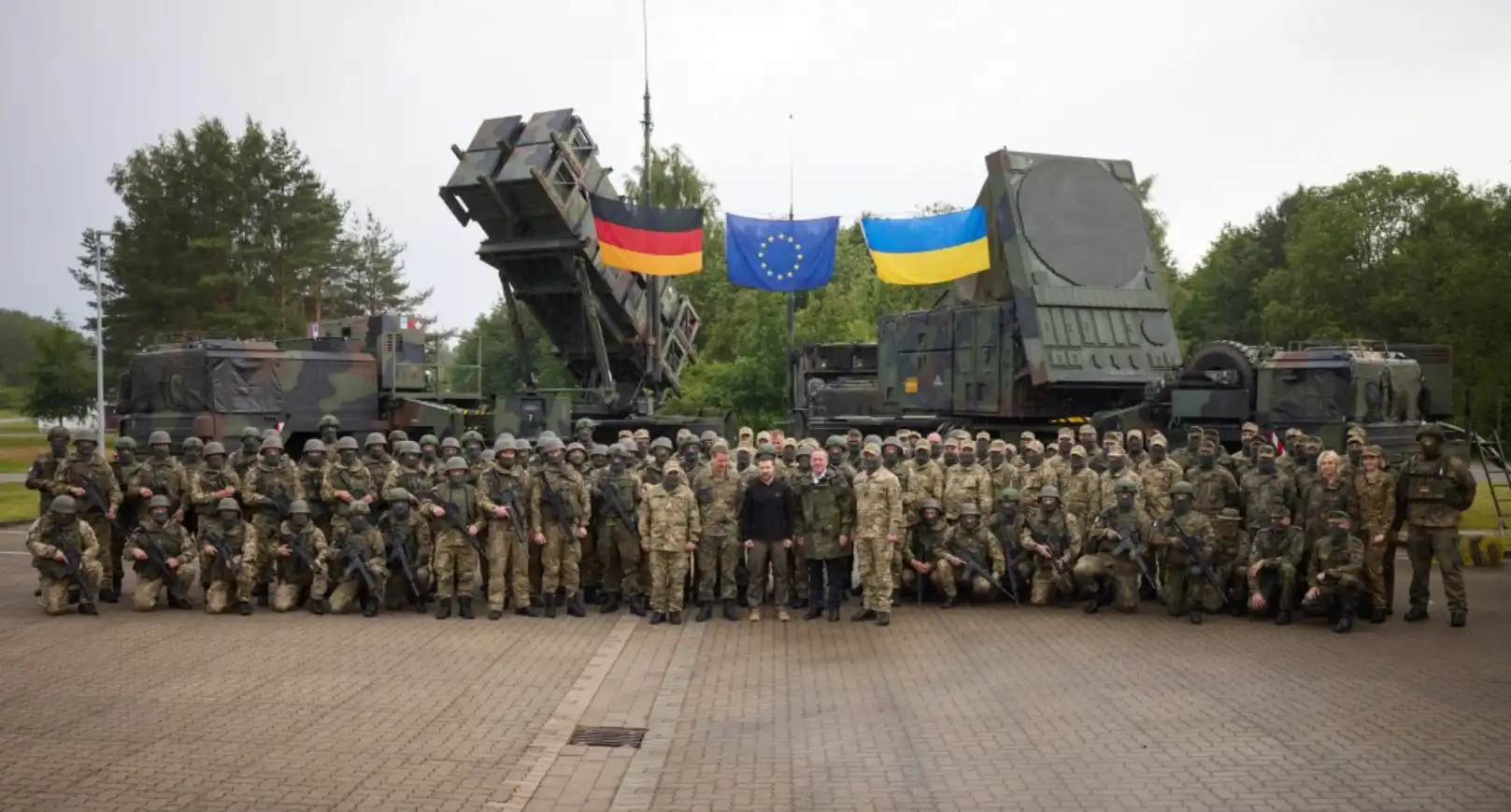
The European Commission disbursed €2.86 billion to Ukraine on October 14, 2026, under the defense component of the €90 billion Ukraine Support Loan (USL), earmarking the funds for drones, air defense systems, missiles, radars, electronic warfare (EW) systems and ammunition. The transfer is the sixth payment from the loan’s defense window since disbursements began on June 30.
The tranche arrives as Ukraine prepares for another winter since Russia’s full-scale invasion, with Russian strikes on cities and civilian infrastructure driving Kyiv’s most urgent requirements. “As Russia stalls on the frontlines, it continues to escalate its aerial attacks,” Commission President Ursula von der Leyen said, adding that the payment addresses Ukraine’s “most urgent operational needs, including drones and missiles.” The USL carries an indicative split of €60 billion for defense and €30 billion for budget assistance across 2026 and 2027.
Ukraine Support Loan Defense Window: Six Payments Since June 30
The Commission opened the defense window on June 30 with €3.9 billion, the first payment under a drone procurement tranche of roughly €6 billion. A €1.1 billion payment followed on July 15, then €3.47 billion on July 30 for additional drones, including long-range jet-powered models, as well as missiles and Gripen fighter jets. On September 11, the Commission approved €6.1 billion for air and missile defense and other needs, including PAC-3 missiles for Patriot batteries, and disbursed €3.3 billion on September 18. A €1.24 billion tranche on October 7 covered drones, drone interceptors, drone ammunition and missiles manufactured by Ukrainian entities.
The Council’s Implementing Decision of April 23, 2026, set total support for this year at up to €45 billion, including €28.3 billion for Ukraine’s defense industrial capacity and €16.7 billion in budget support. After the October 14 transfer, the Commission says €12.54 billion of the 2026 defense allocation remains available. That implies nearly €16 billion, or roughly 56 percent of the envelope, has been paid out in just over 15 weeks.
Payments follow Ukrainian payment requests, and the Commission has said it checks the supporting procurement contracts against the rules of the USL Regulation. All funding decisions, according to the Commission, remain subject to agreed conditions and monitoring.
Drones, Radars and EW: What the €2.86 Billion Tranche Funds
The Commission has not published a breakdown of the October 14 tranche by capability, contractor, quantity or country of manufacture, and no individual platforms are named. Unlike the October 7 announcement, it does not state whether the systems come from Ukrainian producers.
The six categories nonetheless describe a layered counter-air package alongside frontline consumables. Radars provide detection and cueing against Russian cruise missiles and one-way attack drones such as the Geran-2, a derivative of the Iranian Shahed-136. EW systems target the satellite navigation and datalinks those weapons rely on. Drones, including the interceptor types funded in earlier tranches, and surface-to-air missiles then complete the engagement, with interceptor drones offering a far lower cost per kill than missiles against cheap, massed attackers. Ammunition and strike drones sustain the ground fight.
Commission officials framed the payment around speed. Executive Vice-President for Tech Sovereignty, Security and Democracy Henna Virkkunen said “Europe must act with determination and speed,” while Commissioner for Defence and Space Andrius Kubilius called the USL an “effective mechanism to strengthen the country’s defence.”
Budget Support and the Legal Architecture Behind the €90 Billion Loan
The European Parliament and the Council adopted Regulation (EU) 2026/467 in February 2026, establishing the USL through enhanced cooperation among 24 member states after Hungary, Slovakia and Czechia opted out. The loan is financed by EU borrowing on capital markets and backed by the EU budget. Ukraine submitted its Financing Strategy in March, and on April 1 the Commission validated Ukraine’s use of procurement derogations for the first defense product schedule, which focused on drones. The Commission has said the USL covers two thirds of Ukraine’s overall financing needs for 2026 and 2027, based on International Monetary Fund (IMF) assessments.
The budget leg opened with a €3.2 billion Macro-Financial Assistance instalment on June 25. Across both components, Ukraine still has €29.64 billion in EU financial support available for the rest of 2026. That total includes €25.24 billion under the USL, split between the €12.54 billion defense balance and €12.7 billion in budget support, plus €4.4 billion remaining under the separate Ukraine Facility. The resulting pool of more than €17 billion in budget support depends on Ukraine meeting the conditions set out in the Ukraine Plan and the Memorandum of Understanding.
Since 2022, the EU and its member states have provided €231.5 billion in overall support to Ukraine, including €3.8 billion from the proceeds of immobilized Russian assets.
Analysis: The October 14 payment matters less for its size than for what the defense window has become. Six payments in 15 weeks have made the USL one of Kyiv’s most predictable sources of procurement funding, and the recurrence of drones, interceptors and air defense across tranches shows the air war now setting European spending priorities. Because the instrument pays against Ukrainian contracts, including with Ukrainian manufacturers, rather than relying solely on drawdowns from European stocks, it also tests whether Brussels can finance a war economy at scale without the delivery shortfalls that hampered the EU’s 2023 pledge of one million artillery shells. The defense component is explicitly designed to modernize Ukraine’s defense technological and industrial base and integrate it gradually into the European one.
The Commission says further 2026 disbursements will follow in the coming weeks. Clearing the remaining €12.54 billion by December 31 would require roughly €1.1 billion per week, slightly above the average of about €1 billion per week since June 30. Still unknown are the capability split of each tranche and how the 2027 allocation, about €31.7 billion for defense under the indicative split, will be divided between Ukrainian and European suppliers.