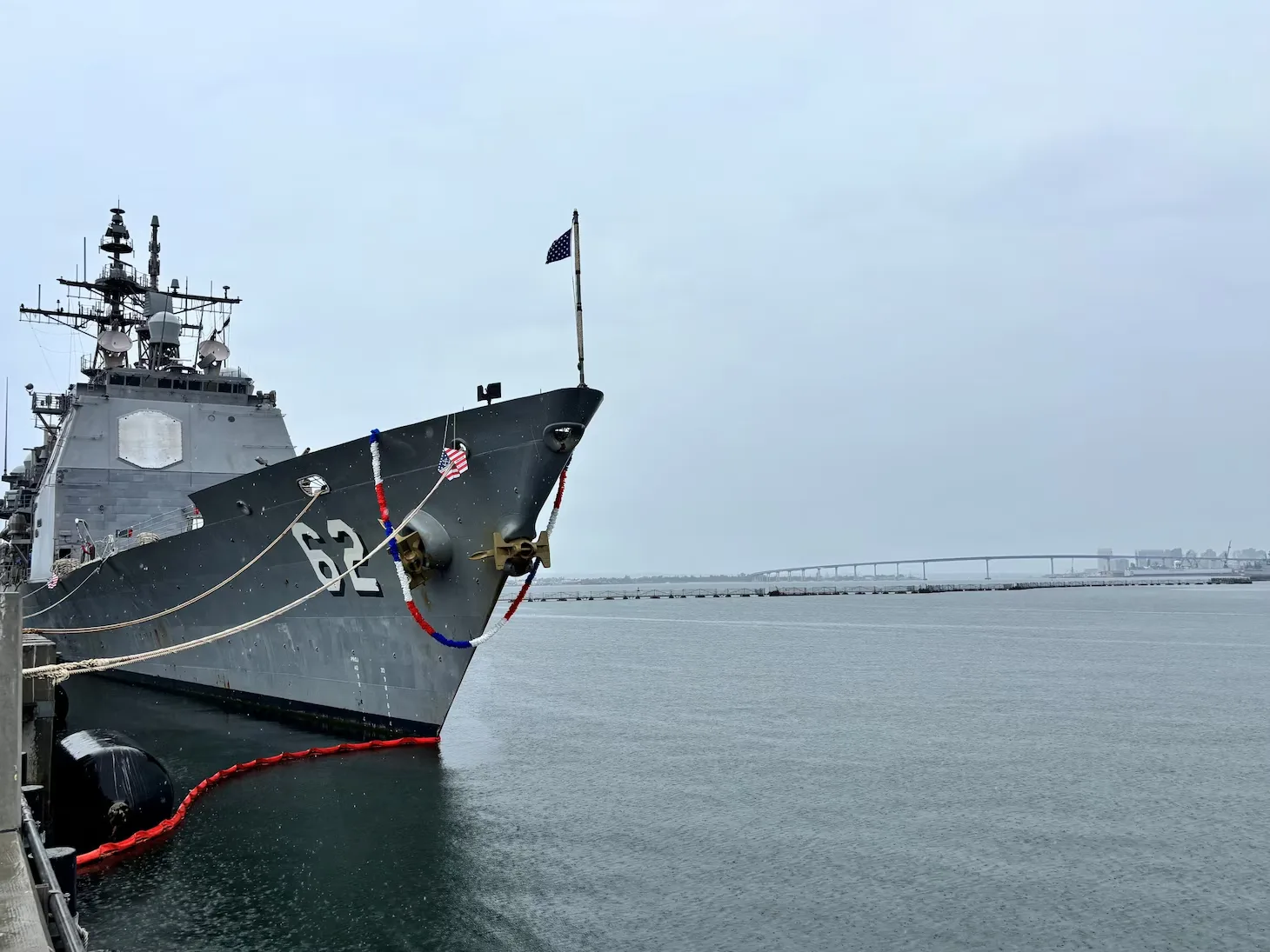
The U.S. Navy guided-missile cruiser USS Robert Smalls (CG 62) arrived at its new homeport of Naval Base San Diego on October 9, 2026, completing a seven-month deployment with U.S. 7th Fleet that doubled as a permanent homeport shift from Yokosuka, Japan. The Ticonderoga-class cruiser left Yokosuka on March 9, 2026, and supported two carrier strike groups and an amphibious ready group across the Western Pacific before returning to Yokosuka for its final departure from Japan.
The arrival ends the Navy’s last overseas cruiser homeporting. Robert Smalls, commissioned in November 1989 as USS Chancellorsville and renamed in 2023, had been based in Yokosuka since June 2015, following an earlier Forward-Deployed Naval Forces (FDNF) tour from 1998 to 2006. The Navy described the move as a scheduled rotation under federal law limiting FDNF ships to 10 years forward deployed. The Arleigh Burke-class destroyer USS Mustin (DDG 89) arrived in Japan in March 2026 to take its place. The timing tracks the wind-down of the class: the Navy decommissioned USS Lake Erie (CG 70) on September 25 and USS Shiloh (CG 67) on September 30, leaving five Ticonderoga-class cruisers in commission.
USS Robert Smalls Deployment: Two Carriers and 40,000 Nautical Miles
Operating with an air detachment from Helicopter Maritime Strike Squadron (HSM) 51, Robert Smalls supported the Abraham Lincoln Carrier Strike Group, the George Washington Carrier Strike Group, and the Tripoli Amphibious Ready Group with the embarked 31st Marine Expeditionary Unit. According to the Navy, the cruiser steamed more than 40,000 nautical miles across the 3rd and 7th Fleet areas of operations and transited five strategic waterways, which the service did not identify.
The ship’s core role was air and missile defense. For both the George Washington and Abraham Lincoln strike groups, Robert Smalls served as Alternate Composite Warfare Commander, Air and Missile Defense Commander and Aircraft Control Unit. Over the summer, Robert Smalls sailed as cruiser escort for the Yokosuka-based carrier USS George Washington (CVN 73), whose strike group also included Carrier Air Wing 5 and the destroyers USS Benfold (DDG 65) and USS Shoup (DDG 86), and operated in the Philippine Sea during Valiant Shield 2026 in June. Commanding officer Capt. Francisco X. Garza cited the ship’s service as sole escort for a carrier through sea trials, workups and certification, as well as “complex air defense operations in the South China Sea.”
The cruiser also completed 14 underway replenishments, two with an Australian oiler and one with a U.S. commercial tanker, evidence of how allied and contracted logistics now sustain forward operations. Robert Smalls integrated three Australian warships and one Japanese warship into the strike group’s battle rhythm, and made what the Navy called a historic return to Da Nang, Vietnam, a visit tied to the two countries’ Comprehensive Strategic Partnership. The Navy has not named the allied ships or released dates for the carrier certification events.
Aegis Baseline 9 and 122 Missile Cells: The Cruiser’s Combat Suite
As USS Chancellorsville, CG 62 was the first cruiser to receive the Aegis Baseline 9 upgrade under the Navy’s cruiser modernization program, completed in San Diego in 2013. Baseline 9 fuses air defense and ballistic missile defense processing through the Multi-Mission Signal Processor and enables Naval Integrated Fire Control-Counter Air (NIFC-CA), which lets the ship engage targets beyond its own radar horizon using tracks from other sensors. The package added an improved Cooperative Engagement Capability, the AN/SPQ-9B radar, AN/SQQ-89A(V)15 antisubmarine warfare upgrades, and two Mk 45 5-inch/62 caliber gun mounts with the Mk 160 fire control system.
Publicly available specifications indicate the Ticonderoga hull displaces roughly 9,600 tons at full load on a length of 567 feet, with four General Electric LM2500 gas turbines producing about 80,000 shaft horsepower for speeds above 30 knots. Its AN/SPY-1B phased array radar cues two Mk 41 Vertical Launching System modules totaling 122 cells, which can carry Standard Missile variants, the Evolved SeaSparrow Missile, Tomahawk land-attack missiles and vertical-launch antisubmarine rockets. Embarked MH-60R Sea Hawk helicopters extend antisubmarine and surface surveillance. The cruiser’s larger combat information center and staff spaces explain why strike groups have traditionally assigned the air defense commander role to a cruiser.
USS Mustin and the Shrinking Ticonderoga Cruiser Force
The replacement trades launcher depth for a younger hull. Mustin, a Flight IIA Arleigh Burke-class destroyer, carries 96 Mk 41 cells, 26 fewer than the cruiser it relieves. Fleet-wide, retiring Lake Erie and Shiloh removed 244 cells; the five remaining cruisers, Robert Smalls, USS Princeton (CG 59), USS Gettysburg (CG 64), USS Chosin (CG 65) and USS Cape St. George (CG 71), account for 610 more.
Robert Smalls has been near retirement for years, but the cruiser did not appear on the Navy’s fiscal year 2026 inactivation list, which covered Lake Erie and Shiloh. The Pentagon’s fiscal year 2027 force structure changes report now plans its decommissioning during the current fiscal year, which ends September 30, 2027. The modernization effort behind its Baseline 9 suite has also drawn scrutiny: a December 2024 Government Accountability Office report found the Navy spent about $3.7 billion on cruiser modernization beginning in 2015 without achieving its objectives. The Navy intends to replace the class with its next-generation guided-missile destroyer, DDG(X).
Analysis: The Navy kept its last forward cruiser in frontline air defense work until the final months of its Japan tour, including in the South China Sea. That underscores the gap the class leaves. The forward-deployed George Washington strike group now relies entirely on destroyers for area air defense against the People’s Liberation Army’s growing inventory of anti-ship ballistic and cruise missiles, with fewer cells per escort and without the extra command spaces cruisers brought to the air defense commander role. Allied integration, visible in the Australian and Japanese ships folded into the strike group, partly offsets that loss, but it does not replace magazine depth in a sustained engagement.
Robert Smalls now joins Naval Surface Force, U.S. Pacific Fleet, in San Diego. The Navy has not announced a decommissioning date or whether the hull will be retained as a logistics support asset, as Lake Erie and Shiloh were. The next markers are the fiscal year 2027 inactivation message, Mustin’s first patrol as George Washington’s air defense escort, and the DDG(X) schedule.