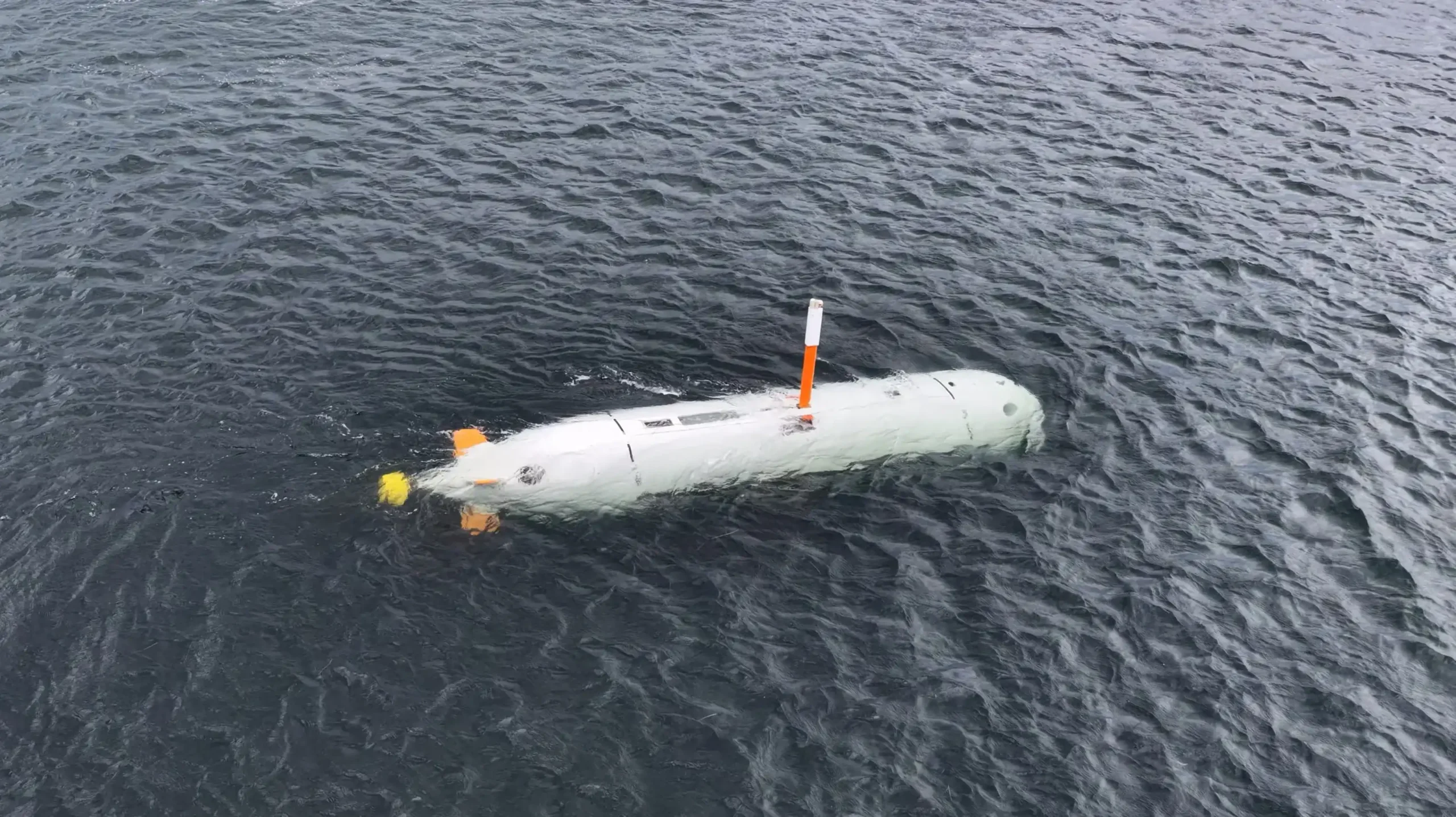
Saab, the Swedish Defence Materiel Administration (FMV) and the Swedish Armed Forces have designed, built and launched a Large Uncrewed Underwater Vehicle (LUUV) demonstrator less than a year after contract award, the company announced on October 16, 2026. Sea trials are complete, closing the program’s first phase.
FMV awarded Saab the SEK 60 million (about $6.3 million at the time) development contract, announced on August 29, 2025, with Saab as prime contractor for design, construction and testing. The vehicle arrives as Sweden, a NATO member since March 7, 2024, confronts a Baltic Sea where seabed cables and pipelines have become a standing security concern, prompting NATO to launch its Baltic Sentry mission in January 2025. The program’s results will inform Swedish decisions on acquiring autonomous underwater systems and operating them alongside crewed platforms, including submarines.
Saab LUUV Demonstrator: Size, Endurance and Sonar Payload
Saab markets the vehicle under the proprietary name Autonomous Ocean Drone (AOD). Company figures released in March 2026 for the baseline intelligence, surveillance and reconnaissance (ISR) configuration give a length of 7 meters, a diameter of 1.4 meters and a weight of 6.5 metric tons. Lithium-ion batteries power the vehicle, and Saab quotes a range of more than 600 nautical miles at a patrol speed of about 4 knots, which equates to more than six days of continuous submerged transit. Saab has not confirmed whether the FMV demonstrator matches those baseline figures.
The ISR mission fit combines a multi-aperture sidescan sonar, an intercept sonar, a forward-looking sonar, a flank array sonar and a multibeam echo sounder, with navigation provided by a Doppler Velocity Log paired with an inertial measurement unit. Saab has not disclosed its sensor suppliers. The mix serves two distinct jobs: mapping and inspecting the seabed with the sidescan and multibeam sensors, and passive acoustic detection through the intercept and flank arrays. Both are core tasks of undersea infrastructure protection in shallow Baltic waters.
The hull also carries an internal payload bay, with reserved volume and margin in the weight compensation system to offset payloads released on the seabed. Saab has said the vehicle will not carry weapons in its first phase, and company officials have described future effectors as a possibility rather than a program commitment.
Autonomous Ocean Core Moves Below the Surface for the First Time
Saab credits the pace of the program to its software-centric approach and to Autonomous Ocean Core, the vessel-agnostic autonomy system it unveiled at Euronaval in Paris in November 2024. The open-architecture system integrates three subsystems: a vessel control system, a fleet management layer that presents autonomous assets to command as networked services, and a remote control center that can operate ashore, at sea or in the air. Saab already runs the software on Combat Boat 90 (CB90) craft and other surface test platforms; the AOD is its first underwater application.
The shift matters. A submerged vehicle loses satellite navigation and high-bandwidth radio, so it must rely on inertial and Doppler navigation and act with little or no operator input for long periods. Saab says operators can add mission capabilities over time without losing built-in safety functions, matching its stated plan to field progressively more capable software on the same hull.
Saab pairs that software with submarine design experience from its Kockums yard in Karlskrona and with its smaller AUV62 family, including the AUV62-MR mine countermeasures vehicles FMV ordered in December 2024. Since April 1, 2026, Kockums has sat within Saab’s new Naval business area, led by Mats Wicksell. “This project demonstrates how new technologies can be rapidly translated into practical operational value,” Wicksell said.
What the LUUV Means for Sweden’s A26 Submarine Force
FMV has framed the demonstrator as serving two tracks. The first tests whether industry and government can move from an identified operational need to hardware in the water at speed. The second, according to FMV’s Director Naval Systems, Rear Admiral Fredrik Lindén, is to begin exploring what a future organic LUUV for the A26 Blekinge-class submarines could look like. The A26 design includes a Multi-Mission Portal sized for larger uncrewed vehicles.
Key integration questions remain open. Neither FMV nor Saab has said whether the 1.4-meter-diameter baseline hull can pass through that portal, how launch and recovery would work at depth, or which communications links the vehicle and its host would share. With HMS Blekinge and HMS Skåne due for delivery in 2031 and 2033 under a fixed cost ceiling of SEK 25 billion for the two boats, the LUUV effort gives the Swedish Navy several years to mature tactics and procedures before the host boats arrive.
Sweden is not alone in this class. Germany has taken delivery of the BlueWhale large autonomous underwater vehicle from thyssenkrupp Marine Systems (TKMS) and Israel Aerospace Industries, and Australia has trialed C2 Robotics’ Speartooth LUUV.
Analysis: The program’s weight lies less in the vehicle than in the procurement model. A SEK 60 million demonstrator that went from contract award to launch in under a year contrasts sharply with the A26 program, ordered in 2015 and now running into the 2030s. For a navy that must monitor dense seabed infrastructure across the Baltic, a persistent sonar carrier with six days or more of endurance offers a way to add coverage without adding crews. The harder test comes next: turning a sensor testbed into a fielded system with secure communications, submarine launch and recovery, and a decision on arming the payload bay.
The next phase will concentrate on more advanced software, sensors and autonomous functions, but FMV and Saab have not published its budget, duration or test objectives. Saab has said it hopes to begin exercise-based operations with the navy within the next couple of years, and no date has been set for an AOD product line. The results will shape whether Sweden moves from demonstrator to acquisition.