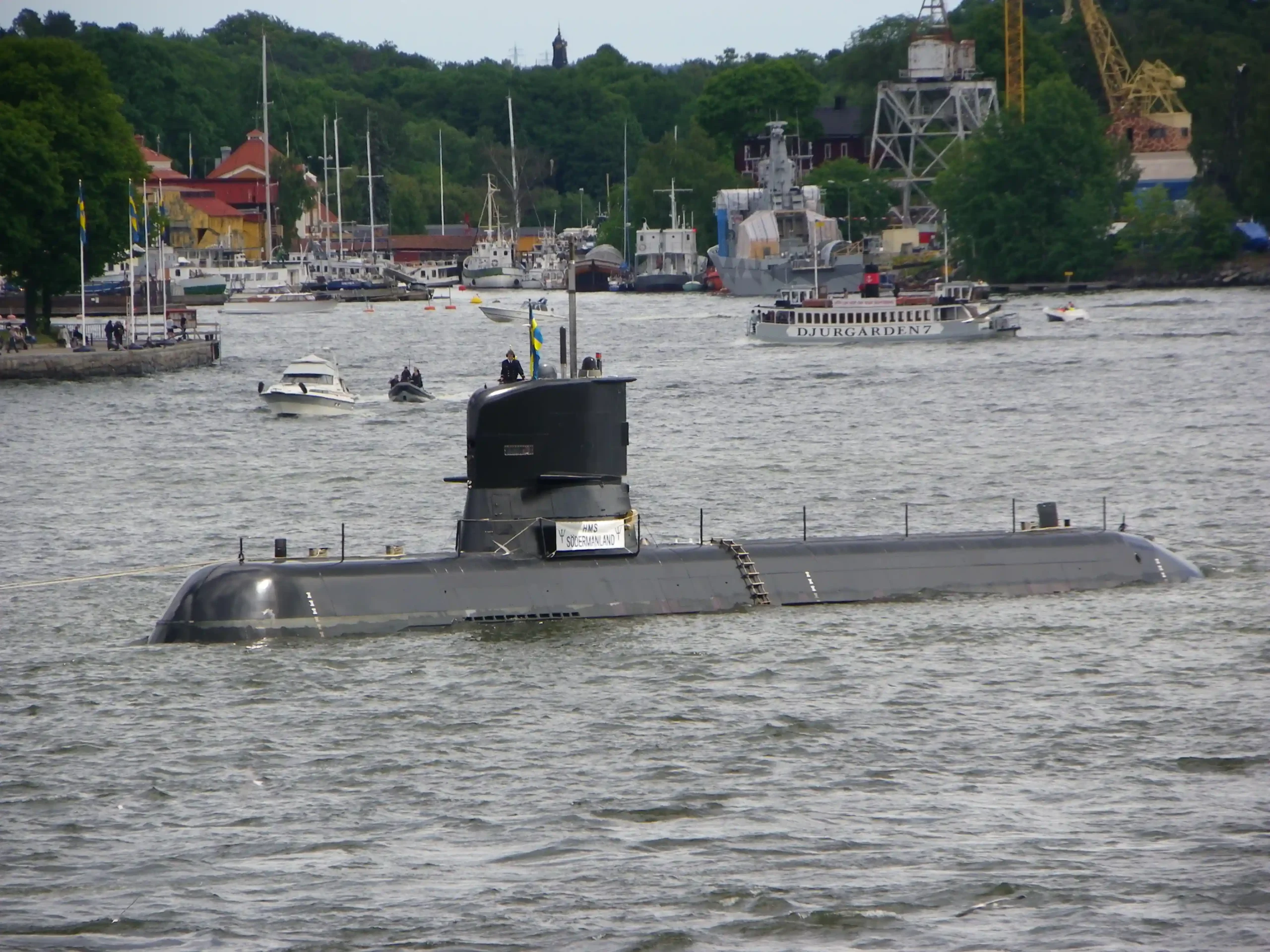
Sweden’s Defence Materiel Administration (FMV) and the Swedish Armed Forces have signed an implementation agreement committing the Royal Swedish Navy to train Polish crews and sustain HMS Södermanland, the air-independent propulsion (AIP) submarine Sweden will lease to Poland until 2032. The Swedish Navy announced the agreement on October 12, 2026, formalizing the interim pillar of Poland’s Orka program.
The deal implements the package both governments signed in Gdynia on June 29, 2026. That day, Poland’s Armaments Agency awarded Saab a contract worth about SEK 47 billion ($4.8 billion) for three A26 submarines with weapons, training and support, while FMV and the Armaments Agency concluded a separate lease running from October 2026 to October 2032. The urgency is structural: Poland’s entire underwater force is ORP Orzeł, a Project 877E Kilo-class boat commissioned in 1986.
How the Poland Submarine Lease Works From Training to 2032
The lease is an intergovernmental transaction in which FMV represents the Swedish state. The new agreement sets out what the Swedish Armed Forces deliver in return: crew instruction, preparation of the boat ahead of transfer, and maintenance and sustainment for the duration of the lease. Polish media value the package, which bundles the submarine, weapons, technical support and training, at about SEK 1.9 billion; Swedish official statements cite no figure.
Training is already underway. About 30 Polish submariners began an 18-month course in Karlskrona in August 2026, matching the length of Swedish crew training. Instruction starts at the Naval Warfare School and continues with the 1st Submarine Flotilla, focused on Södermanland itself. Technicians train first, and the program covers submarine safety, rescue and weapons handling. Sweden has run similar programs for Australian, Singaporean and Danish crews.
Poland’s Armaments Agency has said the boat will pass to Polish service in 2027 after training, while FMV points to Polish operational capability from 2028. No transfer date has been announced, and the scope and cost of the work FMV and Saab are completing on the boat remain undisclosed.
The lease anchors a broader framework. Sweden will support Poland’s New Type Submarine program from about 2027 to 2038, with an extension option, including Polish participation in trials of the first Swedish A26 boats, HMS Blekinge and HMS Skåne. Saab and Polska Grupa Zbrojeniowa (PGZ) have also signed an agreement setting out their intention to develop in-country submarine maintenance, repair and overhaul capability.
From Södermanland to A26: Stirling AIP Lineage and Key Differences
Södermanland is not a new hull. Kockums launched it in 1988 as the third of four Västergötland-class (A17) submarines, and it entered service in 1989. Between 2000 and 2004, it and sister boat Östergötland were lengthened by 12 meters to take an AIP section, a conversion extensive enough to justify reclassification as the Södermanland class. It is now the last active boat of its type.
Publicly available specifications indicate a length of 60.5 meters, a beam of 6.1 meters, and a submerged displacement of about 1,500 tonnes. Propulsion pairs two Hedemora diesel generators with two Kockums V4-275R Stirling engines, stretching submerged endurance from days to weeks. Armament comprises six 533 mm tubes for heavyweight torpedoes and three 400 mm bow tubes for lightweight anti-submarine torpedoes, with mines as an alternative load, managed through the SESUB 960 command and control system. The torpedo types in the Polish package have not been specified.
The training value lies in continuity. Södermanland shares Stirling AIP, Swedish combat system lineage and a Baltic-optimized concept with the A26, which open sources place at about 66 meters and roughly 1,900 tonnes surfaced in its Polish configuration, with up to 18 days of continuous submerged operation. The A26 adds a bow Multi-Mission Portal for divers and uncrewed underwater vehicles alongside four 533 mm tubes that can also fire 400 mm lightweight torpedoes; whether Poland’s boats will receive an optional vertical-launch cruise missile module is unconfirmed. For crews moving off a non-AIP Kilo with Soviet-era systems and procedures, Södermanland turns a generational jump into an intermediate step.
Analysis: The lease buys Poland competence, not combat mass. One 1980s hull cannot sustain a continuous Baltic patrol presence, but it protects a submarine skills base that is slow and costly to rebuild once lost, and that the repair-prone Orzeł can no longer guarantee. Sweden absorbs part of the cost: the lease takes one boat out of its fleet, leaving three Gotland-class submarines until its A26s arrive. Schedule is the larger exposure. The lease ends in 2032, the first Polish A26 is planned for 2031, and Sweden’s own A26 deliveries have slipped from 2022 to 2024 under the 2015 order to 2031 and 2033 after repeated rebaselines. Another slip at Karlskrona would leave Warsaw relying on a hull launched in 1988.
The 18-month course points to completion around February 2028, later than the 2027 handover cited in Warsaw, and no transfer sequence has been published. The next markers are the formal handover, the first Polish-flagged patrol, and whether Saab can hold 2031 for Poland’s first A26 while completing Sweden’s two boats in the same yard.