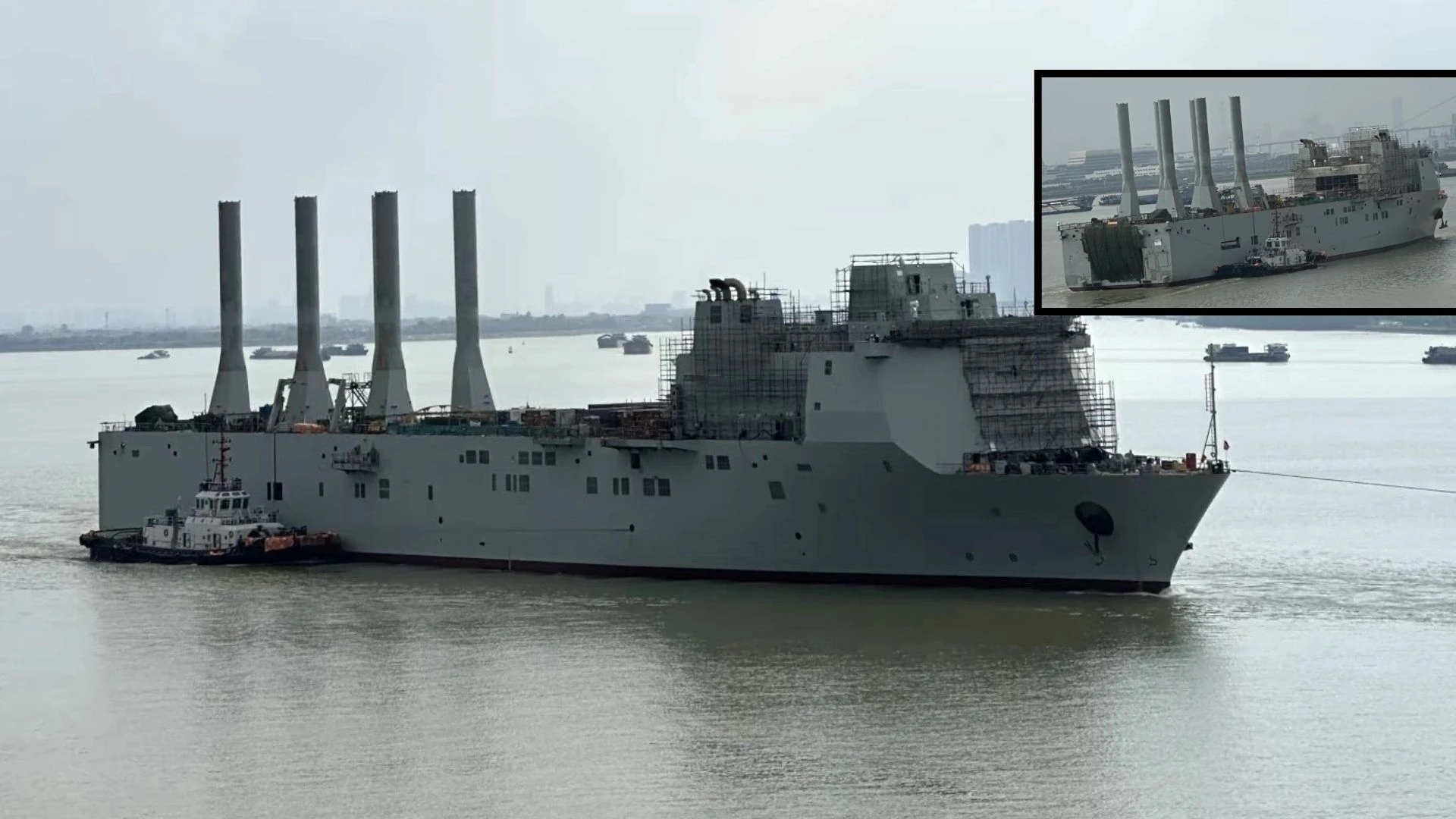
A second suspected Chinese uncrewed underwater vehicle (UUV) mothership has surfaced in Guangzhou, where video clips circulating on Chinese social media as of October 18, 2026, show an unfinished hull under tow on the Pearl River. The gray-painted ship, presumed to be destined for the People’s Liberation Army Navy (PLAN), carries six tall masts at the stern that open-source analysts believe could lift a cradle used to launch and recover very large underwater drones.
The vessel follows a larger design under construction at Hudong-Zhonghua Shipbuilding on Changxing Island, Shanghai, since at least April 2026. Satellite imagery analyzed by The War Zone puts that ship at roughly 204 meters long and 30 meters wide, with twelve jack-up struts over a stern well and a cradle of about 50 meters observed at the yard. Observers assess both ships as possible tenders for China’s extra-extra-large UUVs (XXLUUVs), two prototypes of which, estimated at between 35 and 45 meters long, are being tested on Hainan. The Chinese military rarely discloses details of such programs.
What the Guangzhou Footage Shows About the Second UUV Mothership
The imagery comes from two brief video reels first shared on Weibo before spreading to other platforms, including X. Their authenticity has not been confirmed. Naval News reported that checks with multiple AI-detection tools suggest the material is genuine, although superficial enhancements cannot be ruled out. Tugboats are seen moving the ship near Guangzhou’s Panyu district, with automaker GAC’s research and development headquarters in the background. The hull remains wrapped in scaffolding and carries no sensor or communications equipment.
Naval News initially estimates the new ship at around 150 meters, shorter and narrower than the Shanghai unit. Its stern arrangement also differs: six extended masts of similar height, set two abreast, instead of twelve struts at staggered heights. Both designs share a raised forward deckhouse with the bridge at its front, a large aft opening into a hangar-like volume, and a stern aperture resembling a well-deck gate. Side-by-side diesel exhausts sit at the rear of the deckhouse on both ships, and visible differences in the uptakes likely reflect different installed power. The Guangzhou hull is also more conventional, with inward-canted sides limited to the deckhouse, whereas the Shanghai vessel’s upper hull angles inward along its full length.
The builder remains unconfirmed. Naval News identifies the COMEC yard on Longxue Island, formerly Guangzhou Shipyard International, as one plausible candidate, while at least two Huangpu yards upriver could handle fitting-out. COMEC has built a range of PLAN auxiliaries in recent years, including a second batch of Type 903A replenishment ships, a new replenishment ship design larger than the Type 901 and amphibious bridging barges.
What a Dedicated XXLUUV Launch and Recovery Platform Would Change
China’s XXLUUV prototypes are currently housed in floating docks, at least one of them purpose-built, from which the vehicles are launched and recovered at sea. The arrangement suits trials but imposes hard limits: each dock carries a single vehicle, and because the whole dock floods, one craft cannot undergo maintenance while another is launched or recovered. A self-propelled tender with an internal hangar and a cradle lowered beneath the hull would remove that bottleneck and keep vehicles out of the water between sorties.
Analysts have estimated that the Shanghai ship’s hangar could hold two to four XXLUUVs. No estimate is yet available for the Guangzhou hull. Salvage, deep-sea research and servicing undersea sensor networks have been cited as possible secondary roles.
Analysis: A second hull of a different size, emerging at a separate shipbuilding hub, suggests the PLAN may be investing in a support architecture for large uncrewed submarines rather than a single test asset. Whether the two designs compete, as the two XXLUUV prototypes appear to, or form complementary tiers remains unclear. If the role is confirmed, at-sea launch and recovery would let these vehicles begin missions far from Chinese ports, complicating allied efforts to track them across the First Island Chain and beyond. For scale, China’s XXLUUVs are estimated at six to eight times the overall size of the US Navy’s Boeing Orca extra-large UUV.
Indicators to watch include where the Guangzhou hull completes fitting-out, the installation of sensor masts, overhead imagery of any stern cradle, and the appearance of a hull number or type designation. An open-source observer on X has reported that the Shanghai ship has since been launched; this has not been independently confirmed. Firm conclusions on either vessel’s role will depend on clearer imagery and on whether more hulls follow.