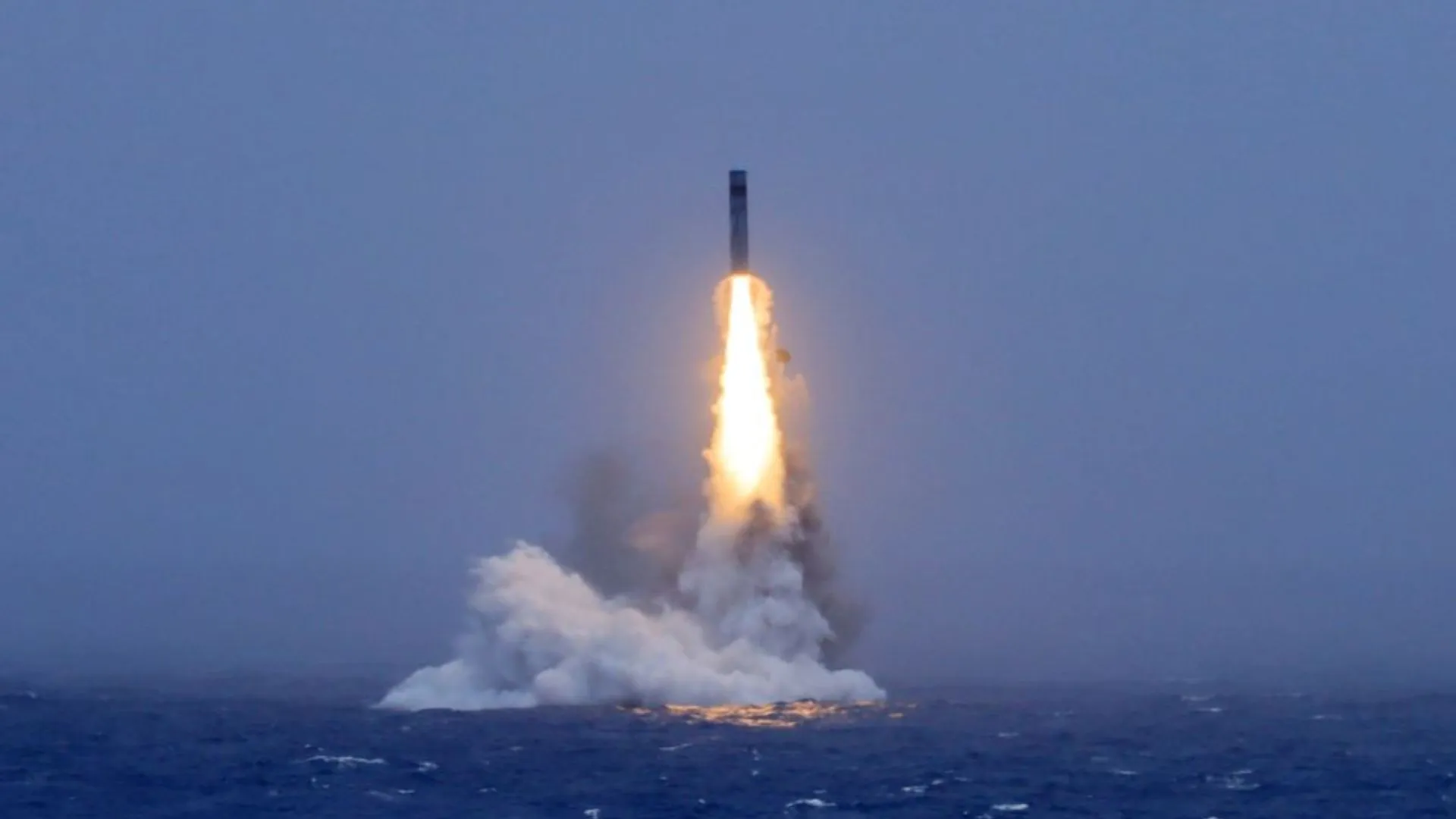
China has tied the July 6, 2026 test launch of a submarine-launched ballistic missile (SLBM) into the South Pacific to a third generation of its Changzheng nuclear submarine series, the first time Beijing has associated the shot with its newest boats. In a WeChat post on October 17, 2026, the official Xinhua News Agency said the series had “reached the third generation” and had successfully launched a submarine-launched strategic missile.
The post marked the 90th anniversary of the Long March, the episode that gives the Changzheng (“Long March”) submarines their name. It revisits a launch that drew objections from Japan, Australia, and New Zealand.
Before July, China’s only publicly known intercontinental ballistic missile (ICBM) shots into the Pacific were land-based: a DF-5 test in May 1980 and a September 25, 2024 launch assessed as a DF-31-family missile. The People’s Liberation Army Navy (PLAN) has still not named the submarine class, hull, or missile used in July.
What the July 6 China SLBM Test Demonstrated
According to the PLAN, a strategic nuclear submarine fired the missile at 12:01 p.m. Beijing time carrying a training dummy warhead. Open-source analysis places the launch point in the South China Sea and the impact area in the South Pacific, roughly 7,000 to 7,300 kilometers downrange and inside the nuclear-free zone established by the Treaty of Rarotonga.
New Zealand said it received notice only hours in advance, and Australia called the test destabilizing. China’s Foreign Ministry urged other governments the next day not to overinterpret it.
The flight profile matters as much as the platform. Chinese SLBM testing has typically relied on lofted trajectories that keep the reentry vehicle in or near Chinese-controlled waters. A near-full-range shot into the open Pacific exercises the complete chain under representative conditions: underwater ejection, boost, midcourse flight, reentry, and terminal accuracy, plus long-range telemetry and command and control.
Beijing has not identified the missile, which analysts assess as either the JL-2 or the newer JL-3. U.S. Defense Department figures credit the JL-2 with about 7,200 kilometers of range, placing the July flight at or near its limit.
The solid-fueled JL-3, first flight-tested in November 2018 and paraded in Beijing on September 3, 2025, is credited with more than 10,000 kilometers. The July flight therefore did not demonstrate the JL-3’s full reach.
Type 094 vs Type 096: Identifying the July Launch Platform
In the standard Western taxonomy, the Type 091 attack boat and Type 092 nuclear-powered ballistic missile submarine (SSBN) form China’s first generation, the Type 093 Shang class and Type 094 Jin class the second, and the Type 095 and Type 096 the third. Before the Xinhua post, analysts had generally assumed the July shot came from a Type 094, the backbone of China’s sea-based deterrent since the mid-2010s.
The Jin class remains the PLAN’s only acknowledged SSBN type. The Pentagon counts six boats, each with up to 12 launch tubes, and reports they conduct near-continuous deterrence patrols from Hainan Island; U.S. officials have said the class has been refitted with the JL-3. Publicly available specifications put the Type 094 at roughly 135 meters long and about 11,000 tonnes submerged.
Taken at face value, Xinhua’s wording points to a third-generation hull. The only third-generation SSBN design associated with the PLAN is the Type 096, which Beijing has never formally acknowledged; photos purporting to show it remain unverified.
The Pentagon assessed in 2021 that Type 096 construction would likely begin in the early 2020s and that China would operate the Jin and Type 096 fleets concurrently. The Type 095 is assessed as an attack and cruise-missile boat, not a strategic missile carrier. The wording also permits a narrower reading, with the generational claim describing the program rather than the launch boat.
Bohai and Jiangnan Imagery Points to Faster Submarine Construction
The disclosure lands as commercial satellite imagery points to accelerating construction. In February 2026, imagery of the Bohai Shipyard in Huludao, Liaoning province, showed the first Type 095, with analysts pointing to X-shaped stern rudders; later imagery confirmed a pumpjet propulsor. Both features target the acoustic signature that has long been the principal weakness of Chinese nuclear boats. The Type 095 was not known to have entered service.
In May 2026, imagery showed a roughly 120-meter submarine, comparable in size to a nuclear-powered boat and with no conventional sail visible, at Jiangnan Shipyard in Shanghai, a yard previously associated with destroyers and aircraft carriers. If confirmed as nuclear-powered, construction at Jiangnan alongside Huludao would point to parallel production lines rather than a single specialized yard.
Quieter hulls matter more than additional missile range. The Pentagon already assesses that the JL-3 can reach portions of the continental United States from Chinese littoral waters. Pairing it with a harder-to-detect boat in the South China Sea bastion would raise the bar for the anti-submarine warfare (ASW) effort built around U.S. and Australian P-8A Poseidon fleets, Japan’s P-1 force, and allied attack submarines.
Analysis: Whether the July shooter was a Type 096 or a modernized Jin, Beijing’s decision to claim a third-generation milestone is a deliberate deterrence signal. A full-range launch from a new-construction SSBN would resemble the Demonstration and Shakedown Operation (DASO) launches the U.S. Navy conducts before certifying a boat for strategic patrol, implying the Type 096 is closer to operational status than open-source tracking suggested.
If confirmed, China’s sea-based leg is moving from a noisy, range-limited force toward a survivable second-strike capability, which tightens the timeline for allied investment in undersea surveillance across the first island chain.
Indicators to watch include official imagery or a commissioning ceremony for a new SSBN, the Pentagon’s next annual report on Chinese military power, and whether the PLAN repeats full-range Pacific shots on an annual cadence. Beijing has still not disclosed the missile type, hull number, or impact coordinates. Regional objections to launch notices given only hours in advance are likely to persist.