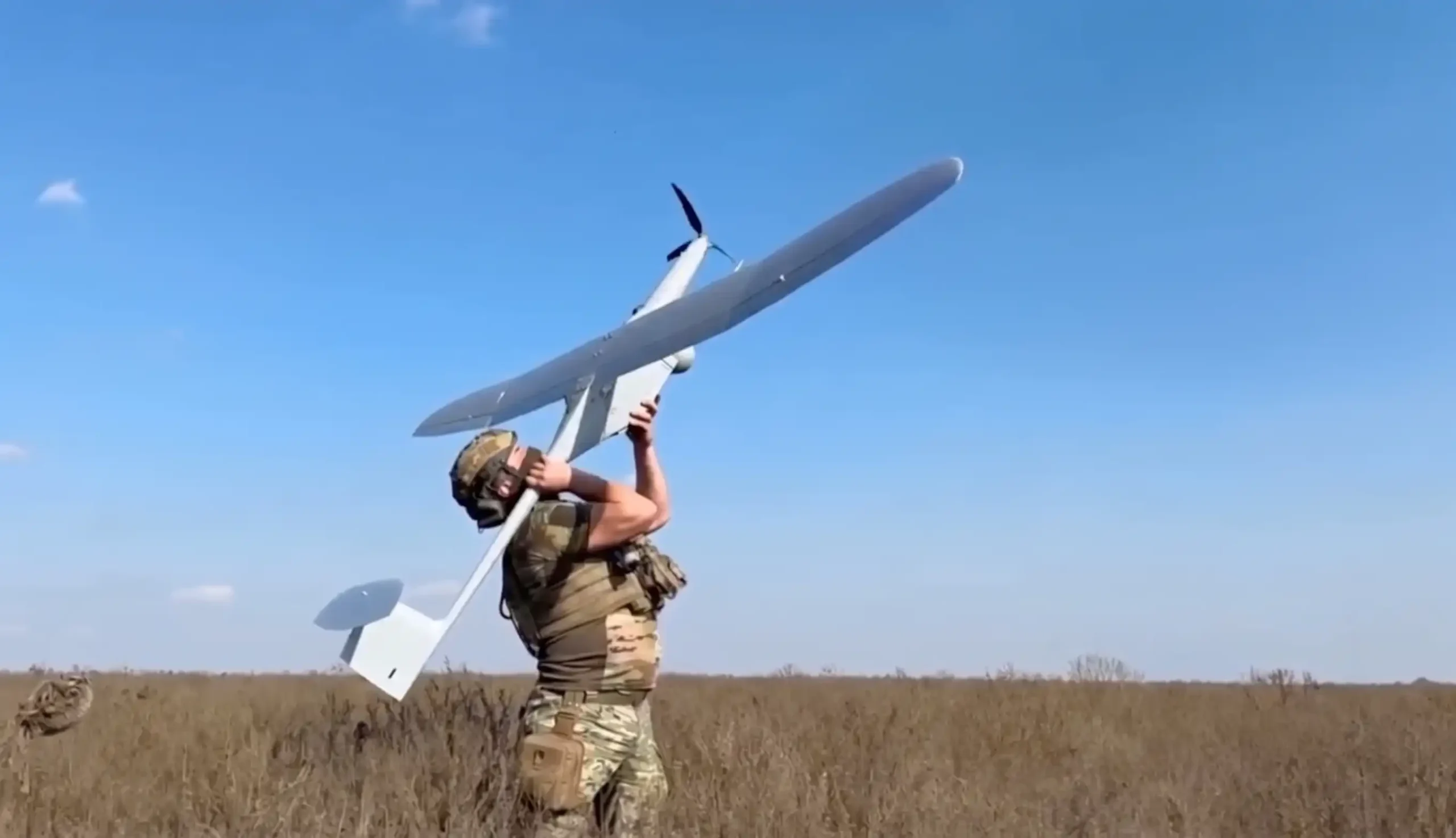
Paratroopers of Ukraine’s 25th Sicheslav Airborne Brigade are using Polish-made FlyEye reconnaissance drones, alongside FPV drones, to hold back Russian forces pushing toward the Donbas town of Dobropillia, according to video reports published on October 15 and 17. The hand-launched electric motor glider has served Ukrainian units since 2015 and is now built inside the country by its manufacturer, WB Group. Crews use it for day and night surveillance, tracking Russian movements, and adjusting artillery fire.
The FlyEye is one of the few Western drone designs formally adopted by Ukraine’s Armed Forces, with first deliveries in 2015, a year after Russia seized Crimea and fighting broke out in the east. A decade later, WB Group describes it as one of the most heavily used systems on the front line, with one of the highest mission survivability rates, a notable claim in a theater where dense Russian electronic warfare (EW) has shortened the combat life of many small drones. Units have also received FlyEyes through public fundraising, including the government-run Army of Drones campaign in 2022.
FlyEye Drone Design: A Silent Electric Glider for Artillery Spotting
Developed in 2010 by Flytronic, a Gliwice-based subsidiary of WB Electronics within WB Group, the FlyEye is a mini-class unmanned aerial vehicle (UAV) built around an electric motor glider airframe with a nose-mounted folding propeller and lithium-polymer batteries. Publicly available specifications indicate a 3.6-meter wingspan, a 1.8-meter length, and speeds of 60 to 120 kilometers per hour, while WB Group’s current datasheet lists a 12-kilogram takeoff weight, four hours of flight time, and a maximum ceiling above 3,500 meters.
The airframe is the tactical point. Operators can shut down the motor and glide over a target area, reducing the acoustic signature that alerts troops on the ground. The full system packs into two backpacks carried by two soldiers and launches by hand without a catapult, letting a team go airborne in under 10 minutes. On recovery, the aircraft releases its sensor head under a parachute shortly before landing, then sets down close by.
An underslung observation head pairs a daylight camera with a thermal imager for round-the-clock coverage. The drone is reported to operate up to 50 kilometers from its crew. Because the motor runs only during takeoff and altitude changes, the airframe can stay aloft far longer in favorable conditions; WB Electronics has reported test flights exceeding 18 hours. The autopilot handles route following and landing, and the aircraft can continue its mission or return to a preset point after losing its radio link, a critical feature under heavy jamming.
From HIMARS Targeting to Local Production: WB Group in Ukraine
The FlyEye’s value lies in the fires it enables. Recent Polish orders specify integration with WB Group’s TOPAZ combat management system, linking FlyEye to mortars, self-propelled howitzers, and rocket launchers in Polish service. In July 2026, Ukraine’s 26th Separate Artillery Brigade reported using a FlyEye to locate a Russian ammunition depot and artillery position in the Bakhmut sector, then guide a High Mobility Artillery Rocket System (HIMARS) strike that destroyed both.
In early 2025, under a previously signed agreement, WB Group began producing FlyEye platforms at a facility operated by WB Ukraine, a subsidiary established in the late 2010s that had until then handled servicing, repairs, and spare parts for the Ukrainian fleet. The company withheld the news for security reasons, citing intensified Russian strikes on Ukraine’s defense industrial base, and disclosed it on August 31, 2025, after a visit by Piotr Łukasiewicz, head of Poland’s diplomatic mission in Ukraine. Production volumes have not been released.
In Poland, the FlyEye is used across all branches of the armed forces. Warsaw signed a framework agreement in September 2023 covering more than 400 systems, or close to 1,700 aircraft, through 2035. In late May 2026, the Armament Agency signed a further contract for 190 systems worth about 1.3 billion zlotys, funded through the EU’s SAFE program, and reported the first deliveries on September 30, 2026, with completion due by the end of 2030.
Analysis: Building the FlyEye in Ukraine shortens the loop between battlefield feedback and the production line while reducing dependence on cross-border logistics that Russia can target. It fits a wider pattern in which Western drone makers, including Germany’s Quantum Systems, now manufacture inside Ukraine rather than only shipping to it. For NATO, a decade of FlyEye combat data under contested EW conditions now informs the same system Poland is buying in quantity.
Key unknowns remain the monthly output of the Ukrainian line, the share of components sourced locally, and whether newer FlyEye variants or other WB Group systems will follow into Ukrainian production. Given Russia’s strike campaign against defense plants, any expansion will likely stay undisclosed until it is safe to announce.