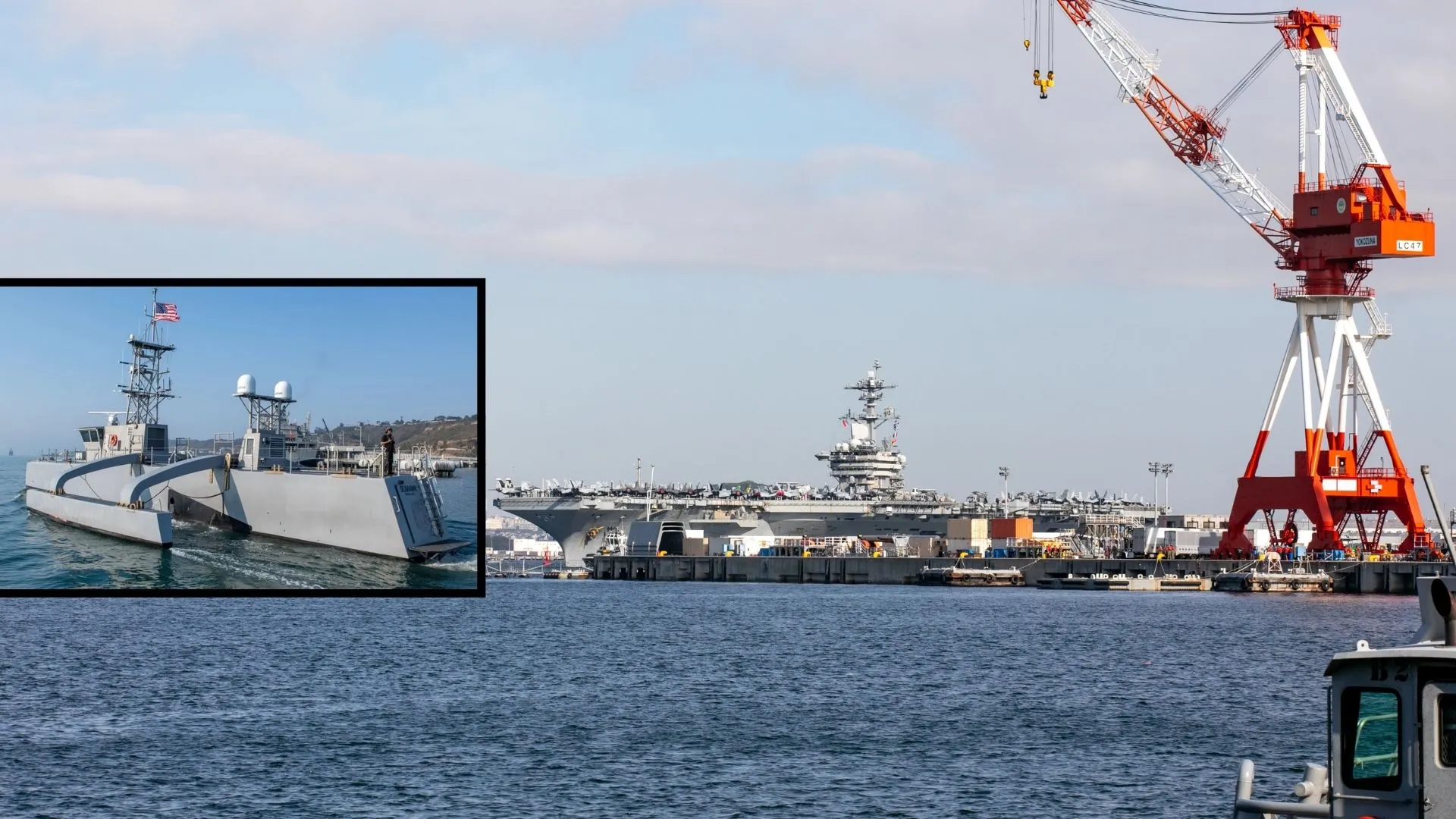
The US Navy has deployed the Seahawk medium unmanned surface vessel (MUSV) with the USS Theodore Roosevelt (CVN-71) Carrier Strike Group, the first US carrier strike group to deploy alongside an ocean-going autonomous ship. Acting Navy Secretary Hung Cao confirmed the move on October 14, 2026, at the Association of the United States Army annual meeting in Washington, saying the strike group “just deployed on October 8th, with a medium-sized unmanned surface vessel.”
Cao did not name the vessel, but its builder, Leidos, has identified Seahawk as operating with Carrier Strike Group 9 (CSG 9). The date he cited matches the drone ship’s own departure: Theodore Roosevelt left San Diego on September 27, while Seahawk sailed from Naval Base Point Loma on October 8, according to ship-tracking reports. The strike group, with Carrier Air Wing 11, the cruiser USS Chosin (CG-65) and three Arleigh Burke-class destroyers, is expected to relieve USS George Washington (CVN-73) in the US Central Command area, where the Navy has kept two carriers on station supporting operations against Iran.
Seahawk Unmanned Surface Vessel: Design, Autonomy, and Endurance Limits
Seahawk is the second hull in the trimaran lineage that began with the Defense Advanced Research Projects Agency (DARPA) Anti-Submarine Warfare Continuous Trail Unmanned Vessel (ACTUV) program and its Sea Hunter prototype. Leidos received a publicly reported $35.5 million contract in December 2017 for the follow-on ship and delivered it in 2021. Publicly available specifications indicate a composite hull roughly 135 feet (41 meters) long, a full-load displacement of about 145 tons and diesel propulsion. Sea Hunter’s published figures, a 27-knot sprint, 12-knot cruise and 10,000-nautical-mile reference range, are often applied to Seahawk, but no verified data has been released for the deployed configuration.
Navigation runs on the Leidos Autonomous Vessel Architecture (LAVA), which handles route planning and collision avoidance under international rules of the road while operators supervise remotely. Leidos says the vessel operates within the strike group’s command-and-control architecture and can switch to alternate communications paths if its primary link fails. As delivered, Seahawk was unarmed and configured for surveillance and anti-submarine sensing; its payload for this deployment has not been disclosed.
Endurance is the binding constraint. Finite fuel and a cruise speed below carrier transit speeds make Seahawk dependent on underway replenishment. In September, the destroyer USS Chafee (DDG-90) rehearsed an astern refueling with the vessel, a procedure that ties up a crewed escort each time.
From Fleet Experiment to Tailored Carrier Strike Group Force Packages
Seahawk joined the Pacific Fleet’s Unmanned Systems Integrated Battle Problem in 2021, deployed to the Western Pacific with three other unmanned vessels in 2023 and trained with Theodore Roosevelt during its Composite Training Unit Exercise (COMPTUEX) in April 2026. In January, Capt. Garrett Miller, commodore of Surface Development Group One, said Seahawk and Sea Hunter would leave experimental status and come under fleet control.
Vice Adm. Brendan McLane, commander of Naval Surface Forces, said in February that the Navy intends to pair unmanned vessels with every subsequent strike group, varying the mission package each time. The approach feeds Chief of Naval Operations Adm. Daryl Caudle’s tailored force concept and the Modular Attack Surface Craft (MASC) effort, which merged the large and medium unmanned surface vessel programs. Seahawk itself predates the production designs now pursued under MASC.
Analysis: Seahawk’s value lies less in what it carries than what it frees up. Persistent surface surveillance and submarine trailing fall to Arleigh Burke-class destroyers whose Aegis radars and Mk 41 vertical launch cells belong in air and missile defense, a demand sharpened by Iranian missile and drone threats. An unmanned picket holding a sensor line on the formation’s flank extends warning time without thinning the air-defense screen. The test is whether refueling, maintenance and bandwidth costs consume more escort time than the coverage returns.
Theodore Roosevelt, Chosin and the destroyer USS Decatur (DDG-73) arrived at Fleet Activities Yokosuka, Japan, on October 16 ahead of the Keen Sword exercise. The Navy has not said whether Seahawk entered port, will join Keen Sword or will continue into Central Command waters. Endurance between replenishments, maintenance burden and payload remain undisclosed; those results will shape the unmanned package assigned to the next strike group.