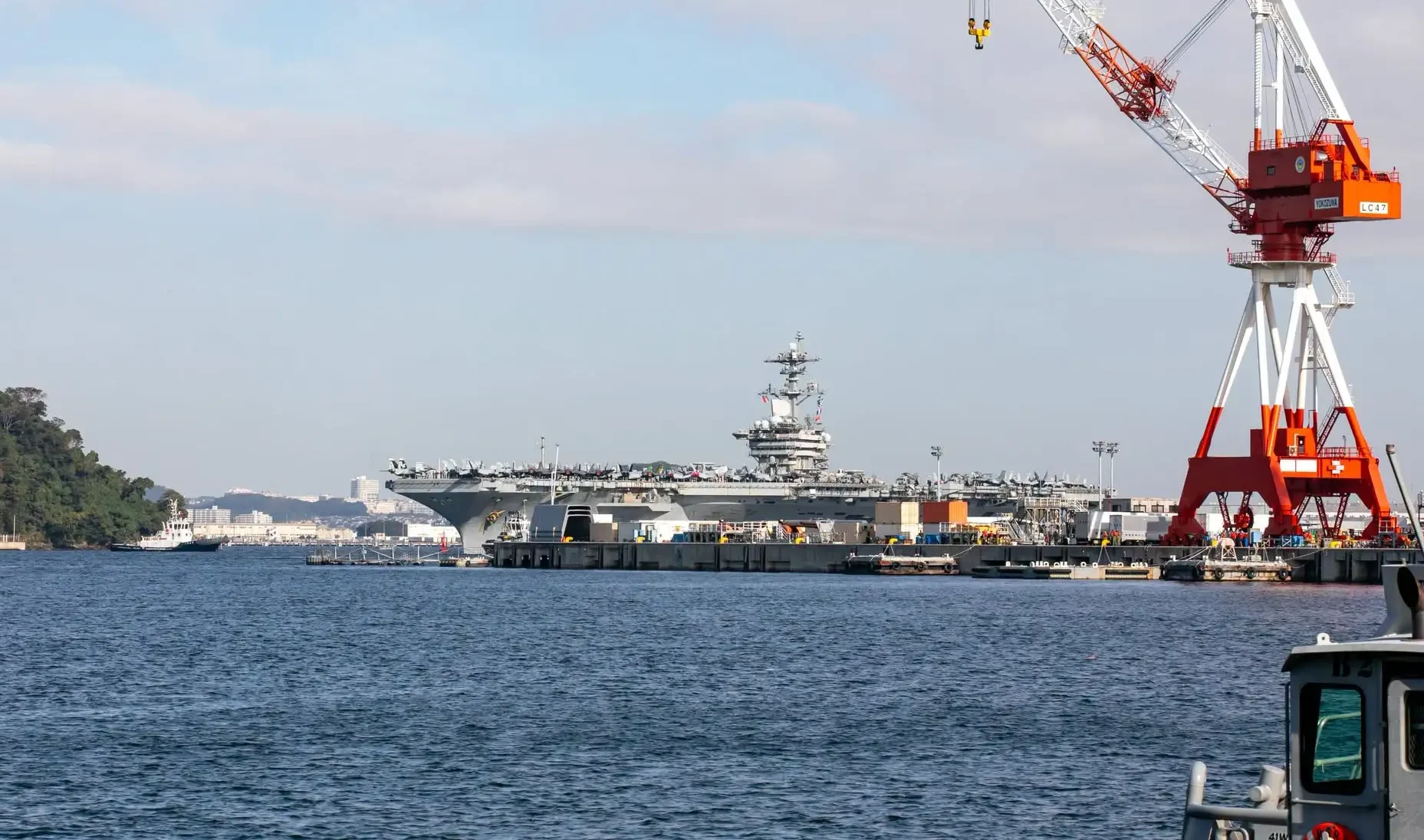
The Nimitz-class aircraft carrier USS Theodore Roosevelt (CVN 71) arrived at Commander, Fleet Activities Yokosuka, Japan, on October 16, 2026, with the Ticonderoga-class guided-missile cruiser USS Chosin (CG 65), three days before the U.S.-Japan field training exercise Keen Sword 27 begins. The flagship of Carrier Strike Group (CSG) 9 will resupply and conduct maintenance in port while its staff aligns tactical procedures with the Japan Maritime Self-Defense Force (JMSDF).
Roosevelt is the first U.S. carrier not homeported in Yokosuka to visit the base since USS Abraham Lincoln (CVN 72) in May 2022. It moored at the berth normally used by USS George Washington (CVN 73), the Navy’s only forward-deployed carrier, which has operated in the Arabian Sea since mid-August 2026 in support of U.S. operations against Iran. Roosevelt left San Diego on September 27, 2026, and is expected to proceed to U.S. Central Command after the exercise to relieve George Washington. Port visits are “vital for crew morale and mission readiness,” said Capt. Will Mathis, the carrier’s commanding officer.
USS Theodore Roosevelt and Carrier Strike Group 9 Order of Battle
Commissioned on October 25, 1986, Theodore Roosevelt is the fourth Nimitz-class carrier and will reach 40 years of commissioned service during the exercise. Publicly available specifications indicate an overall length of 1,092 feet, a full-load displacement of roughly 100,000 tons, and two A4W pressurized water reactors driving four shafts at speeds above 30 knots. A 7th Fleet spokesman put the strike group’s strength at approximately 5,000 sailors and Marines.
Carrier Air Wing (CVW) 11 embarks nine squadrons: F/A-18E/F Super Hornets and F-35C Lightning II strike fighters, EA-18G Growlers of Electronic Attack Squadron (VAQ) 137, E-2D Advanced Hawkeyes of Airborne Command and Control Squadron (VAW) 115, CMV-22B Ospreys of Fleet Logistics Multi-Mission Squadron (VRM) 30, and MH-60R and MH-60S helicopters. The E-2D, F-35C and EA-18G combination gives the wing the airborne sensing, targeting and electronic attack mix that Keen Sword’s air defense and anti-ship serials are built to exercise.
Chosin serves as the strike group’s air defense commander, fielding the Aegis Combat System, the AN/SPY-1 radar and 122 Mk 41 vertical launch cells, according to publicly available specifications. Destroyer Squadron 23 includes the Arleigh Burke-class destroyers USS Paul Hamilton (DDG 60), homeported in San Diego, and USS Decatur (DDG 73), homeported at Pearl Harbor. Decatur entered Yokosuka with the carrier, according to local reporting; the Navy has not said where Paul Hamilton is operating.
CSG 9 also sails with the Medium Unmanned Surface Vessel (MUSV) Seahawk, which Leidos describes as the first MUSV to deploy operationally with a carrier strike group. The Navy has not said whether Seahawk will take part in Keen Sword.
Keen Sword 27 Training Events, Scale, and Yonaguni Firsts
Keen Sword 27 runs from October 19 to October 29, 2026, under Adm. Tateki Tawara, commander of the JSDF Joint Operations Command, and Adm. Stephen Koehler, commander of U.S. Pacific Fleet, who led CSG 9 aboard Roosevelt in 2017. Japan’s Joint Staff lists 15 major training events, including integrated air and missile defense, bilateral joint offensive anti-ship operations, space domain awareness, joint electromagnetic warfare, cyber attack response, and distributed operations.
The Japan Self-Defense Forces (JSDF) commit approximately 45,000 personnel, 6,100 vehicles, 40 vessels and 260 aircraft. The Australian Defence Force participates, along with elements of the Canadian, French, German, Dutch, New Zealand and Philippine armed forces. It is the 18th field iteration of a bilateral series begun in fiscal 1985. Rear Adm. Marcos Jasso, the CSG 9 commander, called the alliance “the cornerstone of peace and security across the region.”
The ground component pushes the exercise toward Taiwan. The 12th Marine Littoral Regiment will deploy the Navy-Marine Expeditionary Ship Interdiction System (NMESIS) and the Marine Air Defense Integrated System (MADIS) to Yonaguni, Japan’s westernmost inhabited island about 110 kilometers from Taiwan, for the first time. NMESIS carries two Naval Strike Missiles on an unmanned Joint Light Tactical Vehicle chassis, with a publicly reported range of about 185 kilometers. The U.S. Army will deploy the High Mobility Artillery Rocket System (HIMARS) to Camp Ishigaki, about 130 kilometers east of Yonaguni.
Analysis: Roosevelt’s port call shows how far the Navy’s forward-deployed posture in Japan has been drawn down by the Iran campaign. As of October 13, 2026, George Washington and its Iwakuni-based Carrier Air Wing 5 were in the Arabian Sea, and six Yokosuka-homeported destroyers were operating in the Arabian Sea or Indian Ocean. A rotational, San Diego-based strike group is therefore covering the U.S. carrier role in the alliance’s largest field exercise while en route to the theater that pulled George Washington away. For Tokyo, a carrier on station during anti-ship and missile defense serials offsets that absence; for Washington, it signals that Central Command demand is being met by sequencing Central Command rotations around Pacific commitments rather than cancelling them.
Keen Sword 27 opens on October 19. The Navy has not disclosed which training events Roosevelt will join, how long CSG 9 will remain in 7th Fleet after October 29, or when George Washington will return to Yokosuka. The carrier’s departure date and any announced transit to Central Command are the next indicators to watch.