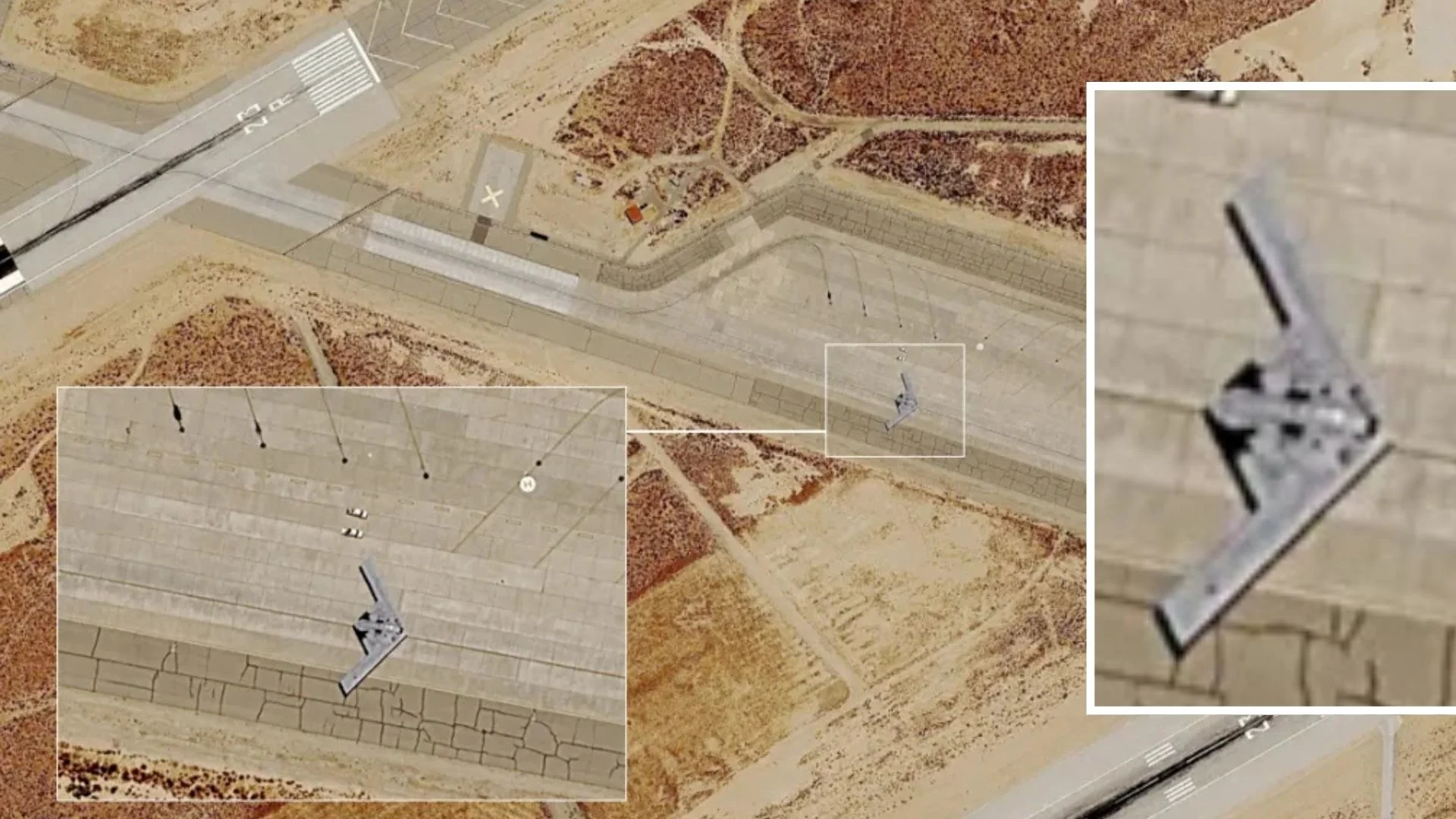
Northrop Grumman’s B-21 Raider stealth bomber has a wingspan of about 152 feet (46.3 meters) and a length of about 61 feet (18.6 meters), according to measurements by The War Zone (TWZ) of satellite imagery of Edwards Air Force Base, California, dated June 20, 2026, and recently published on Google Earth. Accurate to within a few feet, according to the outlet, the figures place the U.S. Air Force’s next-generation bomber roughly 12% below the B-2 Spirit in both span and length.
The Air Force has released no official dimensions since Northrop Grumman unveiled the aircraft at Air Force Plant 42 in Palmdale, California, on December 2, 2022. Unofficial fact sheets, several AI-generated, have circulated on social media with wingspans below 130 feet, while TWZ had held to an estimate of 150 to 155 feet since the unveiling. TWZ found that the new image, which shows a B-21 taxiing between the base’s parallel runways, is in the public domain and, paired with Google Earth’s measurement tools, offers enough resolution for conclusive measurement.
B-21 Raider Wingspan and Length Compared With the B-2 Spirit
Publicly available specifications list the B-2 Spirit at 172 feet (52.4 meters) in span and 69 feet (21 meters) in length. At 152 by 61 feet, the B-21 comes in about 11.6% smaller on each axis, and both aircraft share a length-to-span ratio of roughly 0.40. The Raider’s overall footprint is therefore about 22% smaller than its predecessor’s, a difference that bears directly on hangar sizing, low-observable maintenance facilities and ramp capacity at future main operating bases.
At 61 feet, the Raider is shorter than an F-15 Eagle, which publicly available specifications put at 63 feet 9 inches. As TWZ has noted, flying wings concentrate their size in span, looking compact in profile and imposing from head-on or overhead.
In TWZ’s analysis, the smaller airframe follows from the requirement: the B-21 was designed to prioritize range, affordability and very low observability over maximum payload, and a size reduction of about 12% is consistent with those priorities. It uses two engines, where the B-2 relies on four General Electric F118-GE-100 turbofans rated at roughly 17,300 pounds of thrust each, according to publicly available specifications. Pratt & Whitney was publicly identified as a propulsion supplier in 2016, but the engine type, thrust rating, internal fuel capacity and maximum takeoff weight remain classified. The B-2’s payload is listed at 40,000 pounds; the Air Force has disclosed no equivalent figure for the B-21. Above all, TWZ assesses, the dimensions point to an extreme unrefueled range, drawing on high-altitude cruise aerodynamics, more fuel for the airframe’s size and two efficient engines instead of four. That attribute is decisive over Pacific distances where tankers would themselves be targets.
According to TWZ, the overhead view adds little on signature management. It shows deeply buried exhausts with broad planar exit ramps and a chevron-shaped trailing edge over the exhaust apertures, along with exhaust troughs in a dark finish, a detail edited out of the official top-down photograph the Air Force released in April 2026, as the outlet pointed out at the time.
How Northrop Grumman Is Scaling B-21 Production Toward 2027
The data surfaces as the program shifts from flight test toward fielding. Two production-representative B-21s are flying at Edwards: the first made its maiden flight on November 10, 2023, and the second joined the test fleet on September 11, 2025. Aerial refueling trials with KC-135 Stratotankers are underway, and in June 2026 the Air Force disclosed that an operational test pilot from the Air Force Operational Test and Evaluation Center had flown the bomber alongside a developmental test pilot for the first time. On July 9, 2026, the Air Force confirmed a two-pilot crew, matching the B-2, and opened a transition pipeline for selected weapon systems officers and combat systems officers.
On February 23, 2026, the Department of the Air Force and Northrop Grumman agreed to increase annual B-21 production capacity by 25%, drawing on $4.5 billion already appropriated under fiscal year 2025 reconciliation legislation. Northrop Grumman has committed $2.5 billion of its own capital, and on September 29, 2026, the partners broke ground on a new final assembly line at Plant 42 adding roughly 1 million square feet of production space. The production rate remains classified; previously published estimates point to an eventual rate of about seven aircraft per year. The fiscal 2027 budget request includes $6.1 billion for the program.
Ellsworth Air Force Base, South Dakota, will host the formal training unit and the first operational squadron, followed by Whiteman Air Force Base, Missouri, and Dyess Air Force Base, Texas. Eighth Air Force activated B-21 Integration Detachment 1 at Ellsworth on September 9, 2026, and Air Force Secretary Troy Meink has said one of the Edwards test aircraft will become the first Raider assigned there in 2027.
Analysis: The 152-foot figure confirms the trade the Air Force made a decade ago: a bomber with a footprint about one-fifth smaller than the B-2 and half the engine count, optimized to reach and survive rather than to haul the heaviest possible load. That trade is what makes a 100-aircraft fleet affordable, but it also strengthens the case for buying more. If the smaller airframe carries less internally than the B-2, as its dimensions suggest, holding hardened and dispersed targets at risk across the Indo-Pacific requires more sorties and more airframes. U.S. Strategic Command has advocated 145 aircraft, and Northrop Grumman structured the production deal to accommodate a larger program of record.
The next milestone is the first B-21 arrival at Ellsworth in 2027, while mission systems and weapons integration testing continues at Edwards. The Air Force has not formally committed to growing the fleet beyond its current minimum of 100 aircraft. Official figures for the Raider’s weight, payload and propulsion remain unpublished, leaving open-source imagery as the primary public window into the aircraft’s physical characteristics.