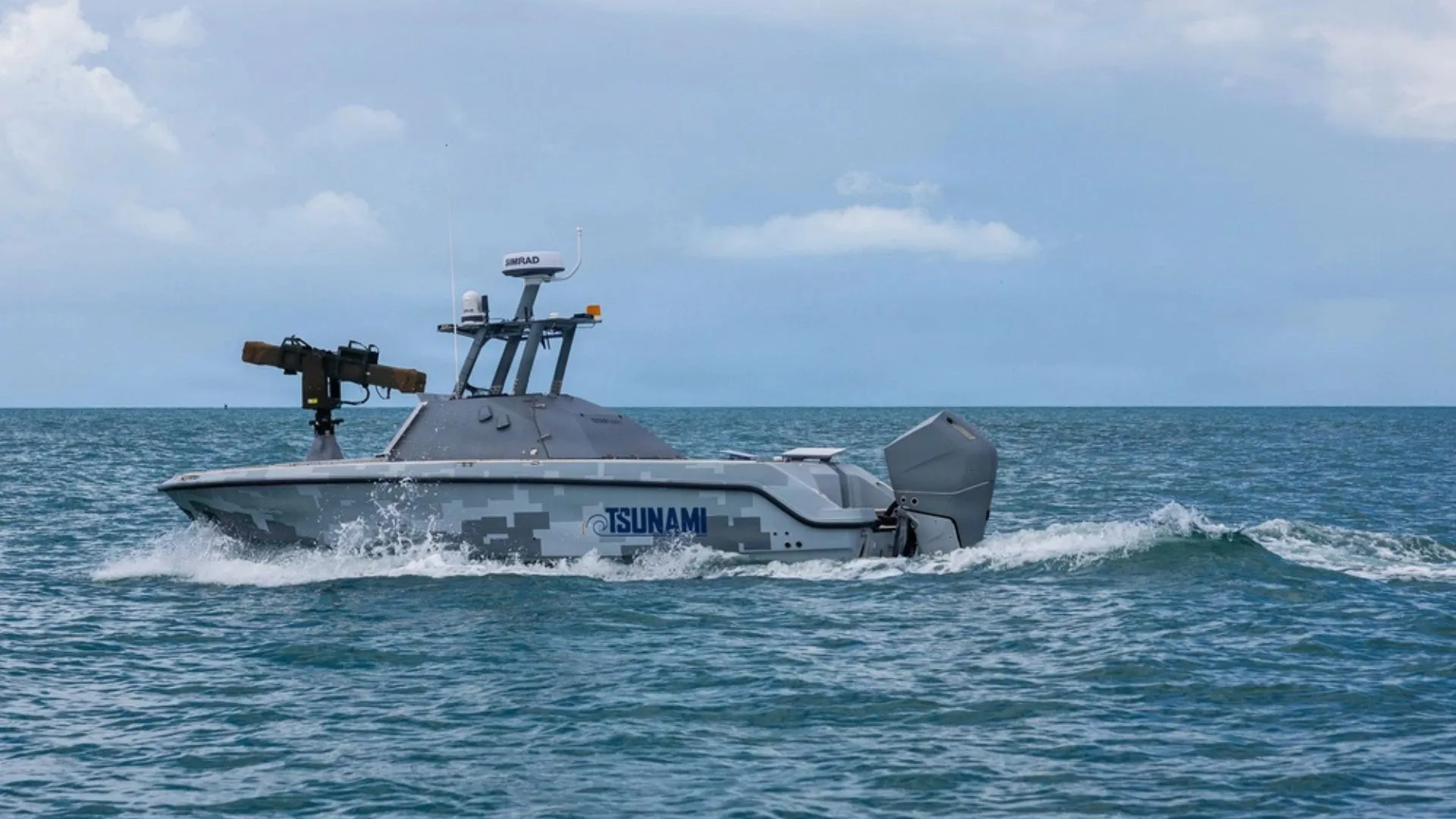
The Department of War Innovation Unit (DIU) has opened Sprint 2 of its Suitable Warfighting Adaptive Payloads (SWAP-USV) prize challenge, seeking production-ready armed USVs, unmanned surface vessels fitted with hard-kill counter-air weapons and deployable forward within 120 days. Proposals are due November 30, 2026, with up to $40 million in prizes and in-water testing planned for early 2027.
DIU runs the effort with the Direct Reporting Portfolio Manager for Unmanned Systems (DRPM UxS), the office Secretary of War Pete Hegseth created in a June 29, 2026 memo to consolidate drone and counter-drone programs. The target is a cost problem the fleet has already paid for in combat: in the first 15 months of Red Sea operations against the Houthis, Navy ships fired 220 missiles, including 120 SM-2s and 80 SM-6s, plus 160 five-inch rounds across 380 engagements, according to figures Navy officials released in January 2025. DIU states that current force packages cannot defeat cheap drones and low-flying threats at a sustainable cost.
Armed USV Requirements: Range, Speed and Engagement Thresholds
Sprint 2 keeps the platform floor set in Sprint 1: a minimum operational range of 200 nautical miles and a sustained cruise speed of at least 10 knots, figures DIU calls thresholds that top performers should substantially exceed. The vessel must navigate autonomously to waypoints, patrol and loiter on station, avoid collisions in open-ocean and littoral waters, and provide 360-degree detection, tracking and positive identification of air and surface contacts through clutter-resilient sensors.
The weapon requirement is more demanding. Solutions must engage Group 1-3 unmanned aerial systems (UAS) and rotary-wing aircraft beyond 3 nautical miles, about 5.6 km, under operator supervision, with Group 5 engagement highly desired. Arming, firing, de-arming and abort must work over the horizon behind human-in-the-loop interlocks, and a two-person crew should be able to rearm pier-side, shipboard or at austere sites.
The maturity gate is strict. DIU will evaluate only hulls, launchers, sensors and effectors drawn from active, verifiable production lines; prototype-only offerings are excluded. Unlike Sprint 1, which accepted standalone vessels, drones or payloads, Sprint 2 requires one integrated submission covering hull, launcher and payload, though teaming is allowed. Selected offerors must demonstrate within 30 calendar days of down-selection. Scoring favors total cost-effectiveness across vessel, weapons, crew, operations and maintenance over raw performance, and the government may prefer affordable high-rate production to exquisite low-quantity systems.
Hellfire, JAGM, APKWS and Stinger: Four Counter-Air Effector Tracks
DIU sorts effectors into four non-exclusive evaluation lanes. Category 1, Heavy Kinetic, covers the AGM-114L Longbow Hellfire and AGM-179 Joint Air-to-Ground Missile (JAGM), and is the only lane with a government-furnished Technical Data Package for launcher interface and fire control. Access requires an active Commercial and Government Entity (CAGE) code, an approved DD Form 2345 and a signed non-disclosure agreement. The Navy already fields Longbow Hellfire in the 24-round Surface-to-Surface Missile Module aboard Freedom-variant Littoral Combat Ships, with USS Indianapolis receiving counter-drone modifications in 2024. Publicly available specifications give both missiles a range of about 8 km; JAGM combines semi-active laser and millimeter-wave radar seekers in one airframe. Lockheed Martin product literature describes the Longbow as out of production, which points Category 1 bidders toward JAGM to meet the production-line requirement.
Category 2, Precision Rocketry, centers on the Advanced Precision Kill Weapon System (APKWS), BAE Systems’ laser-guidance kit for 70mm rockets. Paired with a proximity fuze from L3Harris and Technology Service Corporation, it has been tested against Class 2 and Class 3 drones. No government data is provided, and two-person manual reloading is mandatory.
Category 3 covers stabilized remote weapon stations with Stinger or better missiles, 7.62mm or heavier machine guns, or high-power lasers. Published data put the FIM-92K Stinger’s range at roughly 5 km, short of the 3-nautical-mile threshold, positioning such systems as an inner defensive layer. Category 4 accepts any mature production effector meeting the counter-air criteria.
Little Creek Testing, Project AVO Integration and $200 Million Follow-On
Test Event 1 is a vendor-run, one-to-two-day demonstration covering autonomous and teleoperated maneuvering, 360-degree tracking in high clutter, dry-fire inspection of launcher safety interlocks, and an engineering review of simulation models and shipyard capacity. Test Event 2 is a three-week, government-operated challenge at Little Creek, Virginia, where military end users take tactical control, transit under active jamming with degraded satellite navigation, receive offboard cueing and conduct simulated or, where authorized, live-fire engagements against maneuvering drones and rotary-wing targets.
Command and control must follow a Modular Open Systems Approach (MOSA) and support Project AVO, the Autonomous Vehicle Orchestrator, as the primary layer for maneuver, cueing, sensor sharing and supervised weapon release. AVO stems from a separate $100 million DIU challenge launched January 13, 2026 with the Defense Autonomous Warfare Group and the Navy. Vendors must deliver an AVO interface package, including documentation and an SDK or API, before Test Event 2.
Beyond $100 million in prizes across three sprints, the government has budgeted $200 million for prototype or production Other Transaction agreements under 10 U.S.C. § 4022, and may buy test articles without competition under § 4023. The solicitation is open to US and international vendors.
Analysis: Sprint 2 shifts SWAP-USV from drone-launching strike boats toward organic fleet air defense, and its weapon list shows how DIU intends to bend the cost curve. Published estimates place a Longbow Hellfire at roughly $150,000 to $215,000 and an APKWS round in the tens of thousands of dollars, against about $2 million for an SM-2. Reusing aviation munitions already in production avoids funding a new interceptor. The binding constraint is the hull: few USVs pair 200 nautical miles of range with stabilized deck space and verifiable shipyard throughput.
Proposals, limited to a 15-slide deck, close November 30, 2026, with submissions for Sprint 3, focused on swarm orchestration, due in spring 2027. Sprint 1 selections had not been publicly announced as of mid-October. The open questions are how many vendors can field an integrated hull and launcher within 30 days, and whether live-fire authorization at Little Creek follows.