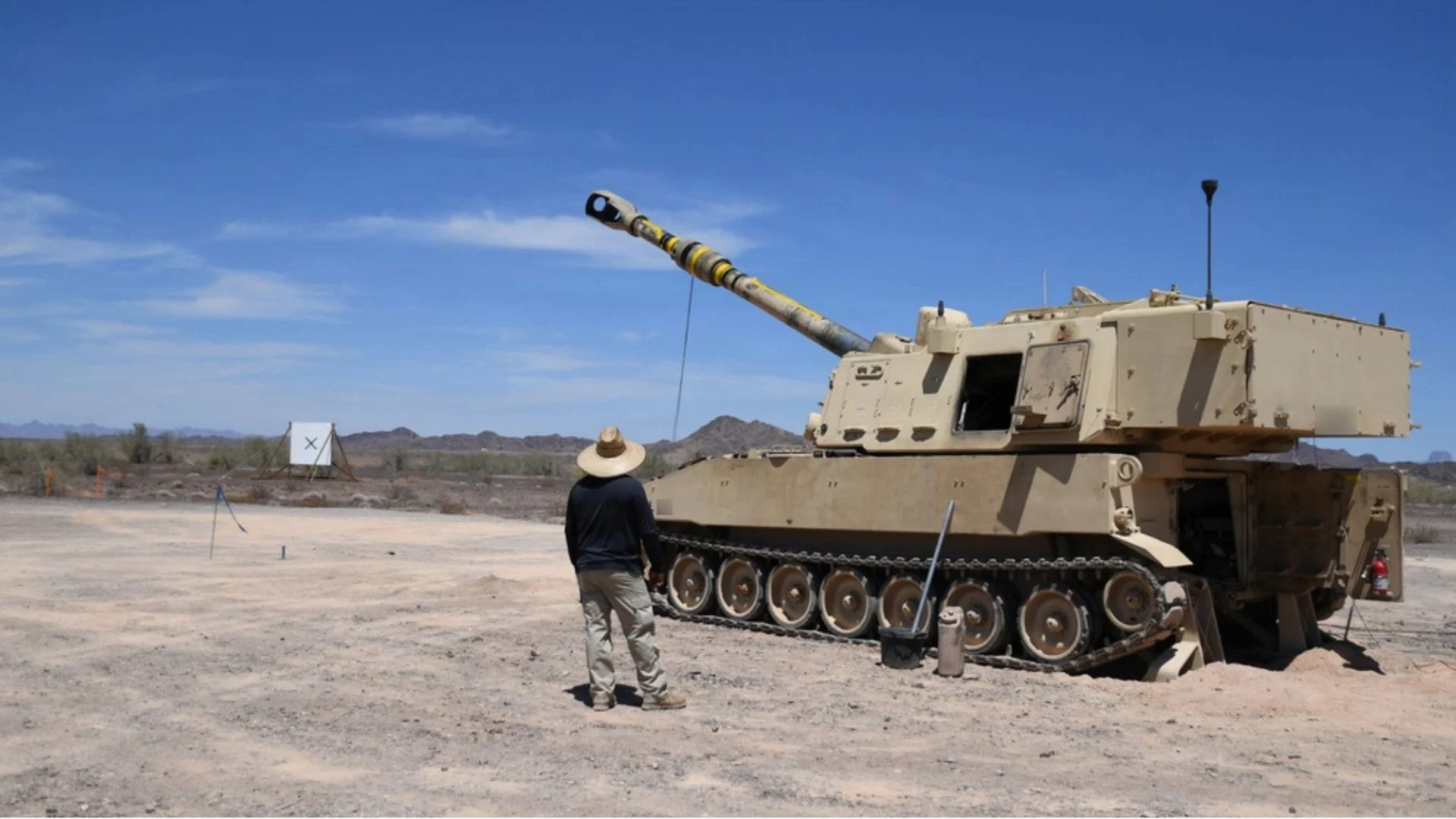
The U.S. Army has gun-launched three prototype XM1180 Cannon-Delivered Area Effects Munition (C-DAEM) Armor hit-to-kill (HTK) projectiles against a tank target at Yuma Proving Ground, Arizona, in the second phase of a Guided Test Vehicle (GTV) series designed to demonstrate the 155mm round’s target-seeking capability. The service disclosed the firings on October 20, 2026, and said it intends to take the same seeker into GPS-denied testing and integrate it into the XM1230 Extended Range Artillery Projectile.
The program dates to 2018, when the Army chose a two-round family to replace Dual-Purpose Improved Conventional Munitions (DPICM), whose submunitions leave a high rate of unexploded ordnance: the XM1208 for personnel and light vehicles, the XM1180 for heavy armor. The first GTV live fire, in February 2024, confirmed target identification and seeker handover and advanced the XM1180 to Technology Readiness Level 6. A 2023 Army market survey targeted low-rate production, restricted to Raytheon in Tucson, Arizona, by the second quarter of fiscal year (FY) 2026; the Army has not confirmed it began.
XM1180 Guided Artillery Round Seeker Trials Against an Armored Target
Yuma Test Center personnel ran the event with Project Manager Combat Ammunition Systems (PM-CAS), the Combat Capabilities Development Command Armaments Center (DEVCOM-AC), Raytheon and other organizations, with PM-CAS Col. Alicia Johnson and her leadership team observing.
The three rounds were fired from a 39-caliber cannon, the barrel length of the Army’s in-service M109A7 Paladin and M777A2 howitzers, each in a different configuration.
Lovjoat Singh, the DEVCOM-AC test and evaluation engineer at Picatinny Arsenal, New Jersey, who led overall test planning and execution, described a two-step sequence: in open-loop mode the seeker searches for the target without acting on it; in closed-loop mode its output steers the projectile. The Army did not say how the rounds were split between modes, release miss distances, or state whether any round struck the tank.
Casey Scharenbroich, an evaluator with the Operational Evaluation Command on site to assess the projectile’s technology maturity, said the seeker builds an image of the target area, locates the vehicle within it and uses that image for terminal guidance. He described the operational payoff as giving commanders a way to engage vehicles that have moved since they were located, or that are still moving.
From Excalibur to Hit-to-Kill: Airframe, Seeker, and Payload
The XM1180 builds on the M982 Excalibur, the GPS-aided inertial navigation 155mm projectile adopted in 2007. Excalibur typically lands within 2 meters of its aim point at about 40 kilometers, but flies to fixed coordinates and cannot engage moving vehicles. In Ukraine, confidential Ukrainian military assessments reported by The Washington Post in May 2024 showed its hit rate falling from above 50 percent to below 10 percent during 2023 under Russian GPS jamming.
The XM1180 keeps that navigation package for midcourse flight and adds an all-weather terminal seeker. Raytheon, which announced completion of the seeker’s design verification test in December 2025, says the HTK seeker draws on design elements from the GBU-53/B StormBreaker glide bomb and performs autonomous target detection, classification and tracking while resisting jamming. Publicly available specifications indicate the StormBreaker seeker combines millimeter-wave radar, uncooled imaging infrared and semi-active laser modes; the company has not disclosed which modes carry over to the artillery round. Earlier open-source reporting credited the XM1180 with about 60 kilometers of range and a search footprint of roughly 28 square kilometers; the Army has not confirmed either figure.
Descriptions of the payload diverge. Reporting on the Army’s 2024 program update cited a unitary shaped-charge armor-piercing warhead, while Raytheon describes a kinetic hit-to-kill effector replacing the conventional high-explosive fill. In October 2024, Col. Leon Rogers, then the PM-CAS project manager, outlined a longer-term goal of networked rounds sharing target data so one volley does not strike the same vehicle twice.
Carrying the HTK Seeker Into the XM1230 Extended Range Artillery Projectile
The seeker’s next destination may matter more than the XM1180 itself. Scharenbroich will assess how the technology applies to the XM1230, and Yuma Test Center test officer Ashley Lochetto said the team’s intent is “to conduct GPS denied testing” of the seeker while integrating it into that round. The Army also noted that the seeker’s added precision minimizes collateral damage.
The XM1230 designation applies to the Extended Range Artillery Projectile (ERAP) effort the Army launched in 2024, the same year it canceled the Extended Range Cannon Artillery (ERCA) howitzer. Army requirements call for at least 65 kilometers from a 39-caliber cannon and more than 70 kilometers from a 52-caliber tube, a non-GPS navigation mode, and the ability to attack moving main battle tanks, self-propelled howitzers, rocket launchers, air defense systems and maritime targets. Low-rate initial production is planned by the second quarter of FY2029 and initial operational capability by FY2030, with output set to rise from 300 rounds a year to 1,500 by the sixth year.
Awards made public in June 2026 cover three competing designs: a Vulcano-derived round from General Dynamics Ordnance and Tactical Systems, Leonardo and Diehl Defence, listed at $37.86 million; BAE Systems Land & Armaments at $81.43 million; and General Atomics Electromagnetic Systems at $24.84 million. The Army has not said how one seeker would be integrated across competing airframes.
Analysis: Army 155mm precision rounds have depended on GPS coordinates or, for the largely retired M712 Copperhead, a laser designator near the target, and Ukraine showed how fast GPS-only precision erodes under jamming. A terminal seeker that finds and classifies armor on its own removes both dependencies; pairing it with ERAP’s reach beyond 65 kilometers would give tube artillery counter-armor and counter-battery missions now largely left to rockets. The constraint is volume: an initial ERAP rate of 300 rounds a year means seeker-guided shells will supplement, not replace, massed fires.
The C-DAEM Armor GTV series runs through FY2027, and XM1230 testing at Yuma is expected within months, alongside GPS-denied seeker trials. Still unanswered: the outcome of the three firings, the status of XM1180 production, and whether the Army fields the XM1180 as a standalone round or makes the XM1230 the primary carrier for its seeker.