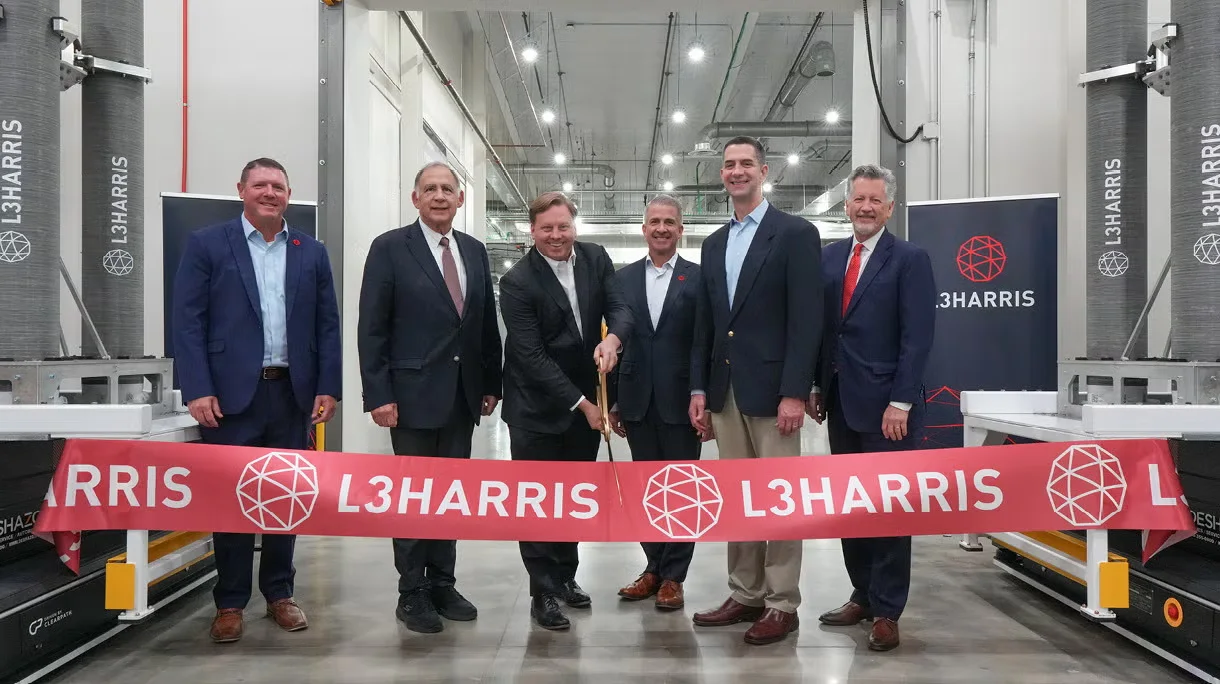
L3Harris Technologies opened its Arsenal of Freedom solid rocket motor production facility in Camden, Arkansas, on October 20, 2026. The company designed the site to double current capacity for the motors that propel the U.S. Army’s Guided Multiple Launch Rocket System (GMLRS), with room for additional growth.
The opening completes a centerpiece of a $216 million Defense Production Act (DPA) Title III cooperative agreement signed with the Department of War in 2023 to expand output for tactical missiles, including Javelin, Stinger and GMLRS. The agreement also funded new facilities at L3Harris’ Orange County, Virginia, site, along with equipment and digital upgrades in Huntsville, Alabama. The ribbon cutting came eight days after Lockheed Martin awarded L3Harris a $250 million follow-on contract for standard-range GMLRS propulsion units, the highest quantity in the program’s history, which the company said will be produced in the new Camden building.
Inside the Camden Solid Rocket Motor Facility for GMLRS
The 60,000-square-foot facility, supported by additional propellant processing buildings, centralizes GMLRS motor production in a single footprint. When construction began, L3Harris said consolidating the line under one roof would cut the distance motors travel during manufacturing by 80%. The company credits advanced automation, robotics and digital manufacturing for the capacity gain. It has not disclosed annual motor output for the new line, nor a date for reaching the doubled rate.
GMLRS is a 227 mm precision-guided rocket fired from the M142 High Mobility Artillery Rocket System (HIMARS) and the M270 Multiple Launch Rocket System. Publicly available specifications indicate a range of roughly 70 km for the standard-range round, while the Extended-Range GMLRS is designed to reach about 150 km. L3Harris also builds the rocket’s electronic safe-and-arm device and proximity sensor. Lockheed Martin, the prime contractor, has set a target of 14,000 GMLRS rockets per year, a rate that depends directly on motor supply.
“Rocket propulsion is a vital national security capability,” said Under Secretary of War for Acquisition and Sustainment Michael P. Duffey, adding that the facility supports “a resilient, responsive, and secure supply chain for precision munitions.”
Arkansas Advanced Propulsion Facilities and the National Buildout
The GMLRS building is one element of a broader expansion in Camden, where rocket motors have been produced since 1979 and which L3Harris took over through its July 2023 acquisition of Aerojet Rocketdyne. In November 2025, the company broke ground on the Arkansas Advanced Propulsion Facilities, a campus of more than 20 buildings across 110 acres intended to increase large solid rocket motor capacity six-fold. Two additional Camden facilities supporting Patriot Advanced Capability-3 Missile Segment Enhancement (PAC-3 MSE) propulsion broke ground in June 2026 and are expected to be operational in 2027.
Across Arkansas, California, Virginia and Alabama, L3Harris says it is investing billions to build approximately 60 new facilities, with the stated aim of doubling, tripling and quadrupling propulsion production rates on key programs. Alongside GMLRS, the company holds major propulsion awards for PAC-3 MSE and the Terminal High Altitude Area Defense (THAAD) interceptor. Ken Bedingfield, president of L3Harris Missile Solutions, described Camden as part of the expansion model the company is implementing nationwide.
Analysis: Doubling GMLRS motor capacity attacks the input that most directly limits rocket deliveries, but the motor is one component among many. Guidance sections, warheads and final assembly at Lockheed Martin must scale in step for the 14,000-round annual target to hold. The Camden opening also illustrates the government’s preferred model for rebuilding the solid rocket motor base: DPA Title III funding seeding dedicated, automated lines at an incumbent supplier while alternate sources mature. Northrop Grumman already supplies GMLRS motors, and General Dynamics has worked on a second-source motor with Lockheed Martin since August 2024, so L3Harris’ expanded footprint will compete for future share rather than define the supply base alone.
The near-term test is the ramp to production on the $250 million standard-range order, followed by the PAC-3 MSE facilities due in 2027. L3Harris has published neither a timeline nor a target rate for the doubled GMLRS capacity, and its production projections remain forward-looking. Follow-on Army GMLRS buys in fiscal 2027 appropriations will show whether demand keeps pace with the new industrial capacity.