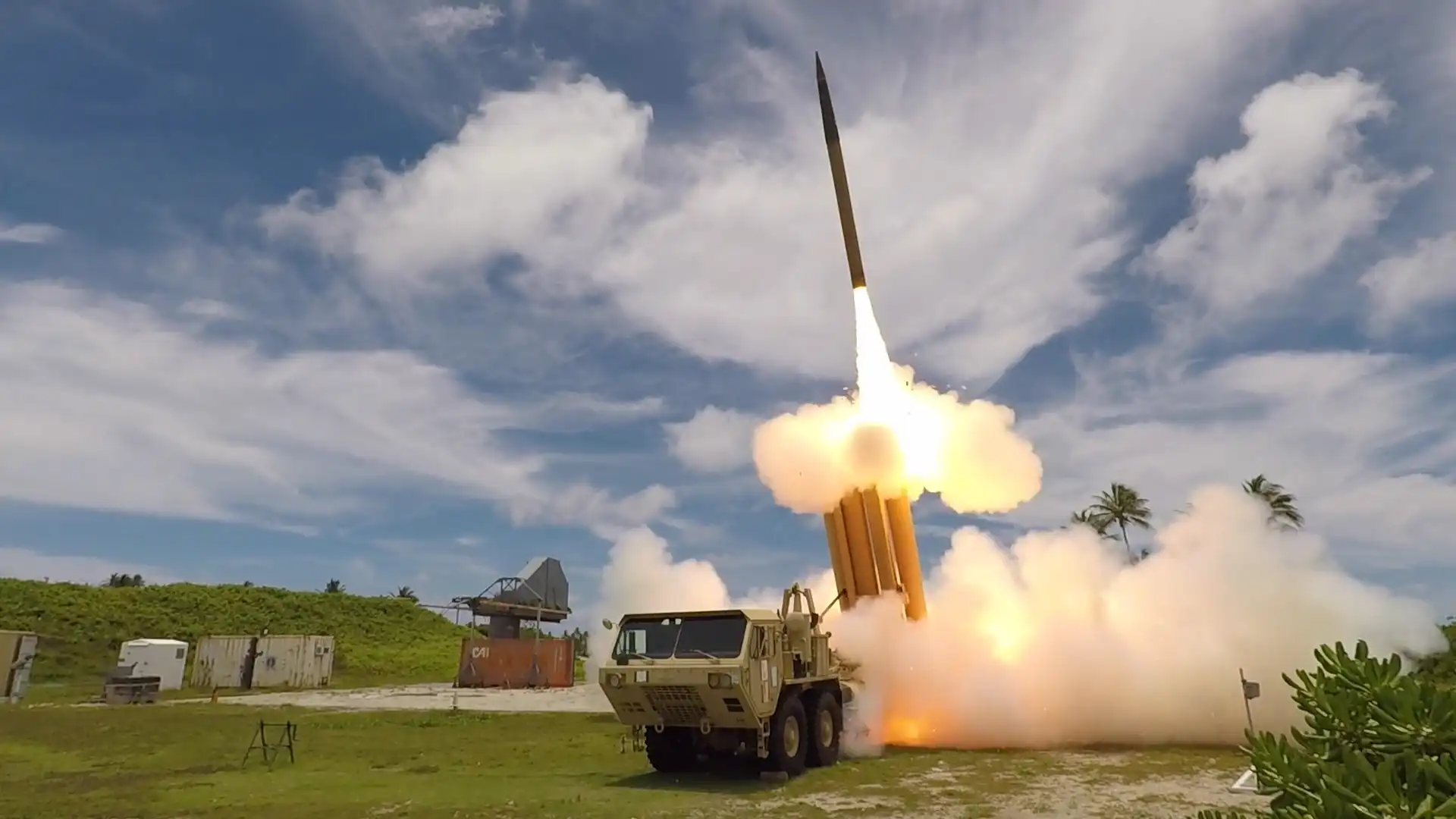
Karman Space & Defense has signed a seven-year, $218 million long-term agreement with Lockheed Martin to manufacture shrouds for the Terminal High Altitude Area Defense (THAAD) interceptor, the Huntington Beach, California-based supplier announced on October 19, 2026. The companies signed the agreement on September 29, 2026. The shroud protects the interceptor’s forward section in flight and must separate cleanly before terminal homing.
The award lands as the THAAD supply chain prepares for a fourfold rate increase. On January 29, 2026, Lockheed Martin and the Department of War signed a framework agreement to raise THAAD interceptor output from 96 to 400 per year over seven years, with an initial contract award tied to final fiscal year 2026 appropriations. The Karman agreement runs over the same seven-year horizon. Reporting after the June 2025 war between Israel and Iran indicated that U.S. forces fired more than 100, and possibly as many as 150, THAAD interceptors defending Israel, more than a year of output at the pre-agreement rate.
What THAAD Interceptor Shrouds Do in the Hit-to-Kill Sequence
According to Karman, the shrouds protect critical interceptor components from extreme aerodynamic loads and environmental conditions during launch and flight, then separate at a defined point in the mission. Publicly available descriptions identify the part as a clamshell-type shroud covering the window of the kill vehicle’s indium antimonide (InSb) staring focal plane array infrared seeker. The shroud is ejected just before seeker acquisition, exposing the seeker for terminal homing.
That separation event sits on the critical path of every engagement. THAAD carries no warhead; its kill vehicle destroys short-, medium- and intermediate-range ballistic missiles by direct impact, and publicly available specifications indicate intercepts at altitudes up to roughly 150 km. A single-stage, solid-propellant booster with thrust vector control accelerates the interceptor, after which the kill vehicle separates and maneuvers using its divert and attitude control system (DACS). A shroud that fails to separate cleanly leaves the seeker blind at the moment ground radar updates give way to onboard guidance. Early THAAD flight test failures in the 1990s included stage separation and seeker faults, a reminder that separation structures are flight-critical hardware.
Karman cites decades of experience in deployable shroud systems and automated processes built for repeatable production. The company has not disclosed which facility will build the THAAD shrouds, annual delivery quantities or unit pricing. Averaged over seven years, the contract equals about $31 million per year; whether that value assumes the full 400-per-year rate or a gradual ramp is not stated.
Karman Long-Term Agreements and the 400-Interceptor Production Target
Karman Chief Executive Officer Jon Rambeau framed the award as a capacity commitment. “Demand for missile defense capabilities is accelerating, and meeting that demand will require significantly more capacity across the industrial base,” he said, adding that the agreement will let Karman support increased THAAD production for years to come.
The THAAD deal is one of three long-term defense agreements Karman described as under negotiation during its August 6, 2026, second-quarter earnings call, when management put their combined potential value at more than $1 billion. By that arithmetic, the remaining two are worth more than $780 million together. Karman has not identified the programs involved or said whether either has closed.
Karman ended the second quarter with a record $1.3 billion backlog, up 65% from the end of fiscal 2025, on quarterly revenue of $182.1 million. In the company’s results release, Rambeau pointed to more than $90 billion in recent prime contractor awards for THAAD and PAC-3 interceptors as a sign of strengthening demand. On the earnings call, he acknowledged that customers locking in long-term arrangements to fund large capacity increases could put pressure on supplier pricing.
At the prime level, Lockheed Martin has more than 340,000 square feet of dedicated U.S. operations space and more than 2,000 U.S. employees supporting THAAD, and the company has broken ground on a Munitions Acceleration Center in Camden, Arkansas, to support THAAD and Patriot Advanced Capability-3 (PAC-3) Missile Segment Enhancement (MSE) production. A fourfold rate increase at final assembly only materializes if every sub-tier supplier, from seekers to shrouds, scales in parallel.
Analysis: The Karman agreement shows the Pentagon’s munitions framework deals cascading down the supply chain. The January framework gave Lockheed a demand signal; a seven-year subcontract gives a structures supplier the confidence to hire and tool up before the government’s own production award is fully funded. That sequencing matters because sub-tier components such as seekers, separation structures and solid rocket motors are widely cited as the binding constraints on interceptor output. Each long-term agreement reduces schedule risk on the 400-per-year target, but it also concentrates flight-critical parts on single qualified sources, a trade-off the Missile Defense Agency and Lockheed will have to manage.
The next markers are the definitized THAAD production contract under the framework agreement, which depends on final fiscal 2026 appropriations, and Karman’s third-quarter results, which should show how the agreement enters backlog and whether the two remaining defense agreements have closed. Delivery quantities, the producing facility and the shroud ramp profile remain undisclosed.