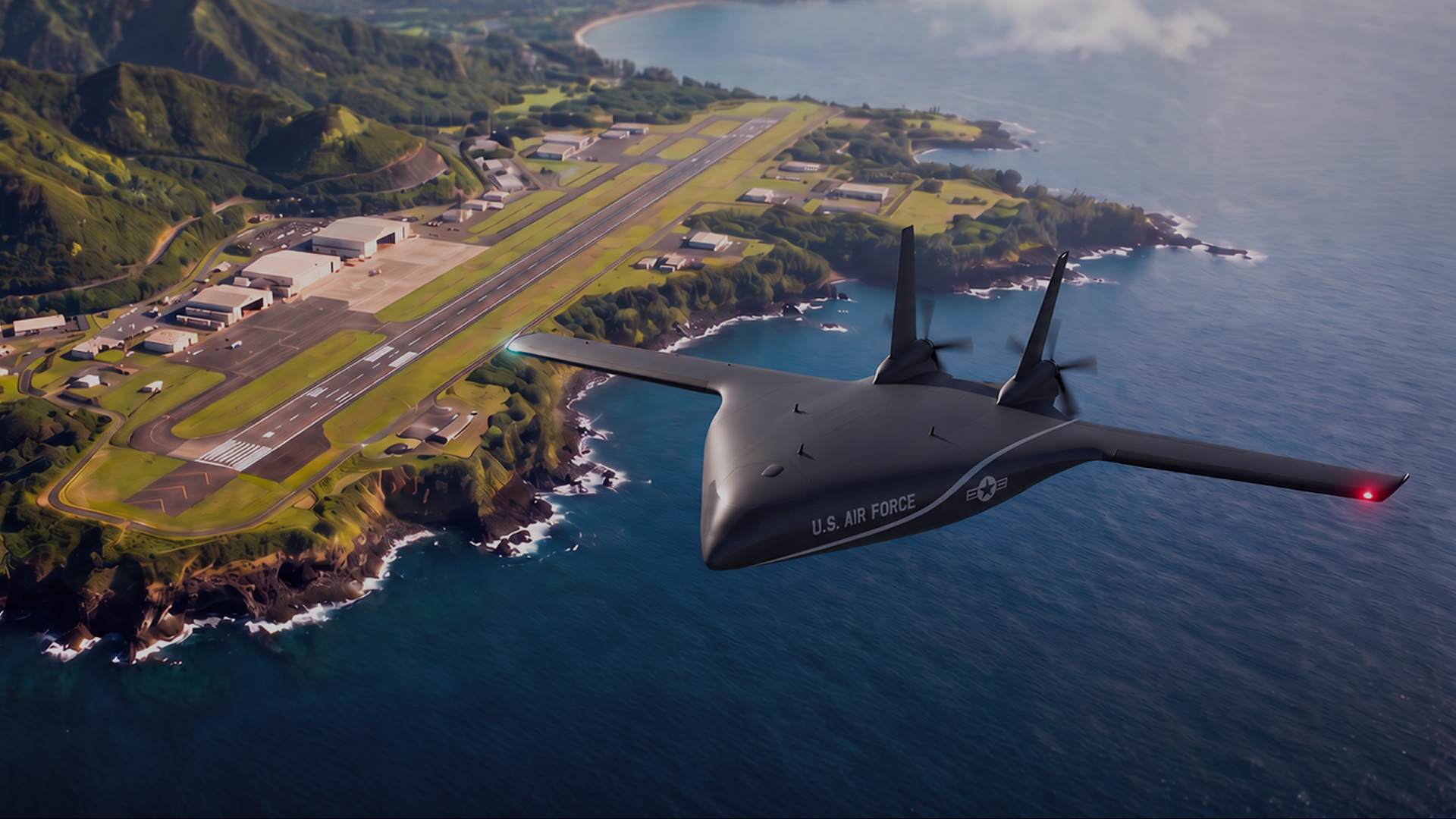
The U.S. Air Force has awarded Natilus $3.5 million in Research, Development, Test, and Evaluation (RDT&E) funding to advance the optionally piloted Natilus KONA regional freighter toward full-scale flight testing and an operationally relevant Joint Force demonstration, the San Diego-based manufacturer announced on October 21, 2026. The funding comes from the Operational Energy Innovation (OE-I) program and the Department of the Air Force through the Assistant Secretary of the Air Force for Energy, Installations, and Environment (SAF/IE).
The award places a commercially funded blended-wing-body (BWB) freighter inside the Air Force’s search for distributed logistics options in the Indo-Pacific, where Agile Combat Employment (ACE) depends on moving fuel, munitions, and spares between dispersed and often austere airfields. Natilus positions KONA as a new class of sub-tactical lift, sitting between light utility aircraft such as the Cessna C-208 Caravan and the Lockheed Martin C-130 Hercules tactical airlifter.
Natilus KONA Design: Payload, Range, and Blended-Wing Efficiency
KONA is rated for a 3.8-ton payload and an 800-nautical-mile range, with short-field capability and compatibility with existing cargo handling infrastructure. Its BWB layout merges a lifting fuselage with high-aspect-ratio wings. Natilus says the configuration burns approximately 30% less fuel than comparable conventional aircraft.
Publicly available specifications indicate an 85-foot (25-meter) wingspan, a largely composite airframe, and two aft-mounted Pratt & Whitney PT6 turboprops; the specific engine variant has not been disclosed. Natilus has also cited the aircraft’s ability to operate from shorter gravel runways.
Those figures place KONA in a gap the services have not filled with a dedicated platform. Publicly available data put the cargo capacity of the Cessna 208B at roughly 1.5 tons, while the C-130J lifts about 19 tons. That sizing suits small-lot hub-to-spoke resupply, where a C-130 is excessive and a Caravan too small.
The program remains in development. Natilus announced successful flights of a subscale KONA prototype in April 2023 and holds an FAA project number formally opening its Part 23 certification effort. In February 2026, the company closed a $28 million Series A round to finish its first full-scale prototype, which it said would fly within 24 months.
Contested Logistics and Fuel Demand Across the Indo-Pacific
In the Indo-Pacific, long distances, dispersed operating locations, and constrained fuel distribution place a premium on range and efficiency, and every gallon an airlifter burns must itself be moved forward.
“In a fuel-constrained environment like the Pacific, efficiency translates directly into operational flexibility,” said Jim Hartle, Associate Deputy Assistant Secretary of the Air Force for Operational Energy, Safety and Occupational Health. “KONA provides an opportunity to evaluate how a commercially developed aircraft can contribute to distributed logistics while generating the data needed to inform future requirements.”
Natilus CEO Aleksey Matyushev said the Department of War is “evaluating a new airlift capability that can generate real-world cost, reliability, payload and utilization data as the broader military requirement matures.” Beyond regional airlift, the company says KONA’s modular architecture and optionally piloted design offer a path to communications relay, intelligence, surveillance, and reconnaissance (ISR), and payload delivery configurations.
The commercial base underwrites the defense effort. Natilus reports more than 570 aircraft pre-orders valued at $24 billion across its product family, and plans a plant sized for 60 KONA per year. Key details remain undisclosed, including the demonstration date and location, the participating units, and the level of autonomy to be tested.
Analysis: At $3.5 million, the Air Force is buying data, not aircraft. The service is testing a privately financed dual-use freighter through an operational energy channel, not a formal airlift requirement. The open question is survivability: KONA is being certified as a civil Part 23 aircraft, and Natilus has published no defensive systems or signature data. Whether a commercially derived platform can sustain spoke-to-spoke resupply inside a contested threat ring, and not only in rear areas, is what a Joint Force demonstration will need to show.
The next milestones are the first flight of the full-scale KONA, which the company’s February 2026 timeline places by early 2028, continued progress on FAA Part 23 certification, and the Joint Force demonstration itself, for which no date has been announced. Whether a service then formalizes a sub-tactical lift requirement will decide if KONA moves beyond experimentation.