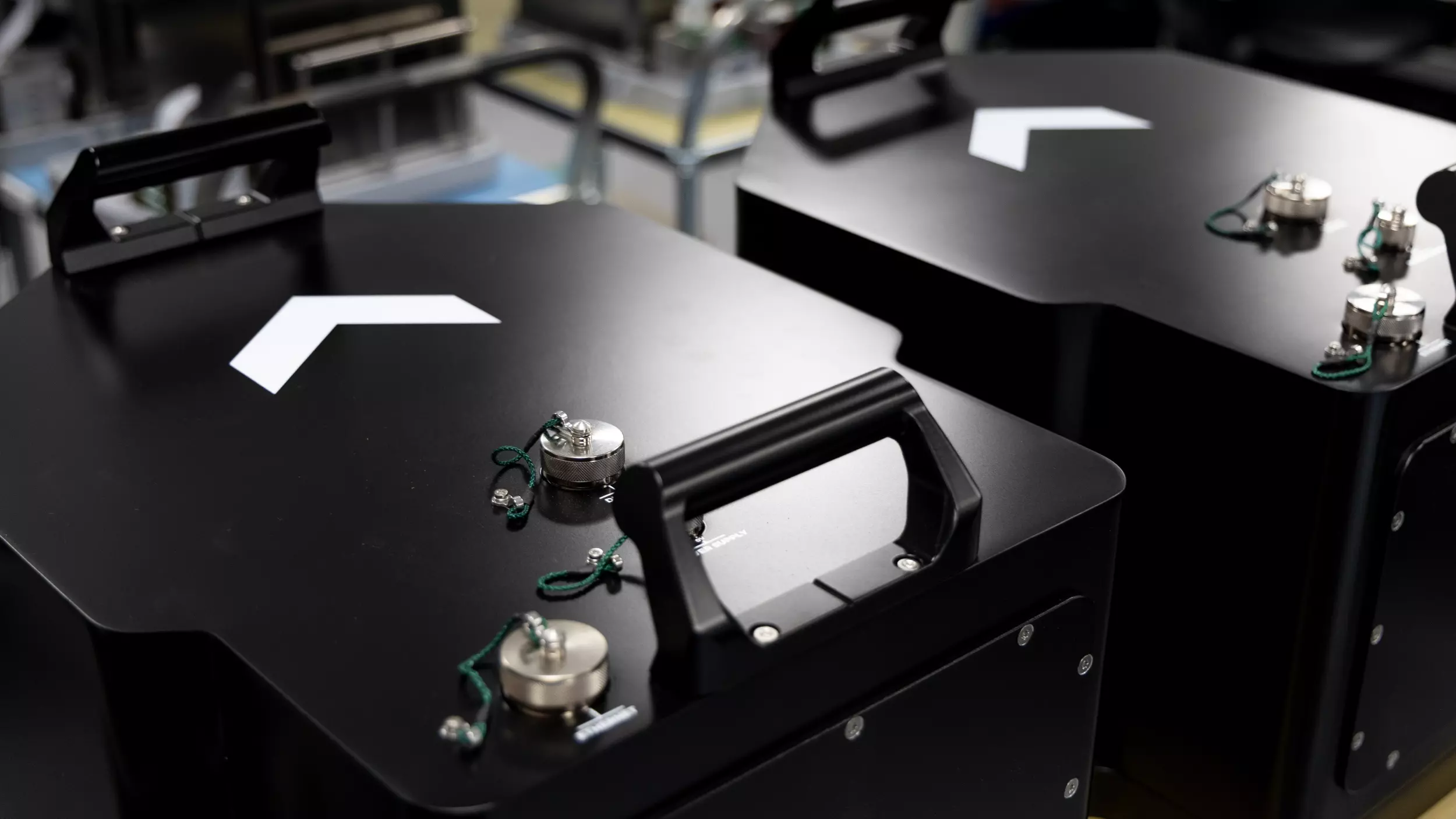
An undisclosed navy has selected Exail’s military-grade Marins inertial navigation systems (INS) to equip its complete fleet of uncrewed surface vessels (USVs), the French navigation and maritime robotics company announced on October 21, 2026. Exail did not name the customer and has not released the number of hulls covered, the Marins grade selected, the contract value or a delivery schedule.
The award comes as navies shift uncrewed surface vessels from experimentation into force structure, relying on them to extend operational reach, reduce crew exposure and sustain a persistent presence at sea. Exail, created from the 2022 combination of iXblue and ECA Group, describes the order as a major contract that reinforces its position in the defense USV navigation market. According to the company, its navigation technologies already equip defense vessels operated by more than 50 navies.
Exail Marins Inertial Navigation Architecture for Uncrewed Hulls
The Marins Series is built around Exail’s fiber-optic gyroscope (FOG) technology. Each unit integrates three FOGs measuring rotation on three axes in a strapdown, fully solid-state configuration with no moving parts, which the company says makes the system silent and maintenance-free over its service life. A FOG measures rotation rate through the Sagnac effect, and its performance scales with the length and diameter of the fiber coil, allowing one core technology to cover several accuracy classes.
The range spans six grades: Marins M3, M5, M7, M8, M9 and M11. The M3, M5 and M7 were introduced at Euronaval 2014, with the higher grades added later. Publicly available specifications indicate the Marins M7 drifts less than 1 nautical mile over 72 hours of GNSS-denied surface navigation or submerged submarine transit. For the USV contract, Exail says the system will deliver position, heading, attitude and velocity data, the core inputs an autonomy stack needs to hold a route, stabilize sensors and maneuver safely without a crew.
The family carries a deep naval pedigree. Under the UK Navigation Compass Programme, 70 Marins M7 units were ordered for 35 Royal Navy surface ships and submarines, and Marins systems also equip Queen Elizabeth-class aircraft carriers and Astute-class attack submarines. In July 2024, Anschütz selected Marins for the Royal Navy’s Type 31 Inspiration-class frigates. The grade chosen by the new customer remains undisclosed, and that choice matters: higher grades extend GNSS-free endurance but add size, weight, power and cost, all tightly constrained on small uncrewed hulls.
GNSS Denial and the Navigation Problem for Autonomous USV Fleets
A crewed warship that loses satellite navigation can fall back on bridge watchkeepers cross-checking radar fixes, visual bearings and dead reckoning. An uncrewed vessel has no such fallback. It depends entirely on onboard sensors that must stay accurate, available and trusted for the full mission, often without continuous human oversight. Exail frames that requirement as most acute in contested environments, where GNSS signals may be degraded, jammed or spoofed.
Spoofing is the sharper threat for autonomy. A jammed receiver fails visibly, while a spoofed receiver feeds confident but false positions into the guidance loop. An independent inertial reference lets the vessel detect that divergence and keep navigating on inertial data alone. The problem is operational, not theoretical: in March 2025, the International Maritime Organization (IMO), the International Civil Aviation Organization (ICAO) and the International Telecommunication Union (ITU) jointly urged states to protect satellite navigation from interference, citing risks to aviation and maritime services.
Exail’s pitch rests on experience in GNSS-free domains. The company says its technologies equip 80% of autonomous underwater vehicles (AUVs) and remotely operated vehicles (ROVs), platforms that never receive satellite signals at depth. It also designs its own uncrewed surface platforms, including the DriX and Oryx series. Jean-Marc Binois, Exail’s chief commercial officer, said scaling USV fleets “requires trusted navigation technologies capable of meeting demanding defense requirements,” pointing to the company’s combined background in naval navigation and autonomous system integration.
Analysis: The notable element is the scope rather than the hardware. By fitting a single military-grade INS across its entire USV fleet, the customer treats assured positioning, navigation and timing as a fleet-level standard instead of a platform-by-platform choice left to individual hull builders. That approach simplifies logistics, training and certification, and gives crewed and uncrewed units a common, GNSS-independent navigation reference for teaming operations. It also shows how USV procurement is reshaping the industrial base: as navies plan uncrewed fleets numbering dozens of hulls, FOG production capacity and inertial supply chains become as relevant to readiness as the vessels themselves.
Key details remain open: the identity of the navy, the size of its USV fleet, the Marins grade selected, the contract value and the delivery timeline. The next indicator to watch is whether other navies adopt fleet-wide inertial standards for uncrewed platforms or continue leaving navigation choices to each USV supplier.