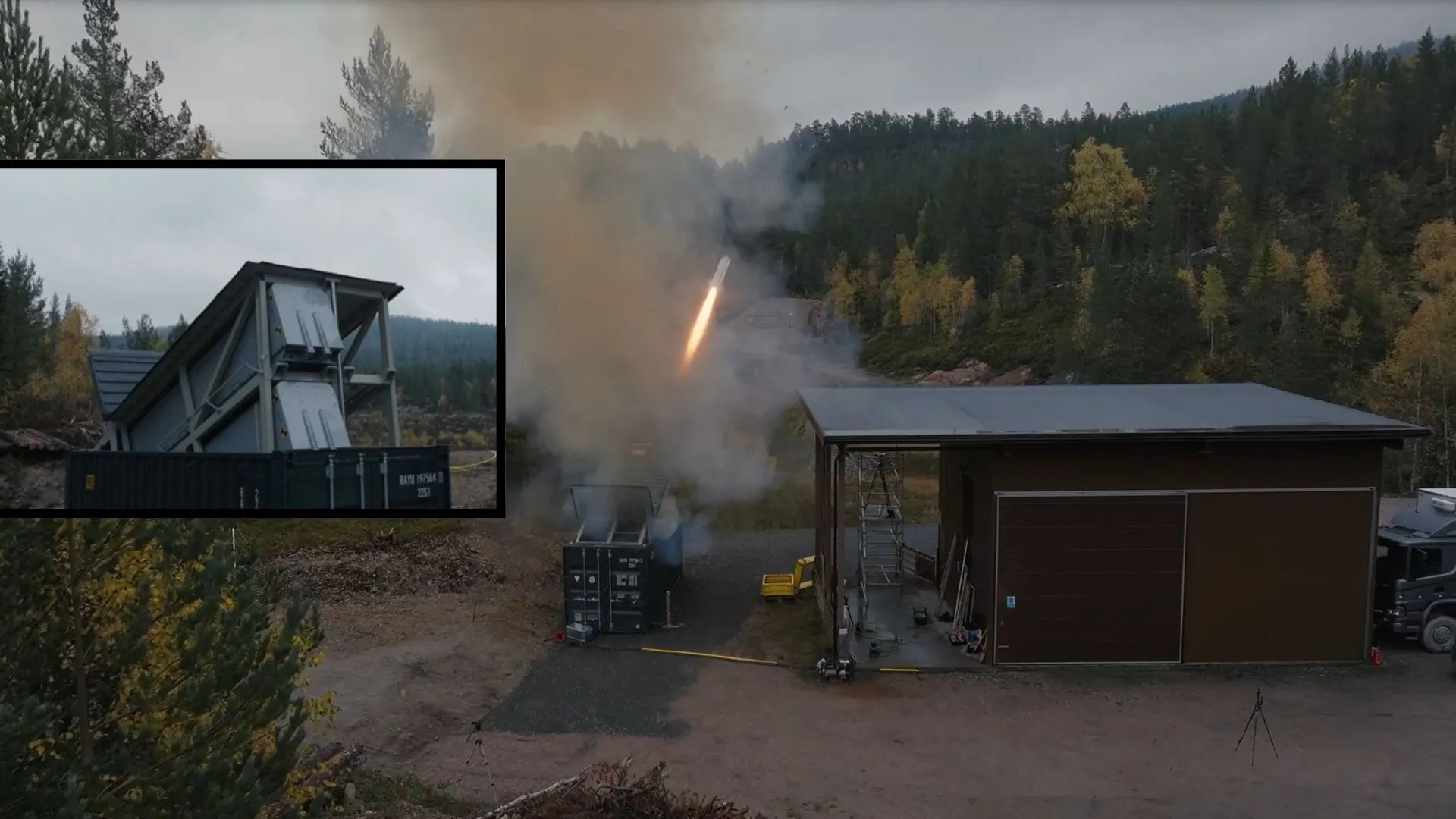
The NSM Mission Module is a containerized launcher developed by Norway’s Kongsberg Defence & Aerospace that houses up to four Naval Strike Missiles (NSM) inside a standard 20-foot shipping container. According to the company, the unit can be deployed without modification from a ship, a truck, or directly on the ground. Kongsberg validated the concept on October 1, 2026, by firing an NSM Ballistic Test Vehicle from the container at a test range in Norway.
The module adds a new branch to an established launch family. The Royal Norwegian Navy first deployed the NSM in 2012 on its Fridtjof Nansen-class frigates and Skjold-class corvettes, and Kongsberg now counts more than 15 user countries. Land variants followed: the truck-mounted NSM Coastal Defence System, first ordered by Poland in 2008; the US Marine Corps’ Navy/Marine Expeditionary Ship Interdiction System (NMESIS), which carries two missiles on an uncrewed Joint Light Tactical Vehicle chassis; and StrikeMaster, a two-round launcher developed with Thales Australia on the Bushmaster vehicle. The Mission Module is the first variant built around commercial container logistics rather than a dedicated hull or chassis.
How the NSM Mission Module Launches From a 20-Foot Container
The module integrates a four-round, multi-canister launcher into a 20-foot ISO container, the most common box in global shipping. At roughly 6.06 m long, 2.44 m wide, and 2.59 m high under the ISO 668 standard, it moves on any port crane, container ship, rail flatcar, or tractor-trailer built for freight. Before firing, a roof section of the modified container opens to create an aperture through which the missiles leave their canisters, according to details Kongsberg provided to Janes.
The October 2026 trial tested launch mechanics, not guided flight. The Ballistic Test Vehicle matches the size and weight of an operational NSM but carries no live warhead; in earlier Kongsberg trials, the same type of round paired the booster rocket motor with an inert body replicating the missile’s mass and center of gravity. Kongsberg said the firing aimed to verify safety, handling and loading procedures, and the container’s ability to manage pressure and blast effects during launch. That last point is the central engineering problem, since a cargo box is not designed to absorb a booster plume, and blast management decides whether the unit can fire from a merchant deck or flatbed without damaging the platform.
Kongsberg has not published the module’s loaded weight, power requirements, reload procedure, crew size, or targeting architecture. Those gaps determine whether it operates as a stand-alone battery or as a launcher node tied to an existing fire control system, such as the Coastal Defence System’s command and control, which is derived from the National Advanced Surface-to-Air Missile System (NASAMS).
Naval Strike Missile Specifications: Range, Seeker, and Warhead
The container changes how the NSM deploys, not how it flies. Designated RGM-184A in US service, the NSM is described by Kongsberg as a fifth-generation strike missile. Publicly available specifications indicate a launch weight of about 407 kg (897 lb) and a length of 3.96 m with booster, or 3.48 m without. A solid-propellant booster accelerates the missile clear of its canister and is then jettisoned, after which a Safran TR40 turbojet burning JP-10 sustains high subsonic cruise.
Kongsberg quotes range at more than 185 km (100 nautical miles), depending on flight profile. Inertial, GPS, and terrain-reference navigation let the missile route overland and around coastal terrain before descending to sea-skimming altitude. Terminal homing relies on a passive imaging infrared seeker with automatic target recognition, matched against an onboard database that can discriminate by ship class. A thrust-to-weight ratio above 1:1 supports high-g terminal maneuvers against close-in defenses. The roughly 120 kg (264 lb) titanium-cased blast and fragmentation warhead uses a programmable, void-sensing fuze intended for hardened targets.
For a hidden launcher, those traits cut both ways. A passive seeker and preplanned routing let a concealed battery fire without radiating, but the module cannot find targets on its own; it depends on cueing from coastal radars, maritime patrol aircraft, uncrewed systems, or allied networks.
Containerized Missile Launchers and Distributed Coastal Defense
Kongsberg frames the module as a dispersal tool. Ståle Mortensson, Vice President for Business Development and Strategy in Kongsberg’s Missiles and Aerostructures division, said a containerized unit “can be pre-positioned and deployed discreetly to support operations wherever the need arises.” The company points to regions with long coastlines and large distances, a profile that fits Norway and Australia. Mortensson disclosed the test at the Land Forces 2026 exhibition in Perth, Australia, in October 2026, while Kongsberg’s missile factory in Newcastle, New South Wales, is scheduled to begin manufacturing in 2027. As of October 2026, no customer or contract for the module has been announced.
The concept has precedents. Lockheed Martin’s Mk 70 Payload Delivery System fits four strike-length Mk 41 vertical launch cells into a 40-foot container and fired an SM-6 from the flight deck of USS Savannah (LCS 28) on October 24, 2023; the US Army’s Typhon Mid-Range Capability belongs to the same launcher family. Russia’s Club-K markets Kalibr-family cruise missiles in shipping containers, and Danish firm SH Defence offers CUBE weapon modules in 20- and 40-foot formats. The NSM Mission Module sits at the lighter end of this field: half the length of the Mk 70, suited to smaller decks and standard trucks, and dedicated to anti-ship strike.
Analysis: The module’s contribution is logistical rather than ballistic. By turning the NSM into a payload that travels through freight infrastructure, Kongsberg lets a navy or army multiply potential launch points without new hulls or vehicles, complicating an adversary’s targeting along NATO’s northern flank, the Baltic approaches, or Indo-Pacific archipelagos. The limits are concrete: four rounds per box is modest firepower, concealment ends once the roof opens and the booster fires, and lethality depends on a sensor network the container does not provide. Carrying weapons in boxes that resemble civilian cargo, particularly aboard merchant ships, also raises legal questions about distinguishing military from civilian shipping that operators will need to settle before deployment.
The next milestones are a guided live-fire against a target from the container, disclosure of its weight, crew, and fire control architecture, and a launch customer. Existing NSM operators with long coastlines form the natural market, although none has publicly stated a requirement. Until then, the NSM Mission Module remains a validated launch concept built on an in-service missile, not a fielded capability.