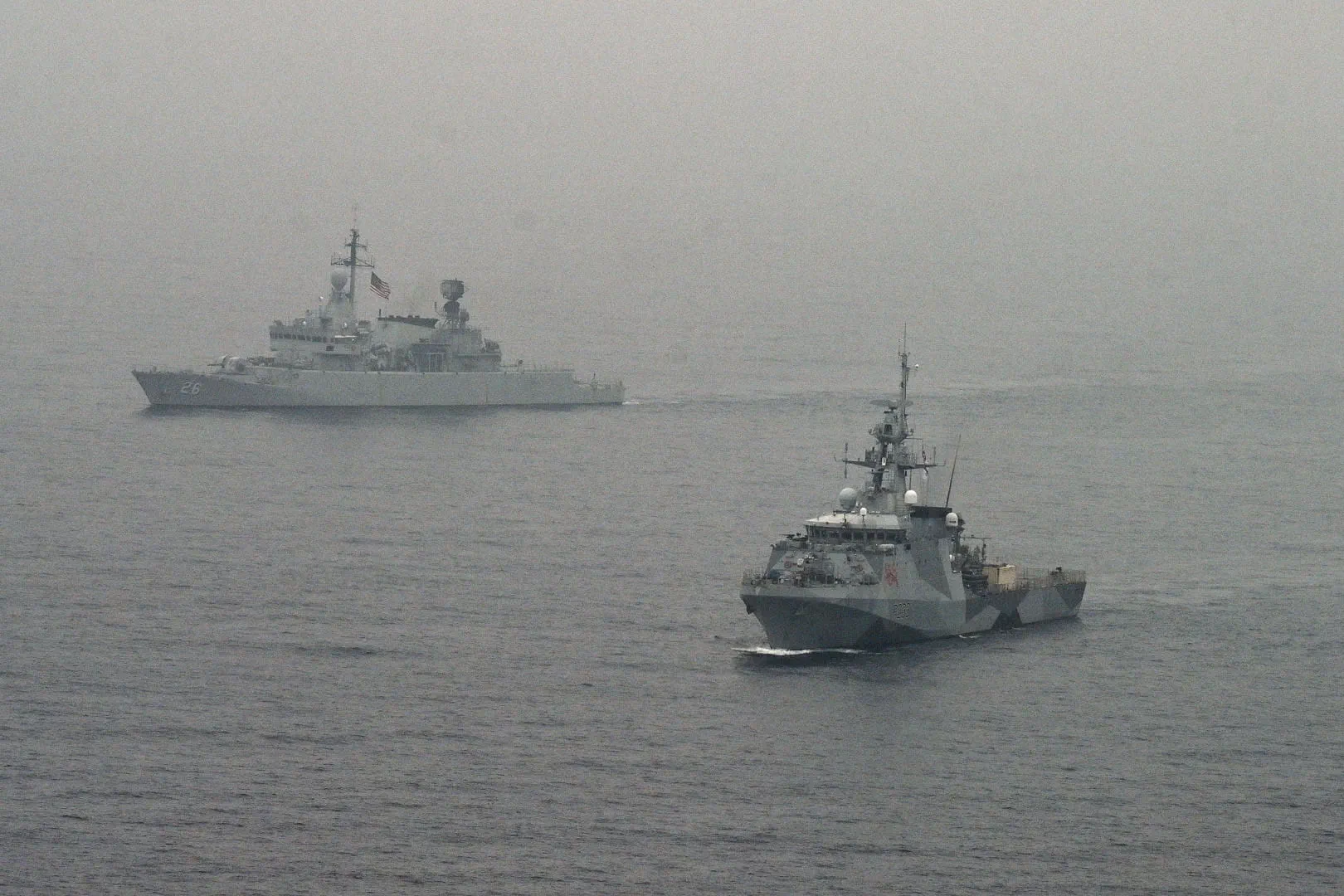
The Royal Navy’s forward-deployed patrol ships HMS Tamar and HMS Spey have completed Exercise Bersama Lima 2026, a ten-day multinational exercise in the South China Sea with the armed forces of Australia, Malaysia, New Zealand and Singapore, the Royal Navy announced on October 23, 2026. The two River-class Batch 2 offshore patrol vessels (OPVs) led the United Kingdom’s contribution to the annual Five Power Defence Arrangements (FPDA) drill, hosted this year by Singapore.
Signed in 1971, the FPDA is a consultative arrangement rather than a mutual defense treaty: its five members commit to consult on a response if Malaysia or Singapore comes under armed attack. Bersama Lima, Malay for “Together Five,” is its flagship exercise, with scenarios that build in complexity toward a two-day war game. The 2026 iteration follows Bersama Lima 25 in Malaysia, where the UK contributed its Carrier Strike Group. This year, the British presence rested on the two Portsmouth-based OPVs that have sustained Operation Highwall, the Royal Navy’s persistent Indo-Pacific deployment, for more than five years.
HMS Tamar and Spey in the Bersama Lima 2026 Maritime Phase
The exercise opened with a week-long harbour phase in which crews worked through each navy’s vessel capabilities, procedures and working language, so that communications would hold once the tempo increased at sea. The maritime phase then brought together corvettes, frigates, patrol ships and a submarine. The Royal Navy has not published the full order of battle.
Serials covered the spectrum of naval warfare. Ships conducted maritime security operations, boarding and searching suspect vessels; soldiers directed naval gunfire onto targets ashore; and the force ran a submarine hunt and an air defence exercise supported by aircraft. HMS Tamar embarked a Royal New Zealand Navy (RNZN) Deployable Boarding Team (DBT), which was exercised repeatedly against scenarios involving suspected illegal fishing and narcotics smuggling. Both the team and the ship will conduct those patrols operationally on their next tasking.
Commander Tom Lindsey, HMS Tamar’s commanding officer, said the exercise offered “great breadth,” citing “fifth-generation fighter jets, international boarding teams and Singapore’s newest submarine.” He added that the serials showed the allies “can put a task group together in short order and successfully operate together to achieve a spectrum of scenarios.” The Royal Navy did not specify which nation flew the fifth-generation fighters; Royal Australian Air Force F-35A aircraft deployed to Singapore for Bersama Lima 2024, the first time the type joined an FPDA exercise. Open-source records indicate Singapore’s newest submarines are the Invincible-class (Type 218SG) boats built by thyssenkrupp Marine Systems, which use air-independent propulsion.
Able Seaman Mansfield, one of Tamar’s seaman specialists, said driving the New Zealand boarding team up to a suspect vessel with a second sea boat “really brought the exercise to life.” Tamar also conducted a replenishment at sea with HMAS Stalwart, the Royal Australian Navy’s Supply-class auxiliary oiler replenishment ship, essential for ships operating far from Portsmouth.
River-Class Batch 2 Capabilities and Their Limits in FPDA Drills
Publicly available specifications indicate the River-class Batch 2 OPVs, built by BAE Systems on the Clyde, displace around 2,000 tonnes at full load, measure 90.5 meters in length with a 13.5-meter beam, and reach a top speed of about 24 knots. A design range of roughly 5,500 nautical miles and endurance of up to 35 days between resupply explain why the class suits Highwall: the ships can cover the distances between Southeast Asia, Australia and the Pacific islands without a dedicated tanker in company.
Armament is constabulary. Each ship carries a single 30 mm DS30M Mk2 automated cannon, supplemented by miniguns and general-purpose machine guns, alongside two rigid-hull sea boats. The flight deck can accept a Merlin-sized helicopter, but there is no hangar and no permanently embarked aircraft. Accommodation for up to 50 additional personnel above the core complement is what allows a hull like Tamar to host a foreign boarding team; the Royal Navy states each ship currently sails with around 60 sailors.
Neither OPV carries hull-mounted or towed sonar, surface-to-air missiles or anti-ship missiles, and the Royal Navy’s account of the submarine hunt and air defence serials does not indicate a sensor or weapons role for either ship. Their value lies in boarding operations, building the surface picture and sustaining presence at low cost, the tasks that dominated Tamar’s program.
Analysis: Bersama Lima 2026 illustrates both the utility and the ceiling of the UK’s Indo-Pacific posture. Two OPVs with roughly 60 sailors each give London a continuous FPDA presence that a carrier group, deployed once every few years, cannot provide. Hosting the RNZN boarding team turns British deck space into an interoperability asset for a smaller partner navy and rehearses the constabulary work regional states prioritize. Yet the step down from a Carrier Strike Group in 2025 to two lightly armed patrol ships in 2026 means the UK’s warfighting contribution to the FPDA remains episodic, at a time when Australia’s Department of Defence frames its own participation around collective deterrence under the 2026 National Defence Strategy.
HMS Spey is now heading for several weeks of patrols and diplomatic engagement in Southeast Asia, while HMS Tamar sails for Australia and New Zealand via several Pacific island chains to conduct maritime security and counter-illegal-fishing patrols. The Royal Navy has not announced how long the Highwall deployment will continue beyond its fifth year, nor whether a higher-end British asset will join the next Bersama Lima iteration.