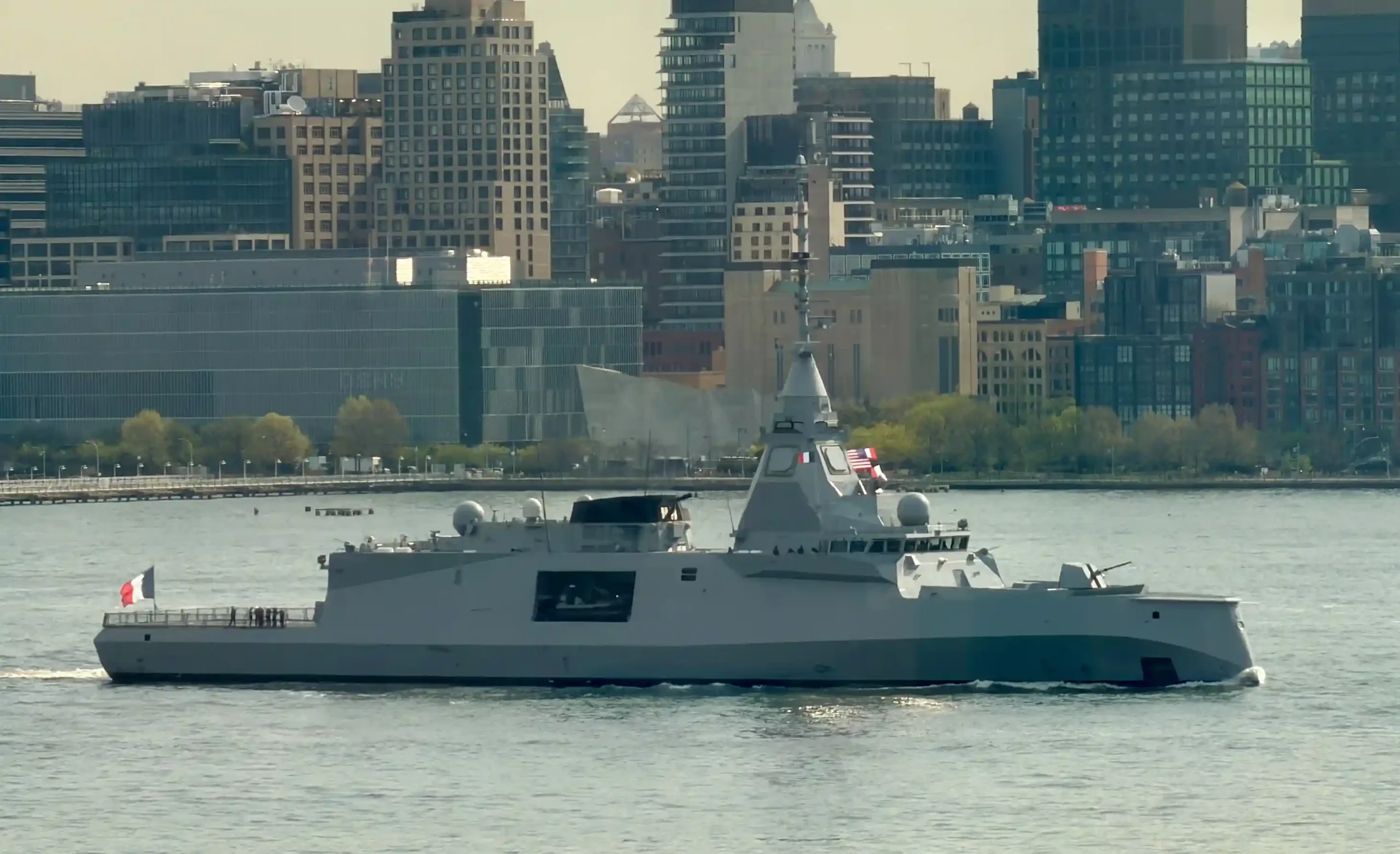
Naval Group signed three memoranda of understanding (MoUs) with Danish firms Copenhagen Global, Saab Danmark and SH Defence on October 21, 2026, at an industry event it hosted in Copenhagen, to support its bid in the Denmark frigate competition. The agreements add named Danish partners to the French shipbuilder’s offer of the Frégate de Défense et d’Intervention (FDI) for the Royal Danish Navy’s planned air defense frigates.
The signings land as Denmark’s frigate decision slows. The requirement surfaced in an April 2025 naval investment plan and sharpened in June 2025, when Chief of Defence Gen. Michael Hyldgaard advised abandoning the upgrade of the three Iver Huitfeldt-class frigates in favor of a rapid buy of a new air defense class. Copenhagen has yet to fix ship numbers or funding. After a snap election, Defense Minister Jeppe Bruus told parliament in September that the analysis of needs, timing and cost is still underway, and the supplier choice is now expected to slip into 2027.
Three MoUs Shape Naval Group’s Denmark Frigate Offer
Each agreement covers a distinct capability block. Copenhagen Global is tied to drones, autonomous systems and military payloads; Saab Danmark to communications equipment; and SH Defence to research and development on containerized mission modules, a launch and recovery system (LARS) for drones, and diving equipment.
The partners bring existing products. Copenhagen Global’s Copenhagen Orca uncrewed surface vessel (USV), unveiled in 2025, is a 13-meter, roughly 5-ton craft with an 825-kilogram payload and a top speed above 40 knots, built to monitor critical undersea infrastructure. SH Defence, part of Svendborg-based SH Group, markets The Cube, a family of containerized mission modules in 20-foot and 40-foot ISO footprints compliant with NATO STANAG 4830. Saab Danmark brings close to four decades in secure integrated communications. The mix points to a frigate designed to launch, recover and network uncrewed systems, in line with Denmark’s 2025 commitment to develop autonomous naval units.
Guillaume Weisrock, Naval Group’s senior vice president of sales for Europe and North America, said that with its Danish partners the company would be “able to build and maintain the FDI frigate in Denmark” if selected. Naval Group has not named a Danish shipyard or quantified local workshare. It cites work with more than 20 Danish companies over 15 years, contacts with almost 50, and its Greek precedent of more than 75 local suppliers on the FDI and other programs.
Thirteen Hulls on Order: The FDI Baseline Offered to Copenhagen
Naval Group is selling a design in serial production. France, Greece and Sweden have ordered 13 FDIs: five Amiral Ronarc’h-class ships, four Kimon-class ships and four Luleå-class frigates. The French lead ship was delivered in October 2025 and Kimon in December 2025. A third hull, which Naval Group’s schedule identifies as the Hellenic Navy’s Nearchos, is due within days, and five more are in production.
Publicly available specifications indicate a 4,500-ton, 122-meter hull with a 17.7-meter beam and a crew of about 125. The combat core is the Thales Sea Fire four-face S-band active electronically scanned array (AESA) radar paired with MBDA Aster 15 and Aster 30 interceptors in Sylver A50 vertical launchers: 16 cells on the first three French ships, 32 on the Greek ships and the last two French hulls. Eight Exocet MM40 Block 3c anti-ship missiles, a 76mm gun, MU90 torpedoes and a CAPTAS-4 Compact variable-depth sonar complete the fit, with a hangar for an NH90 or MH-60R helicopter.
Sweden is the nearest precedent. Stockholm selected the FDI on May 19, 2026, signed a SEK 47 billion ($4.9 billion) contract on August 31 for four ships due from 2030 to 2034, and saw steel cut at Lorient on October 2. The Luleå variant pairs Aster 30 with CAMM-ER and adds Saab and BAE Systems Bofors equipment. Naval Group has said it could deliver a first Danish ship in 2030 if parliament decides quickly. Selection would move Danish fleet air defense from the Mk 41 launcher and Evolved Sea Sparrow Missile (ESSM) of the 6,645-ton Iver Huitfeldt class to the Sylver and Aster family; Naval Group has not detailed a Danish configuration.
Babcock, Navantia and Hyundai Crowd a Delayed Danish Competition
Naval Group faces at least four rivals. Babcock International offers the Arrowhead 140, derived from the Iver Huitfeldt design by Danish firm Odense Maritime Technology (OMT). On August 19 and 20, 2026, Babcock and Danske Flådeskibe (DFS), a consortium of OMT, Terma, PensionDanmark and Semco Maritime, announced a joint approach to the bid. Navantia offers its F110, while Hyundai Heavy Industries has entered a 6,500-ton design with a 42-month first-ship delivery promise and pricing reportedly up to 30 percent below rivals. German shipbuilders are also in the field.
The supplier maps overlap. In August 2026, Babcock signed MoUs with STORMBORN, CUBEDIN and SH Group, the parent of SH Defence. Saab, which teamed with Babcock on an Arrowhead 120 proposal, now sits on Naval Group’s roster through Saab Danmark. Naval Group has also courted Danish decision-makers directly, sending a French Navy FDI to Copenhagen in January 2026.
Analysis: SH Group’s and Saab’s presence on rival teams shows Danish and Nordic suppliers hedging, which means non-binding MoUs alone will not separate the bidders. The discriminators are more likely to be build location, delivery date and through-life support. Babcock’s team is anchored by OMT, design authority for Denmark’s current frigates, inside a Danish consortium. Naval Group counters with a live production line that cut Swedish steel barely a month after contract signature. For NATO, a Danish FDI would put Aster-armed, Sea Fire-equipped frigates in both the Danish and Swedish fleets, giving the Baltic approaches common interceptors and support chains. Commonality is Naval Group’s strongest card; Danish hull work remains its open question.
Copenhagen must settle ship numbers and funding before choosing a builder, and some involved in the process expect a decision in spring 2027. Naval Group’s 2030 delivery offer depends on that timing. Markers to watch are the Nearchos handover, any firm Naval Group commitment to Danish block construction or final assembly, and further Danish signings on either team.