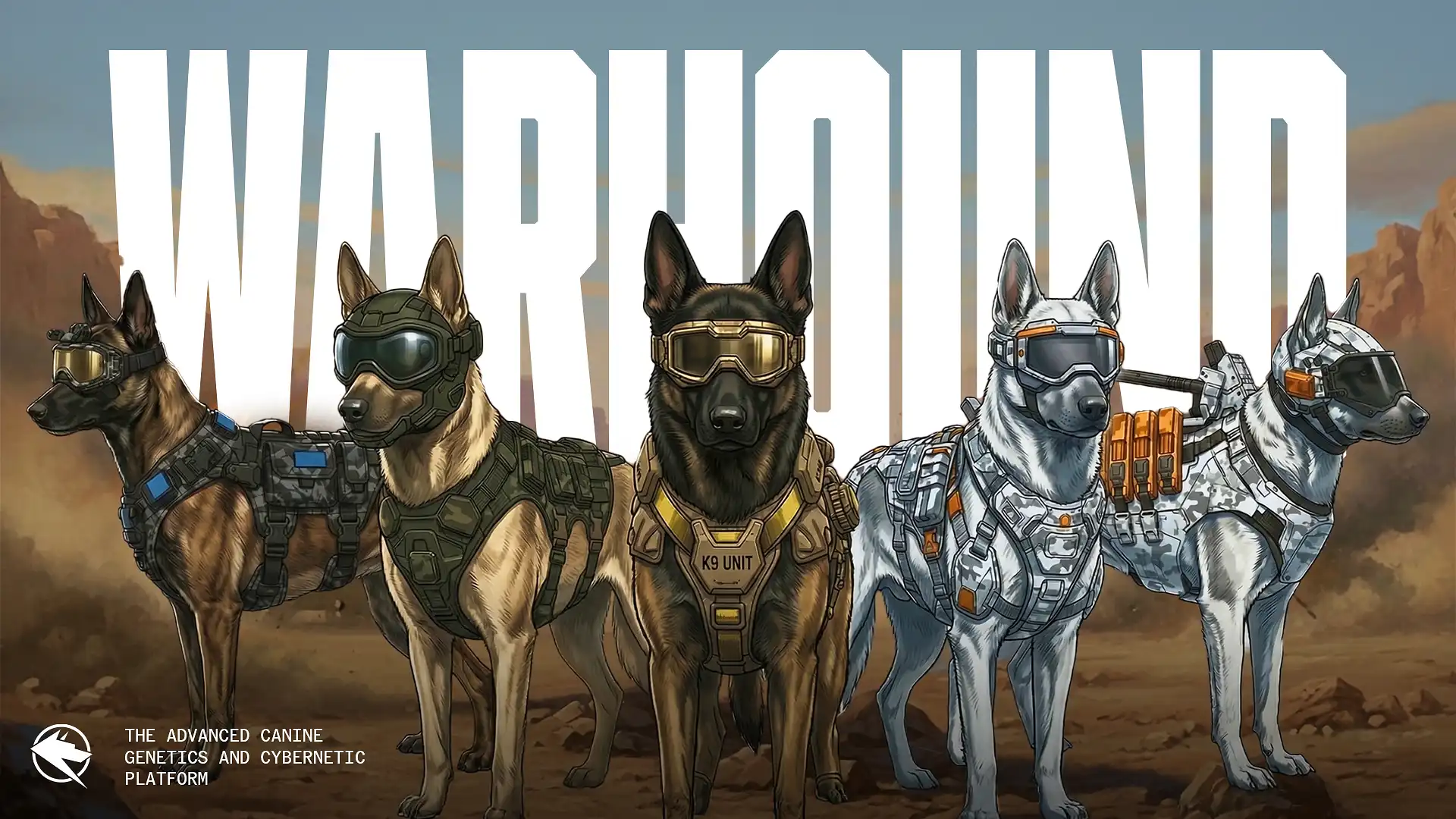
Warhound, a Texas-based defense technology company conceived by Colossal Biosciences chief executive Ben Lamm and Anduril Industries founder Palmer Luckey, emerged from stealth on October 22, 2026, with a $200 million seed round to clone, gene-edit and equip military working dogs for the U.S. armed forces, law enforcement and first responders. The round reportedly values the company at $1.2 billion and was led by Sequoia Capital partner Shaun Maguire, with In-Q-Tel, the venture arm of the U.S. intelligence community, among the backers.
The pitch targets a supply chain the Pentagon has struggled to secure. The Department of War’s Military Working Dog Program, which traces its lineage to the Army’s K-9 Corps established in 1942, fields more than 2,200 dog teams, and more than 80% of its dogs are acquired from Europe, according to Warhound. Fewer than half of procured dogs are judged fit for service after a roughly three-year acquisition and training pipeline, meaning the services must source about 200 dogs to field 100. Lamm told Fortune that U.S. buyers now compete with other governments, including China and Russia, for a shrinking pool of European breeding stock.
How Warhound Plans to Clone and Edit Military Working Dogs
Warhound’s production model runs in three stages. The company identifies top-performing dogs that have completed training, biobanks their cells, then clones those proven animals while applying targeted gene edits. Belgian Malinois and German Shepherd cell lines have already been biobanked and editing is under way, according to Lamm. Cloning will be performed with Viagen, the animal cloning specialist Colossal acquired in November 2025.
The first editing priority is subtractive: screening out known variants linked to hip dysplasia, muscle degeneration and other inherited conditions that end careers in training or early service. Enhancements to olfactory performance, speed, agility and longevity are under study, though Lamm told Fortune the company is still determining which traits are “scientifically and responsibly actionable.”
The technical foundation is Colossal’s April 2025 dire wolf project, in which scientists edited about 20 sites across 14 genes in gray wolf cells, cloned pups from the edited cells and used domestic dogs as surrogates. Warhound expects its first cloned dogs to be born in early 2027 and the first animals to enter service within about two years. Lamm conceded that training and environment will always influence performance; cloning reproduces a genome, not a behavioral record.
How Anduril Gear Links Dogs, Handlers and the EagleEye Network
Anduril’s contribution sits on the dog rather than in it. The company will supply eye and ear protection, body armor and integration with EagleEye, the modular mixed-reality helmet family Anduril unveiled in October 2025 on the back of the Army’s Soldier Borne Mission Command (SBMC) program, the successor to the Integrated Visual Augmentation System (IVAS). Anduril received a $159 million SBMC prototyping award in September 2025. Warhound’s release labels the canine equipment “cybernetic Augments,” and Lamm told TechCrunch the concept includes sensor-equipped protective vests that feed data back to handlers.
The logic is to put the dog-and-handler team on the same network as the squad and its drones. A working dog that reports position and environmental data through a handler’s heads-up display reduces the need for constant visual contact during detection or clearance tasks, and gives the small-unit leader a picture of where the dog is working. Warhound has not released specifications for the vests, their sensor suite, power requirements, weight burden on the animal or datalink architecture, and none of the equipment has been publicly tested with canine teams.
No Contract Yet: Pricing, Procurement and Cloned K-9 Precedents
Warhound has no signed government customer and has not set a price per dog. Lamm told Fortune the company is discussing a “Canine-as-a-Service” model under which an agency would buy a steady flow of trained dogs rather than individual animals, and told TechCrunch that Warhound has briefed multiple government organizations. Chief executive David Spirk, a former Marine, was the first chief data officer of U.S. Special Operations Command (USSOCOM) and later served as the Pentagon’s chief data officer. Colossal licenses its technology to Warhound and holds equity; Luckey holds none. The American Humane Society will certify the training programs.
Current costs provide a baseline. A 2020 Bloomberg report put a dog at roughly $9,000 from U.S. breeders and $5,500 from overseas vendors, with training that can exceed $60,000 per animal. The Air Force, which serves as executive agent for the program at Joint Base San Antonio-Lackland, Texas, budgeted $45 million for military working dogs in fiscal 2025.
Cloned working dogs are not new. South Korea’s customs service fielded six cloned detection dogs in 2009, and Chinese researchers cloned a Kunming wolfdog police dog named Kunxun in 2019. Practitioners remain cautious: Joshua Morton, a former Navy SEAL who founded Canine Tactical, told Forbes that conventional breeding yields only a 10% to 15% success rate per litter for dogs meeting U.S. military standards, but warned that cloning can compound genetic defects across generations.
Analysis: Warhound treats a biological asset as a sovereign supply chain problem, the same logic Washington has applied to rare earths, energetics and microelectronics, and In-Q-Tel’s participation signals that the intelligence community sees detection canines as part of that discussion. Its central claim, however, rests on an untested link between genotype and graduation rate. Many washouts reflect temperament and drive, traits shaped heavily by rearing and training, so an edited clone line will not erase attrition on its own. The nearer-term value may be the subtractive work: removing heritable orthopedic and degenerative defects from proven bloodlines could extend service life and protect the $60,000-plus training investment in each dog.
The next markers are the first births expected in early 2027, Warhound’s first procurement vehicle and pricing, and how its edited animals will be handled under the Food and Drug Administration’s oversight of intentional genomic alterations in animals, a pathway the company has not addressed publicly. Whether the Pentagon accepts a subscription model for dogs, and whether Anduril’s canine equipment enters testing alongside SBMC, will determine if Warhound becomes a program supplier or remains a privately funded experiment.