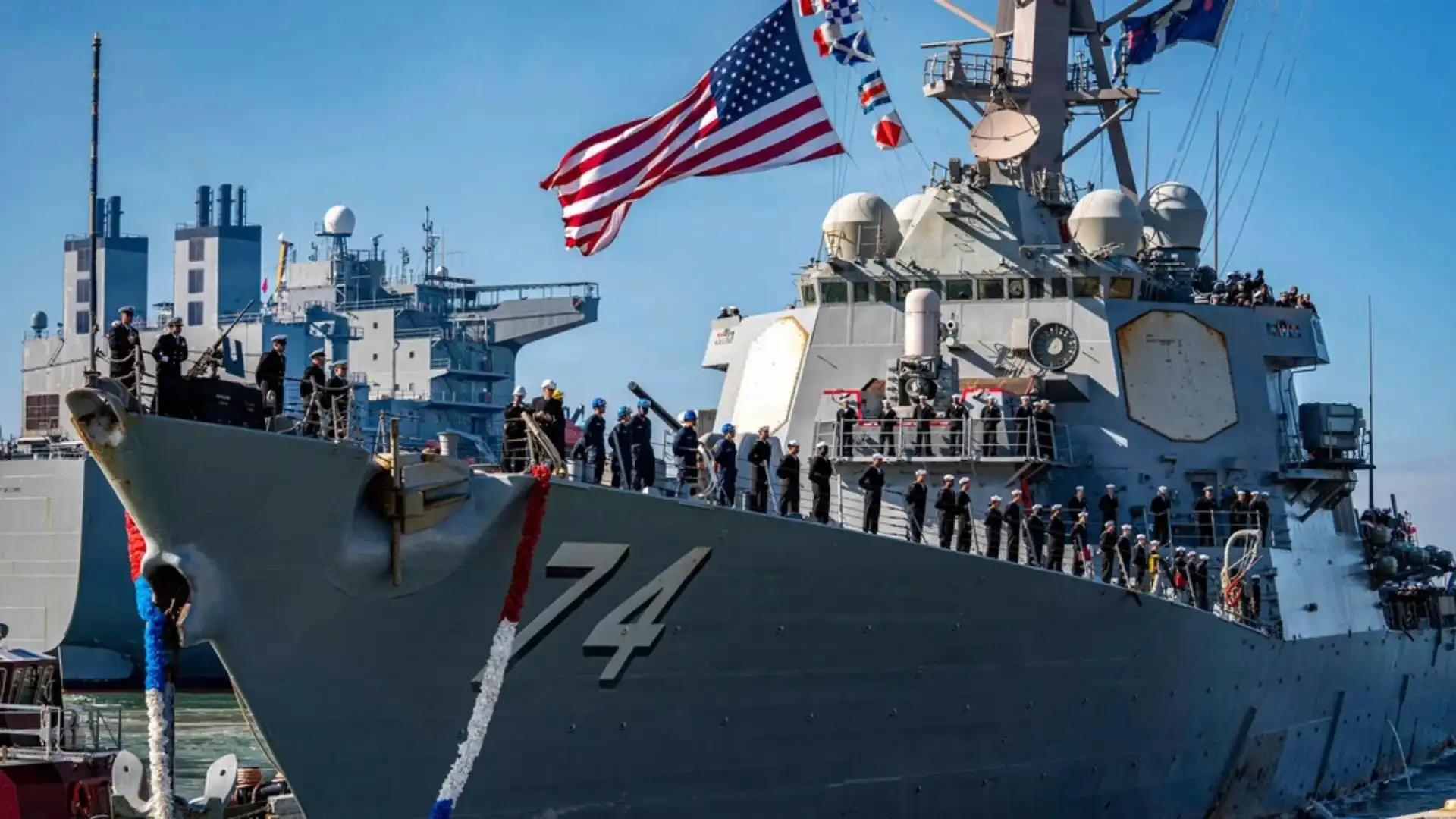
The U.S. Navy Arleigh Burke-class guided-missile destroyer USS McFaul (DDG 74) returned to Naval Station Norfolk, Virginia, on October 23, 2026, ending an 11-month deployment to the U.S. 5th and 6th Fleet areas of operations. During the cruise, the ship conducted combat missions in Operation Epic Fury and integrated with three carrier strike groups, according to the Navy.
McFaul left Norfolk on November 25, 2025, for what the Navy described as a regularly scheduled deployment. Three months later, on February 28, 2026, U.S. Central Command (CENTCOM) launched Operation Epic Fury with Israel, targeting Iran’s ballistic missile and drone forces, its navy and its defense industrial base. Major combat lasted about 40 days, until a Pakistan-mediated ceasefire took effect on April 8; the Pentagon has said 13 U.S. service members were killed. The 11-month cruise runs well past the roughly seven-month deployment built into the Navy’s Optimized Fleet Response Plan.
USS McFaul Deployment: Aegis Escort for Three Carrier Strike Groups
McFaul operated with the USS Abraham Lincoln, USS George H.W. Bush and USS George Washington carrier strike groups, providing anti-air warfare, surface warfare and naval surface fire support. The Navy said the ship employed its Aegis Combat System in the buildup to Epic Fury and during the operation. In the first week of the campaign, the USNI News Fleet and Marine Tracker listed McFaul among six independently deployed destroyers in the Arabian Sea, alongside USS John Finn, USS Milius, USS Delbert D. Black, USS Pinckney and USS Mitscher, while the Lincoln group operated in the same waters.
The carrier pairings trace the war’s arc. Lincoln, deployed from San Diego since November 2025, was in the Arabian Sea when the strikes began. The Norfolk-based Bush group sailed on March 31 and, after routing around Africa, entered the CENTCOM theater on April 23, after the ceasefire. The Japan-based George Washington entered the CENTCOM theater on August 19 to relieve Lincoln, a move that left no U.S. carrier in the Western Pacific. McFaul therefore covered both the high-intensity strike phase and the defensive posture that followed, in which Navy destroyers established a pathway for commercial shipping through the Strait of Hormuz, though CENTCOM said it was not providing dedicated escorts.
The Navy has not disclosed what McFaul engaged, how many missiles it fired, or whether it launched Tomahawk land-attack missiles. Commanding officer Cmdr. Adam Samson credited the crew with “the grit, technical mastery, and resilience required to protect our strike group.”
Flight II Arleigh Burke Specifications and the Aegis Air Defense Role
McFaul was commissioned on April 25, 1998, in Savannah, Georgia, as the 24th ship of its class and the 11th built by Ingalls Shipbuilding in Pascagoula, Mississippi. It belongs to Flight II, the seven-ship block that added Link 16 tactical datalinks, an upgraded AN/SLQ-32 electronic warfare suite and the ability to fire extended-range Standard Missile-2 Block IV interceptors, per publicly available program data.
Publicly available specifications indicate a 505-foot hull driven by four General Electric LM2500 gas turbines delivering about 100,000 shaft horsepower to two shafts, for speeds above 30 knots. The AN/SPY-1D passive electronically scanned array radar feeds the Aegis weapon system, which manages 90 Mk 41 vertical launch cells able to carry Standard Missiles and Tomahawks. A 5-inch/54-caliber Mk 45 gun, two Phalanx close-in weapon systems and Mk 32 torpedo tubes complete the armament. Its crew numbers more than 300.
Two design limits shaped McFaul’s role. Like all Flight I and II ships, it has a flight deck but no helicopter hangar, so it relies on the strike group’s aviation for persistent anti-submarine and surface search. Its 90 cells also cannot routinely be reloaded at sea, so every interceptor an Aegis destroyer fires shortens its time on station. In a carrier escort, magazine depth sets the pace of operations.
Analysis: McFaul’s return underlines how heavily the Navy leaned on legacy Aegis hulls to sustain a multi-carrier commitment against Iran. A 28-year-old Flight II destroyer, without a hangar or the AN/SPY-6 radar fielded on Flight III ships, served as front-line air defense for three different strike groups, a sign that the surface combatant inventory leaves little room to rotate older ships out of high-threat roles. Coming after an eight-month deployment that ended on January 4, 2024, this 11-month cruise consumes hull life and pushes work into a ship maintenance enterprise that already struggles to complete availabilities on time. The cost of Epic Fury is likely to surface as reduced destroyer availability through 2027 and 2028.
Ships returning from deployment typically enter a maintenance availability; the Navy has not announced the timing or scope for McFaul. Key unknowns remain: the number and type of missiles the ship expended, whether it intercepted Iranian threats, and how quickly those rounds can be replaced at current Standard Missile production rates. The answers will shape how the Navy rotates Aegis destroyers through the Middle East while protecting commercial traffic through Hormuz remains a requirement.