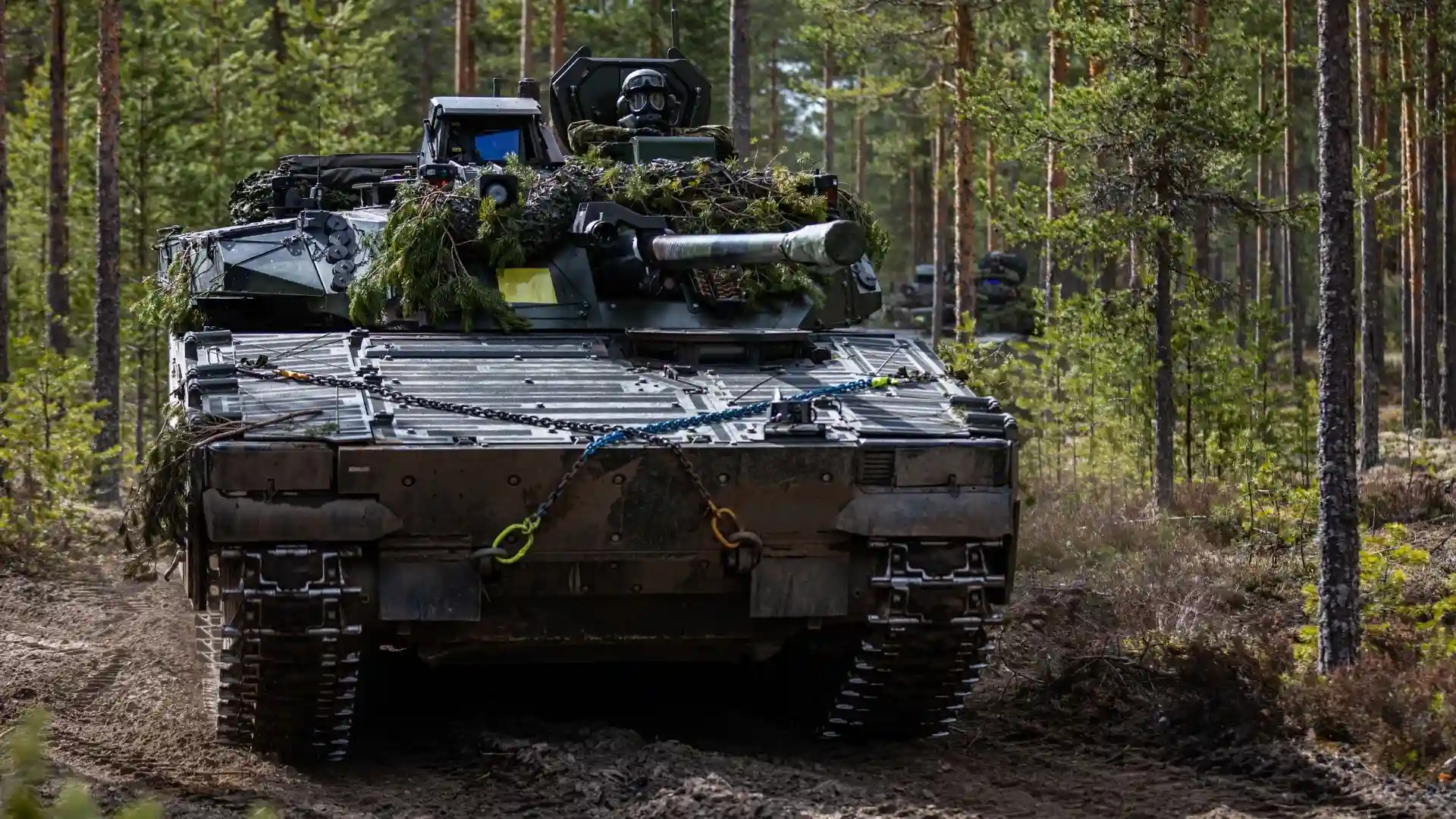
The Netherlands will buy additional CV90 infantry fighting vehicles, more bridge-laying tanks and new breaching vehicles to replace its Kodiak armored engineer fleet, and has selected Germany’s Flensburger Fahrzeugbau Gesellschaft (FFG) to supply Armoured Combat Support Vehicles (ACSV) and Wisent 2 heavy recovery vehicles. State Secretary for Defence Derk Boswijk informed the House of Representatives in writing, the Ministry of Defence announced on October 26, 2026. The ministry did not disclose quantities, contract values or delivery dates.
The ministry ties the package explicitly to a possible large-scale conflict in Europe. Most of the equipment goes to the Royal Netherlands Army’s heavy and medium infantry brigades, which are absorbing a rebuilt tank battalion with newly ordered Leopard 2A8 tanks and a new armored infantry battalion.
CV90 Infantry Fighting Vehicles for a New Battalion in Budel
The additional CV90s will equip an armored infantry battalion still to be formed at the Nassau-Dietz barracks in Budel, under the 13th Brigade. The Netherlands is buying through a joint procurement led by Sweden, which concludes a framework agreement with manufacturer BAE Systems Hägglunds under which participating countries place their own purchase confirmations. The Netherlands, Sweden, Finland, Norway, Lithuania and Estonia signed an agreement on November 12, 2025, to coordinate the assessment, development and acquisition of the CV90; the ministry says participation speeds delivery.
The vehicle on order is the CV90 Nordic Edition, a military off-the-shelf configuration that builds on the standard the existing Dutch fleet is reaching through its mid-life update (MLU). A December 2025 letter to parliament set the project’s budget band at €1 billion to €2.5 billion at 2025 prices and sized the new battalion at roughly 790 positions, supported by unmanned aerial and ground systems bought for the same unit. The vehicle count has not been published.
The army already operates 122 CV9035NL vehicles now going through the MLU, which adds an active protection system against anti-tank guided missiles. Publicly available specifications indicate the CV9035NL carries a 35 mm cannon and up to seven dismounted infantry. A common Nordic configuration gives Dutch crews shared spares, training and upgrade paths with partners on NATO’s northern and eastern flanks.
Replacing the Kodiak Breaching Vehicle and Expanding Bridge-Laying Capacity
The ministry’s sharpest language targets the Kodiak armored engineer vehicle. The Netherlands ordered 10 Kodiaks from the Rheinmetall and RUAG consortium in January 2008 in a joint buy with Sweden, built on surplus Leopard 2A4 hulls. Publicly available specifications describe a vehicle of roughly 62 tonnes with a crew of three, a hinged-arm excavator, a dozer blade and an optional mine-clearing module. The ministry now calls the system outdated, insufficiently protected against current and future threats, and hampered by malfunctions and outages that limit availability.
The ministry intends to replace it with reliable vehicles able to breach heavy defensive lines, minefields, walls and other obstacles. No platform has been selected; Leopard 2-based engineer vehicles on the market include Rheinmetall’s current Kodiak variant and FFG’s Wisent 2 in its engineer configuration.
For gap crossing, the army fields eight Leguan close support bridge vehicles on Leopard 2 chassis, ordered through a bilateral arrangement with Germany in 2016 and fully delivered by 2021; each carries one 26-meter bridge or two 14-meter bridges. The ministry says it will probably join a German contract for additional bridge-laying tanks.
How FFG and Van Halteren Will Deliver the ACSV and Wisent 2
The ACSV is a tracked carrier derived from FFG’s Protected Mission Module Carrier G5. Manufacturer data indicate a gross weight of 26 tonnes, an 8-tonne payload and a 460 kW MTU engine, with a rear deck that accepts 10-foot ISO container mission modules. The Dutch buy covers ambulance, command post, minelayer and driver training variants. Norway already operates the type, and the Netherlands has chosen the same chassis for its NOMADS short-range air defense system and 22 Rheinmetall Skyranger 30 counter-drone systems due from 2028.
The Wisent 2 sits on a Leopard 2 chassis and, per manufacturer data, weighs up to 69.5 tonnes with a 1,100 kW engine and mobility FFG rates as equal to the Leopard 2 tank. In the recovery role it carries a crane with a 32-tonne lifting capacity, and it can be reconfigured as an engineer vehicle in under five hours. The army operates 25 Bergepanzer 3 Büffel recovery vehicles; in February 2026 the ministry told parliament that its heavy and medium brigades need additional heavy recovery capacity.
Van Halteren Technologies will assemble both the ACSV and the Wisent 2 in the Netherlands and maintain them. KONI Netherlands and Neways Electronics will supply components, and Avient Protective Materials, producer of Dyneema ultra-high-molecular-weight polyethylene fiber, will provide ballistic protection material for the ACSV.
Analysis: The package is less about firepower than about enablers that have long been thin across European armies: breaching, bridging, recovery and protected support. The Dutch approach rests on two common platforms. Leopard 2 hulls underpin the Leopard 2A8, the Wisent 2, the Leguan and possibly the Kodiak successor, while the ACSV chassis spans air defense, medical, command and mine-laying roles. That commonality shortens the logistics tail a deployed brigade must carry, and domestic assembly gives the Netherlands repair and regeneration capacity it would need in a prolonged war. The weak point is timing. No Kodiak successor has been selected, so the army will keep relying on a breaching fleet its own ministry calls outdated and prone to breakdowns.
The next milestones are the German bridge-layer contract the Netherlands expects to join, contract signature and vehicle counts for the ACSV and Wisent 2, the Dutch purchase confirmation under the Swedish-led CV90 framework, and the selection of a Kodiak successor. Unit costs and quantities remain undisclosed.