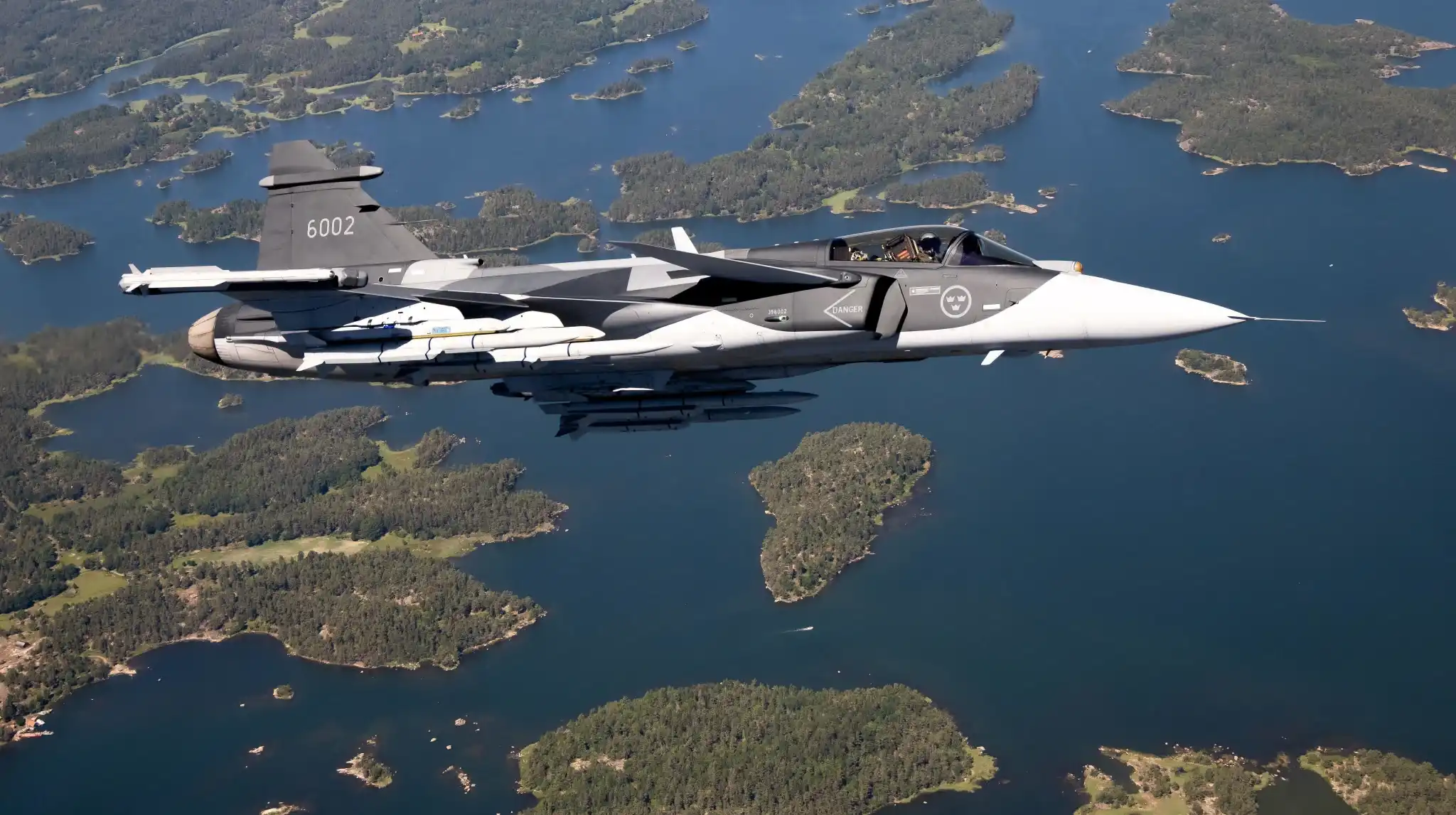
Saab is offering to manufacture Gripen fighters in Canada as part of a campaign to persuade Ottawa to operate a mixed fleet in which the Swedish jet would fly alongside the Royal Canadian Air Force (RCAF) Lockheed Martin F-35A Lightning II. President and Chief Executive Micael Johansson laid out the pitch on Saab’s third-quarter earnings call on October 23, 2026, telling investors that local production and the ability to operate from dispersed air bases sit at the core of the proposal. Saab, he said, is campaigning to convince Canadian decision-makers that a dual fleet is the right fit.
The offer lands at a sensitive point in Canada’s fighter replacement effort. Ottawa signed for 88 F-35As under the Future Fighter Capability Project in January 2023, but Prime Minister Mark Carney ordered a review of the purchase in March 2025 amid trade friction with Washington. That review, originally expected to end around September 2025, remains open with no deadline. Canada holds a legal funding commitment for only the first 16 aircraft, plus long-lead payments for 14 more reported in February 2026. Meanwhile, the RCAF accepted its first two CF-35As at Luke Air Force Base, Arizona, in October 2026 for pilot training, and on October 7 Defence Minister David McGuinty announced nearly C$4 billion for fighter infrastructure at 4 Wing Cold Lake, Alberta.
How Saab Would Build Gripen in Canada: Assembly, Partners and Jobs
Johansson said the industrial package rests on a Gripen manufacturing hub in Canada and cooperation with Canadian companies. He gave no workshare, investment or production-rate figures. Saab’s earlier public offer covered final assembly, integration, testing, sustainment and mission-system upgrades on Canadian soil, together with a secure data center in Montreal designed to keep operational and mission data under Canadian control. The company has cited up to 10,000 Canadian manufacturing and research jobs. In 2026, Saab also signed a memorandum of understanding with Montreal-based CAE, under which CAE would build the Gripen pilot and technician training ecosystem if Canada selects the aircraft.
Saab currently builds the Gripen E/F at Linköping, Sweden, and at Gavião Peixoto, Brazil, where the first locally produced Gripen E rolled out in early 2026. Saab signed a SEK 24.6 billion contract on June 30, 2026, for 16 Gripen E fighters for Ukraine, booked in the third quarter, and company executives have presented Canada as a possible export base to absorb rising demand. That is the substance of the sovereignty argument: domestic production control and technology transfer in exchange for long-term volume.
Gripen E vs F-35A: Dispersed Basing, Combat Mass and Mission Split
Johansson framed the two aircraft as complementary rather than rival, arguing that the F-35 excels in specific roles while Gripen adds combat mass and basing flexibility. The F-35A is a fifth-generation, low-observable fighter powered by a single Pratt and Whitney F135, carrying weapons internally and fusing data from its AN/APG-81 active electronically scanned array (AESA) radar and AN/AAQ-37 Distributed Aperture System.
The Gripen E is a single-engine fighter optimized for cost, availability and dispersed operations. Publicly available specifications indicate a General Electric F414G engine rated at roughly 98 kN with afterburner, a Leonardo Raven ES-05 AESA radar on a mechanical repositioner, a Skyward-G infrared search and track sensor, the Arexis electronic warfare suite and 10 weapons stations compatible with the MBDA Meteor beyond-visual-range missile. Swedish doctrine built the aircraft to fly from road strips of about 800 meters and to be rearmed and refueled by a small ground crew in roughly 10 minutes. For an air force that uses Arctic forward operating locations at Inuvik, Yellowknife and Iqaluit under the North American Aerospace Defense Command (NORAD), that profile suits quick reaction alert and sovereignty patrols, leaving the F-35 for high-threat and coalition missions.
The trade-off is two training, logistics and sustainment pipelines. The Gripen E finished second to the F-35A in the 2022 evaluation, and Canadian media reported mixed-fleet scenarios in mid-2026 ranging from roughly 30 F-35As with 60 Gripen Es to a larger combined force of more than 100 aircraft. Ottawa has confirmed none of them.
Six GlobalEye Aircraft: Term Sheet Signed, Contract Still Pending
Saab is also negotiating the sale of six GlobalEye airborne early warning and control (AEW&C) aircraft. Canada named Saab preferred supplier on May 27, 2026, and on September 25 the company signed a non-binding term sheet with the Canadian Defence Investment Agency covering six aircraft with associated systems, training and support. Johansson gave no date for a final contract. That offer also includes a Canadian production hub, with Saab remaining responsible for delivering the aircraft; he cautioned that setting it up would take time and investment.
GlobalEye pairs the Erieye ER S-band AESA radar with maritime surveillance radar and electro-optical sensors on a Bombardier Global 6500 airframe, a business jet Bombardier already produces in Canada. Sweden operates both GlobalEye and Gripen, which lets Saab present them as one integrated package rather than two separate sales.
Analysis: Saab is no longer selling an airframe against the F-35; it is selling a hedge against dependency. With 16 F-35As firmly funded and long-lead money placed on 14 more, Ottawa already has a path to a fifth-generation core able to preserve NORAD and NATO interoperability with United States fifth-generation fleets. A Canadian Gripen line would give Ottawa something it has lacked since Canadair built the CF-116 in the late 1960s: a domestic fighter production base under national control. The cost is structural: two fighter types would stretch an RCAF already short of pilots and technicians, and Canada’s observer status in the Global Combat Air Programme adds a third long-term claim on the same budget.
Johansson said he would attend an aerospace summit in Canada the following week and expected a clearer read on Saab’s prospects there, but offered no timeline for an order. As he put it, “it is still a political decision to take for Prime Minister Carney.” Open questions remain the review’s end date, the final F-35A count and whether the GlobalEye term sheet becomes a binding contract first.