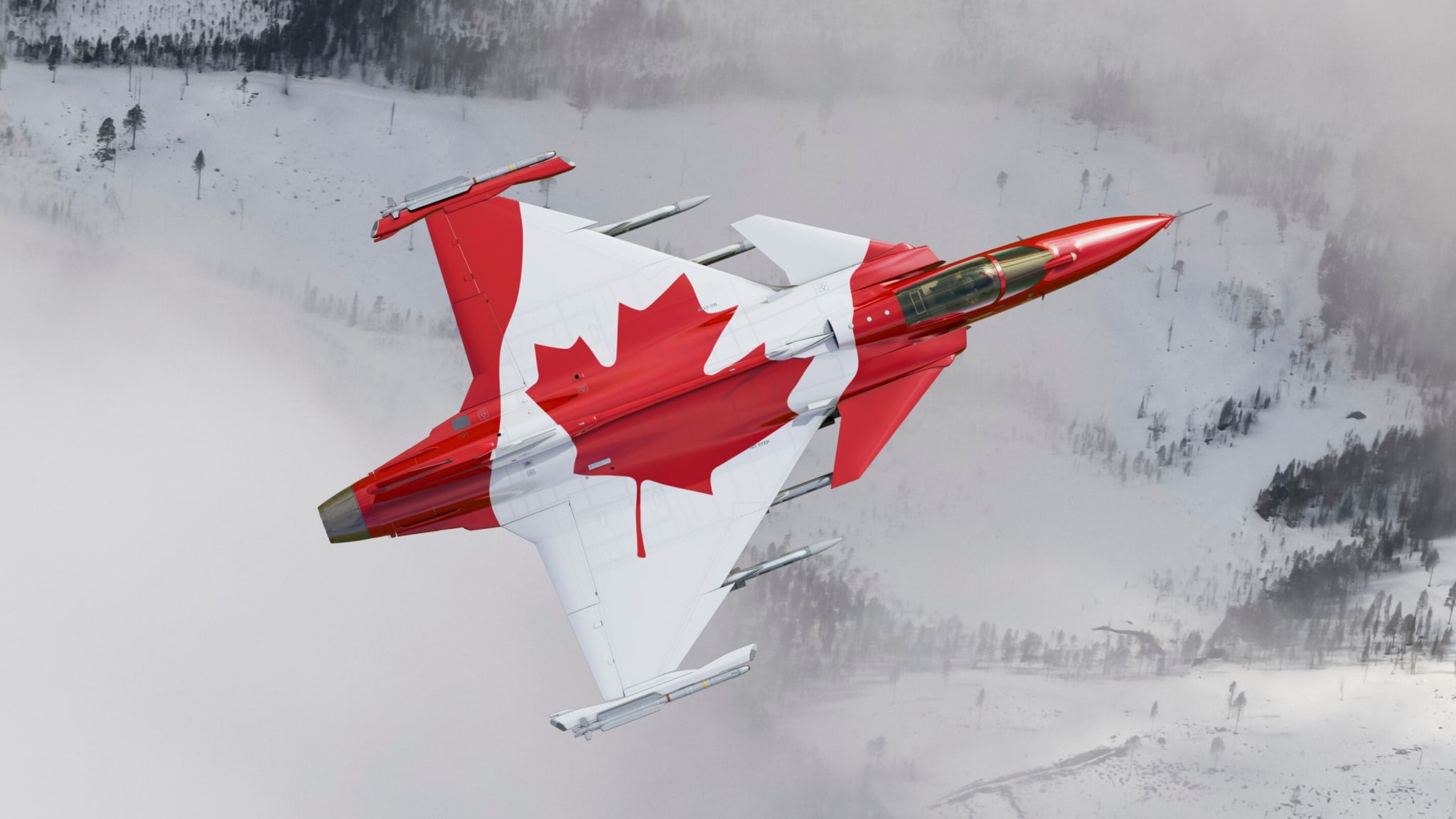
Swedish company Saab named CAE, IMP Aerospace & Defence and Magellan Aerospace on October 27, 2026, as its principal Canadian industrial partners for the Gripen E, signing a teaming agreement under which Halifax-based IMP would establish a Gripen final assembly line in Canada. Every arrangement is conditional on Ottawa deciding to acquire the multirole fighter, and none carries a disclosed value, workshare or production rate. The announcement coincided with the Canadian Aerospace Summit in Ottawa.
The partner list turns a sales pitch into a supply chain. Saab chief executive Micael Johansson said on August 22, 2026, that an order of at least 40 Gripen E fighters would justify Canadian final assembly, and the company has said it needs a third Gripen line, after Linköping, Sweden, and Embraer’s plant at Gavião Peixoto, Brazil, to meet export demand. The review of the 88-aircraft F-35A purchase that Prime Minister Mark Carney ordered in March 2025 remains open, Canada is legally committed to only 16 jets, and the Royal Canadian Air Force (RCAF) received its first two CF-35As at Luke Air Force Base, Arizona, in October 2026.
How IMP Would Run Gripen Final Assembly and Fleet Sustainment
IMP’s teaming agreement covers three tasks: a new final assembly line, electrical assembly production and in-service support (ISS) for a Canadian Gripen fleet. Saab did not say where the line would sit. IMP is headquartered in Halifax, Nova Scotia, and maintains aircraft at Halifax Stanfield International Airport.
The selection reflects IMP’s standing as one of the RCAF’s largest sustainment contractors rather than as a fighter builder. The company, which reports more than 2,400 staff, has supported the CP-140 Aurora maritime patrol fleet since it entered service in 1981, including the Aurora Incremental Modernization Project, and holds CP-140 airframe support through 2030 and CH-149 Cormorant ISS through 2032. Its share of the Cormorant Mid-Life Upgrade, under which it assembles 13 of 16 modernized helicopters in Halifax, gives it recent series assembly experience.
IMP has backed the Swedish fighter since Saab formed its Gripen for Canada team in March 2020, alongside CAE, Peraton Canada and GE Aviation. IMP president David Gossen framed the proposed line as an export asset, saying the company sees “a real opportunity” to produce and support aircraft for Gripen customers internationally. That matches Saab’s own requirement: a Canadian line would build for third-country operators, not only for the RCAF.
Magellan Aerostructures, CAE Training and the Brazilian Gripen Precedent
Magellan Aerospace’s new memorandum of understanding (MOU) covers local manufacture of advanced aerostructures, composite structures and structural assemblies. Neither company has identified which Gripen sections would be built in Canada, and Magellan describes the MOU as an agreement to explore that work, a more tentative formulation than IMP’s teaming agreement.
The Mississauga-based supplier sits on both sides of Ottawa’s decision. Its Winnipeg plant builds horizontal tail assemblies for the F-35A under contract to BAE Systems, a program in which it has targeted more than 1,000 shipsets. In July 2026, Magellan also signed an agreement with GE Aerospace covering maintenance of the Gripen E’s F414 engines, again contingent on a Canadian order. It already provides design and engineering support for the F404 engines of the RCAF’s CF-188 Hornet fleet, the engine family from which the F414 was derived.
The structure mirrors Brazil’s Gripen program. There, Saab Aeronáutica Montagens in São Bernardo do Campo builds tail cones, forward and rear fuselage sections, wing boxes and air brakes that feed Embraer’s final assembly line at Gavião Peixoto for the 36 Gripen E/F Brazil contracted in 2014. The difference is ownership: Saab built the Brazilian aerostructures plant itself, whereas the Canadian offer places that work with an independent supplier that already carries a military order book.
CAE completes the industrial chain under an MOU signed July 17, 2026, covering pilot and technician training, simulators, mission systems engineering and sustainment. The Montreal company already anchors RCAF aircrew training through SkyAlyne, its joint venture with KF Aerospace, which holds the 25-year, C$11.2 billion Future Aircrew Training contract awarded in May 2024.
Analysis: Saab has not created a new Canadian prime around Gripen; it has mapped the offer onto firms that already hold RCAF sustainment, engine support and training work. That lowers execution risk and lets Saab argue that control over the fleet’s whole life cycle, not just its assembly, would sit in Canada. The weak point is volume. Saab’s own 40-aircraft floor, combined with IMP’s export language, means a Canadian line makes economic sense only if Saab routes third-country orders through it, so part of Canada’s sovereignty case would rest on Saab’s global order book. Magellan’s position on both programs also suggests that a split buy would not force Canadian industry to choose sides, since its F-35A tail work is tied to global production volumes rather than to the size of Canada’s order.
The next milestones sit in Ottawa, not Linköping. The government has set no date to close the F-35 review, and none of the three agreements becomes binding work without a Canadian order. Saab’s September proposal reportedly envisioned about 10 prime partners and 250 suppliers, so most of the supply chain remains unnamed, as do the Gripen sections Magellan would build, the planned production rate and the investment needed to stand up the line. Bombardier, which Saab’s chief executive cited as a production discussion partner in November 2025, does not appear among the three named partners.