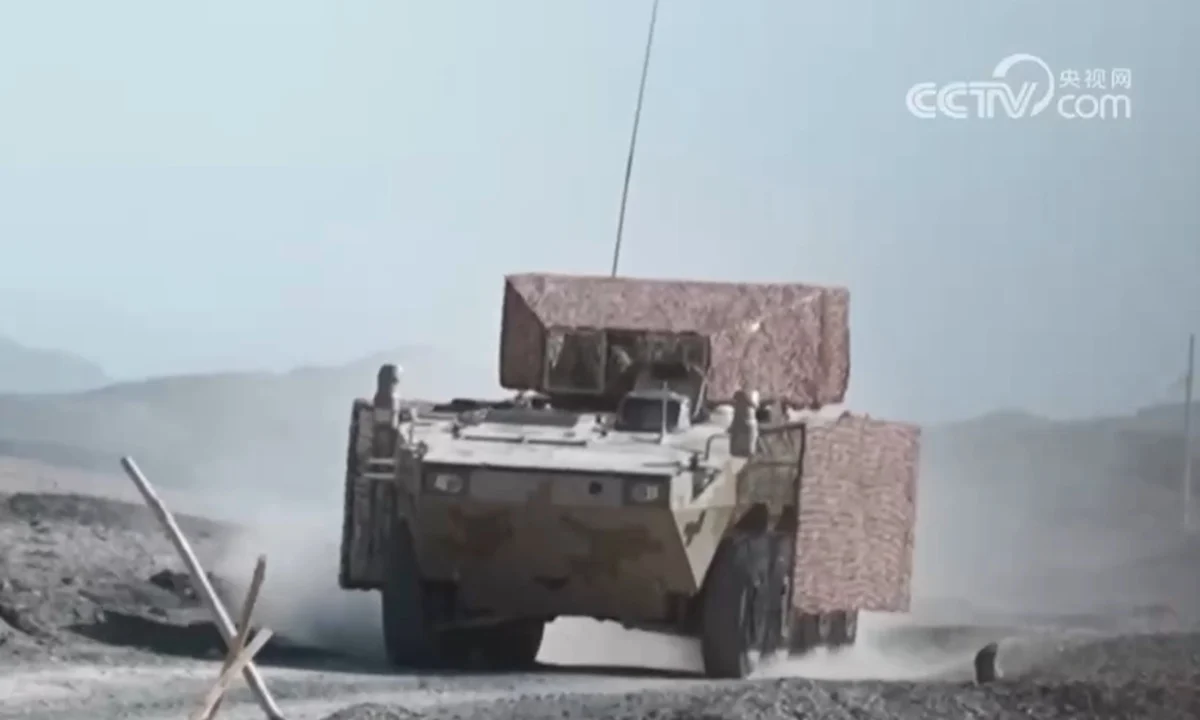
Chinese Type 08 infantry fighting vehicles fitted with welded anti-drone roof cages and side grilles carried assault troops through Karakoram 2026, the first joint army exercise between China and Pakistan, according to footage aired by Chinese state broadcaster CCTV on October 21, 2026. The drill is under way in Korla, in China’s northwestern Xinjiang region, where mixed Chinese and Pakistani units are rehearsing a complete raid on a mock militant camp.
China’s Ministry of National Defense announced the exercise on October 10, 2026, framing it around joint counterterrorism operations at high altitude, with training in drone operations, on-the-move target acquisition and firing, long-range sniping, joint command, and live-force drills. Until now, ground cooperation between the two militaries ran mainly through special operations and border units, while their air forces and navies trained together under the Shaheen and Sea Guardians series. Every weapon and vehicle in play is Chinese-supplied.
Type 08 IFV Specifications and the Anti-Drone Cage Retrofit
The Type 08 is an eight-wheeled, amphibious, modular armored vehicle family built by Norinco. Its infantry fighting vehicle variant, designated ZBL-08, is a mainstay of People’s Liberation Army (PLA) mechanized infantry. Publicly available specifications indicate a combat weight of about 21 tonnes, a crew of three plus seven dismounts, and a Deutz BF6M1015C water-cooled V6 diesel rated at 440 hp (330 kW), for a power-to-weight ratio near 21 hp per tonne, a road speed of roughly 100 km/h, and a range of about 800 km. Armament centers on the ZPT-99 30 mm autocannon and a Type 86 7.62 mm coaxial machine gun, supplemented by HJ-73C anti-tank guided missiles.
The vehicles seen in the footage carried a metal grille over the roof and additional grilles along the hull sides, which CCTV said were designed specifically against drone attack. The ZBL-08’s heaviest protection is rated only over the frontal arc, leaving the roof, rear, and engine areas thinner, precisely where first-person-view (FPV) drones have repeatedly struck tanks and armored vehicles in Ukraine. Such cages, often called cope cages, first spread widely on Russian armor during that war.
Key details remain undisclosed: the cage’s mass, its effect on the vehicle’s amphibious capability and center of gravity, whether it obstructs roof hatches or turret traverse, and whether it is a standard field kit or an exercise-specific fit. The PLA has used similar fixes before, fitting cages to ZBD-09 infantry fighting vehicles and showing Type 15 light tanks with anti-drone cages during a high-altitude exercise in October 2024. Chinese military commentator Song Zhongping told the Global Times the roof cage was a rapid tactical adaptation drawing on lessons from Ukraine and the Middle East, adding that the PLA needs ways to counter militant groups that might use drones for sabotage.
How Karakoram 2026 Rehearsed Drones, Robots and Building Clearance
According to the CCTV footage, the main phase opened with reconnaissance vehicles and drones tracking mock enemy positions inside the camp. Snipers then moved into firing positions, drone swarms conducted one-way strikes on exposed targets, and armored vehicles followed with direct fire. Type 08 vehicles next carried the assault element forward and delivered clearance teams, with quadruped robots scouting building interiors ahead of the infantry.
The equipment list is entirely Chinese. Chinese military television reported that the participating units are using QBZ-191 rifles, Type 201 squad machine guns, ZTL-11 (Type 11) 8×8 assault vehicles, Type 08 IFVs, artillery, and drone and counter-drone systems. That gives the Pakistan Army, already a VT-4 tank operator, hands-on exposure to current PLA infantry kit.
Chinese soldiers told state television they had adopted close-quarters techniques from Pakistani counterparts, citing the Pakistan Army’s long counterinsurgency record. One described Pakistani troops bouncing grenades off the floor so they ricochet across a room rather than landing where an enemy could pick them up and throw them back.
Analysis: The cages matter less as hardware than as evidence of doctrine moving through the PLA. A force without recent combat experience is importing battlefield fixes from Ukraine and applying them across both tracked and wheeled platforms, even in a counterterrorism scenario where the likely threat is cheap commercial airframes rather than mass FPV strikes. For Pakistan, which faces cross-border militant threats along its border with Afghanistan, a drill built around drone swarms, counter-drone systems, and robotic reconnaissance doubles as a showcase of what Beijing can supply. For US and NATO planners, it signals that the PLA now treats top-attack protection as routine.
Beijing has given no end date for Karakoram 2026 beyond its mid-to-late October window. The open questions are whether the PLA standardizes an integrated anti-drone kit for the Type 08 family in place of welded grilles, whether Pakistan’s exposure to Chinese counter-drone systems translates into procurement, and whether similar cage designs begin appearing on export vehicles offered to partner armies.