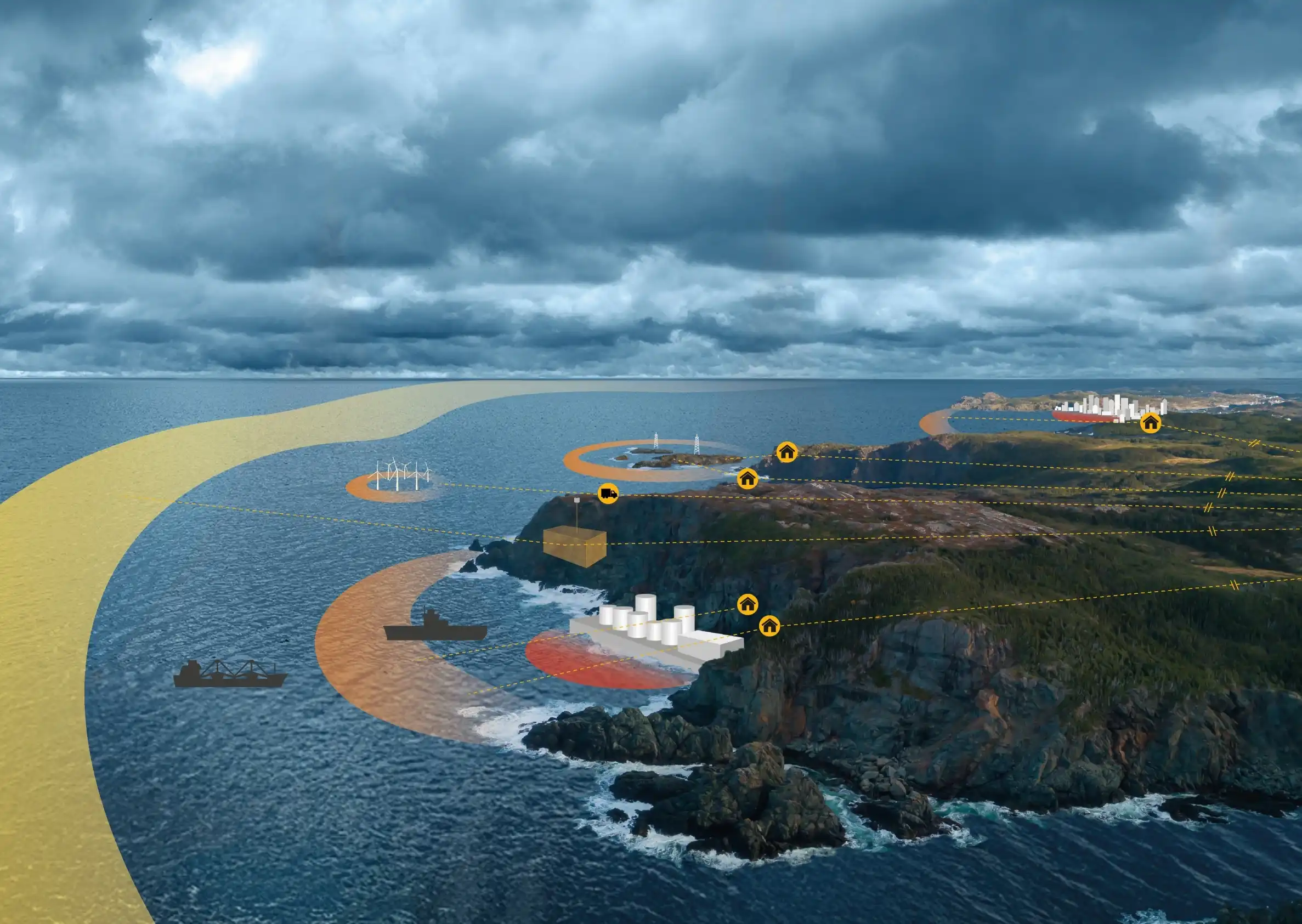
Saab unveiled Ocean Barrier on October 28, 2026, a scalable underwater surveillance system designed to detect, track and analyze subsurface activity around ports, naval bases, offshore installations, coastlines and territorial waters. The Swedish group positions the system as a single networked layer that fuses sensors, data collection and operator tools into one real-time picture of the undersea domain.
The launch comes as European navies confront a sustained run of suspected sabotage against seabed infrastructure. The October 2023 rupture of the Balticconnector gas pipeline and the December 2024 damage to the Estlink 2 power cable, which Finnish investigators linked to the tanker Eagle S, pushed NATO to launch its Baltic Sentry activity in January 2025. Åsa Schöllin, head of the Underwater Systems business unit in Saab’s Naval business area, framed the product around that grey zone threat to sea lines of communication, warning that an aggressor may seek to disrupt them, “damaging both economic activity and military logistics.”
How Saab Ocean Barrier Organizes Its Detect, Prevent, Protect Layers
Ocean Barrier is built around three defensive perimeters, designated Detect, Prevent and Protect. According to Saab, each perimeter can be tailored to a specific operating environment and can run independently or as part of a larger integrated architecture. That modularity is the system’s central design choice: the same framework is intended to scale from a single harbor or naval base to an offshore energy installation or an entire national coastline.
Saab has not disclosed which sensors populate each layer, the detection ranges it targets, or the response options tied to the Protect perimeter. The company describes the system as sensor-agnostic, meaning it is designed to ingest data from existing surveillance networks rather than impose a proprietary sensor fit. For operators that already run fixed hydrophone arrays, hull-mounted sonars or diver detection sonars, that approach lowers integration cost and preserves prior investment.
The product draws on an established underwater portfolio. Saab Kockums builds the A26 Blekinge-class submarines for the Swedish Navy, and the company fields the Double Eagle mine countermeasures vehicle and the AUV62 family of autonomous underwater vehicles. Saab has not specified whether any of these platforms are offered as organic sensors or responders within Ocean Barrier.
The architecture is described as modular and cyber-secure, with provisions to add new sensors, technologies and analytical tools as threats evolve. On October 21, 2026, Saab also signed a strategic collaboration agreement with Dutch firm Optics11, which specializes in passive fiber-optic underwater sensing. Neither company has announced a link between that agreement and Ocean Barrier.
REPMUS 2026 Demonstration: Autonomous Track Handoff via NATO-Standard Protocol
Saab showcased Ocean Barrier at REPMUS 2026 (Robotic Experimentation and Prototyping with Maritime Unmanned Systems), the NATO-backed experimentation event hosted by the Portuguese Navy from August 31 to September 25, 2026, around Troia. According to NATO, the edition drew more than 3,700 participants, roughly 300 uncrewed systems, 60 research and development companies and representatives of 36 navies.
During the exercise, Ocean Barrier fused data from diverse sensor systems and autonomously handed off tracked objects to the exercise’s central command system using a NATO-standard protocol, according to Saab. The company did not name the protocol, the number of tracks handled or the sensors involved.
The handoff matters more than the detection itself. A contact that stays inside a national or vendor-specific system cannot be prosecuted by an allied frigate, maritime patrol aircraft or uncrewed vessel without manual relay. Automated, standards-based track sharing shortens that chain and aligns with wider NATO work to network uncrewed assets at scale, including Task Force X-Arctic, whose connectivity backbone was assessed at the same exercise.
Analysis: Ocean Barrier is less a new sensor than an integration product, and that is where demand is moving. Navies and infrastructure operators in the Baltic and North Sea already own fragments of an undersea picture; what they lack is a fused, shareable track that triggers a timely response. By leading with sensor agnosticism and NATO-standard handoff, Saab is competing on systems integration, drawing on its submarine, torpedo and mine countermeasures base. The decisive test is the Protect layer, since detection without credible interdiction does little to deter grey zone actors.
Saab has announced no launch customer, pricing or delivery timeline. Indicators to watch include adoption by Nordic and Baltic critical infrastructure protection programs, any role within Baltic Sentry, and whether the Optics11 partnership feeds fiber-optic sensing into future configurations. Disclosure of sensor fits and Protect-layer effectors will determine how seriously navies treat the offering.