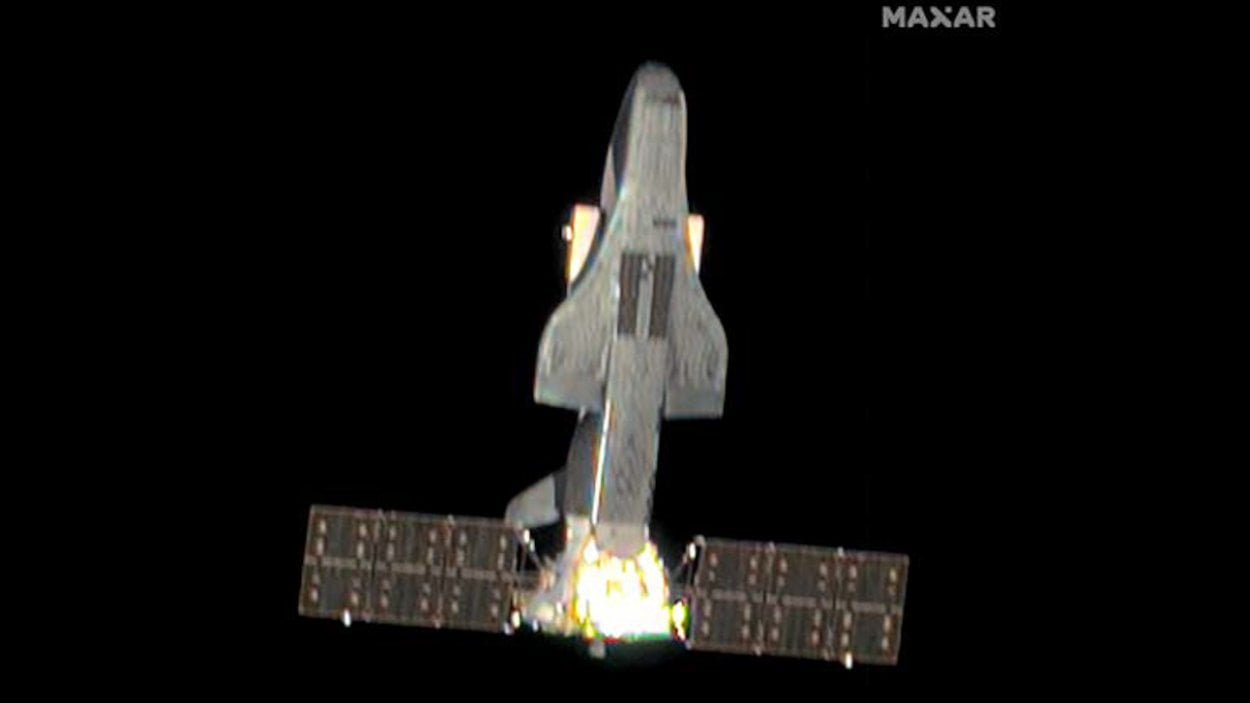
The Defense Intelligence Agency (DIA) has confirmed that a commercial satellite image first shown publicly in 2024 depicts China’s experimental reusable spaceplane in orbit. A sharper copy of the picture, taken by a Maxar Technologies (now Vantor) satellite and carrying a 2024 copyright date, appears in the agency’s 2026 Challenges to Security in Space report, released on October 26, 2026. The vehicle’s layout closely mirrors the U.S. Space Force’s Boeing X-37B Orbital Test Vehicle (OTV).
U.S. Space Force Col. John Patrick, then commander of U.S. Space Forces-Korea, first showed a much lower-resolution version at the Open Space Forum in South Korea in 2024, without confirming whether it depicted an X-37B. The DIA caption now settles the question, identifying a “PRC Spaceplane captured by Maxar.” The report follows editions published in 2019 and 2022 and lands while China’s spaceplane is flying its fourth mission.
What the DIA Image Reveals About the Chinese Spaceplane Design
As The War Zone (TWZ) noted in a side-by-side comparison with the X-37B, the image shows a miniature shuttle configuration with small wings, twin vertical tails and upward-opening doors above a central payload bay, which appears open. An aft extension carries solar panels deployed on either side, matching the service module concept the X-37B first flew on its OTV-6 mission in 2020 to expand payload capacity. Paired ventral bays likely house main gear for a tricycle arrangement, as on the X-37B. The clearest difference is the wing, which has a markedly longer chord than the X-37B’s.
Publicly available specifications indicate the X-37B measures 8.9 meters (29 feet 3 inches) long with a 4.5-meter (14-foot 11-inch) wingspan and a launch weight of roughly 4,990 kilograms (11,000 pounds) before the service module is added. China has released no dimensions, mass or payload figures for its vehicle.
After the fourth launch, amateur trackers reported an initial orbit near 494 kilometers at roughly 50 degrees inclination, followed by thruster firings on February 9 and February 12, 2026, that raised the vehicle to about 594 kilometers. That maneuvering margin underpins the DIA’s broader judgment that spaceplanes, being reusable and more maneuverable, suit certain missions better than traditional satellites.
Four Missions of Releases, Rendezvous and Proximity Operations Since 2020
The DIA report traces a program that moved quickly from demonstration to long-duration operations. The first mission, launched on September 4, 2020, lasted two days. The second, launched in August 2022, stayed in orbit for 276 days; in November 2022, the spaceplane appeared to maneuver alongside a companion satellite, at one point within about 100 meters, and possibly rendezvoused with it before releasing it again. The third mission ran 268 days, from December 14, 2023, to September 6, 2024, during which, according to the DIA, the vehicle released and interacted with an object; outside observers reported several smaller objects released on that flight. Given the 2024 date on the Maxar image, it was most likely captured during this third flight.
The fourth mission lifted off from the Jiuquan Satellite Launch Center aboard a Long March 2F on February 7, 2026. On June 22, 2026, commercial tracking firm LeoLabs detected an unknown object near the spaceplane and assessed with high confidence that the vehicle had released it. As of October 27, 2026, the mission had logged 262 days, with no public report of a landing.
Previous flights appear to have ended at a remote airfield in northwestern China with a runway of roughly 16,400 feet (5,000 meters), a facility that has expanded substantially in recent years. Chinese state media describe each flight only as technology verification for the peaceful use of outer space, without disclosing payloads or objectives.
Shenlong, Tengyun and the Wider Chinese Reusability Push
The DIA states that China has two primary spaceplane models, the Shenlong and the Tengyun, but does not specify which appears in the Maxar image. Shenlong is the name most commonly attached to the orbital vehicle; imagery that emerged in 2007 showed a prototype or test article slung beneath an H-6 bomber. Tengyun, unveiled in 2016 by the state-owned China Aerospace Science and Industry Corporation (CASIC), is part of a two-stage-to-orbit concept using an atmospheric carrier aircraft instead of a launch rocket. CASIC targeted a 2025 flight test, which remains unconfirmed. A third design, Haolong, from Aviation Industry Corporation of China (AVIC) subsidiary Chengdu, is in development as a cargo option for the Tiangong space station.
The spaceplane effort sits inside a broader reusability drive. On July 10, 2026, the China Aerospace Science and Technology Corporation (CASC) recovered the first stage of a Long March 10B at sea using a capture system aboard a specially configured recovery ship. On August 19, 2026, LandSpace landed the first stage of its Zhuque-3 in Minqin County, Gansu province, China’s first booster recovery on land. The DIA links these efforts, arguing that reusable technologies, though harder and costlier to develop, stand to greatly reduce the cost of spaceflight.
Analysis: The confirmation matters less for what it shows about the airframe than for what it signals about the contest around it. Washington has now publicly validated commercial non-Earth imaging of an adversary military spacecraft, turning space domain awareness into a function shared between government and industry. Meanwhile, the Chinese vehicle’s documented record, including deployment, rendezvous and re-release of a companion satellite, describes the core toolkit for on-orbit inspection and potential co-orbital counterspace operations. No public evidence shows weapon payloads aboard. Still, the United States no longer holds a monopoly on long-duration, maneuverable, reusable orbital test vehicles, and Beijing pairs its spaceplane with more than 510 ISR-capable satellites credited to the People’s Liberation Army by U.S. Space Force assessments.
The next marker is the fourth mission’s return: at 262 days, the flight is closing on the 276-day mark set by the second mission. Key indicators include a landing at the northwestern airfield, any confirmation of a Tengyun flight test, and the planned reflight of the recovered Long March 10B first stage.