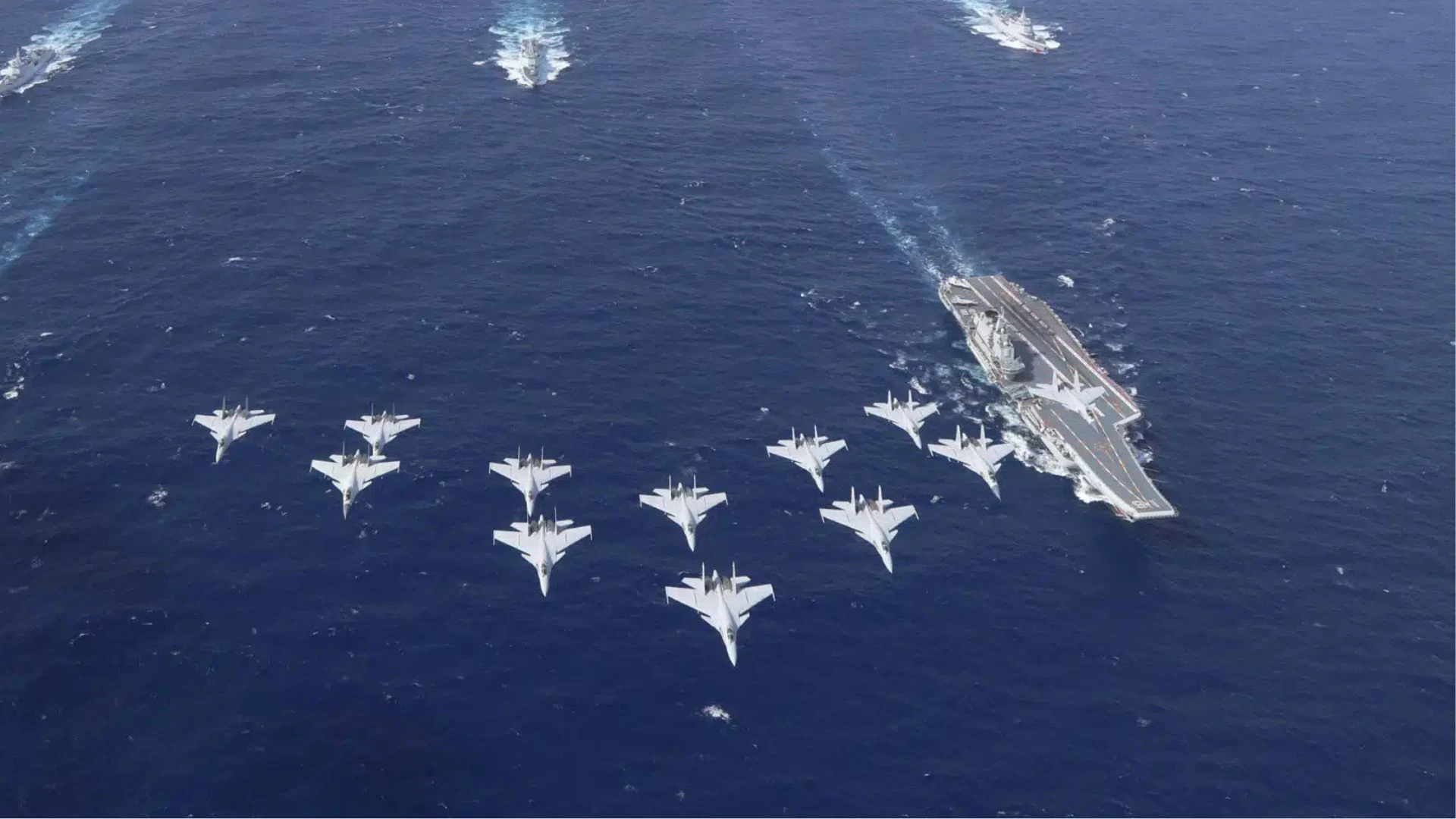
Taiwan’s National Security Council has mapped 53 Chinese navy and government vessels operating across a corridor stretching from southern Japan to the Philippines, including 34 People’s Liberation Army Navy (PLAN) warships and the aircraft carrier Liaoning. Secretary-General Joseph Wu released the map on social media on October 28, 2026, warning that “the simultaneous threat to Taiwan, Japan and the Philippines is obvious.” Taiwan’s Ministry of National Defense (MND) separately reported six PLA aircraft sorties, seven PLAN vessels and one Chinese official ship around the island in the 24 hours to 6 a.m. local time on October 29.
The disclosure is part of a deliberate Taiwanese effort to publish the positions of Chinese warships and China Coast Guard (CCG) cutters rather than leave regional deployments unreported. Wu posted a comparable map in May, and in July he reported more than 110 Chinese military and coast guard ships along the First Island Chain, a figure Taipei called a record. The current count is roughly half that peak; Taipei’s emphasis this time is geographic spread.
How the Liaoning Carrier Group Anchors a Three-Front Deployment
According to the map, the Liaoning and its escorts were positioned east of the Philippines, while other formations operated off Taiwan’s eastern and southeastern coasts and three more vessels sailed off southern Japan. Japan’s Ministry of Defense reported on October 28 that it had tracked three Chinese warships and a coast guard ship transiting the Osumi Strait, south of Kyushu, into the Pacific on October 27.
The carrier’s route to the Philippine Sea is partly documented. Japan’s Joint Staff reported that the Liaoning, two Renhai-class (Type 055) destroyers with hull numbers 103 and 104, and a Luyang III-class (Type 052D) destroyer, hull number 123, passed between Okinawa and Miyako-jima into the Pacific on October 14, with carrier-based fighters flying from the Liaoning about 250 kilometers south of Ishigaki-jima the same day. The Armed Forces of the Philippines, which counted 54 Chinese vessels in the West Philippine Sea between October 20 and October 26, said the carrier’s passage was not a cause for alarm.
Beijing framed the deployment as routine. Chinese defense ministry spokesperson Zhang Xiaogang said on October 29 that the Liaoning’s western Pacific training is an annual event to test long-range, open-ocean combat capability and is not aimed at any country. Taiwan’s Defense Minister Wellington Koo told reporters at parliament the same day that Taipei was unhappy with any attempt at deterrence signaling that could undermine peace and stability in the Indo-Pacific.
Liaoning, Type 055 Escorts, and the STOBAR Range Penalty
The Liaoning, commissioned in September 2012 from the unfinished Soviet hull Varyag, is the PLAN’s oldest carrier. Publicly available specifications indicate a displacement of roughly 60,000 tonnes, an overall length of about 305 meters and a steam turbine plant driving four shafts. The ship launches aircraft from a ski-jump bow in a short takeoff but arrested recovery (STOBAR) configuration, with an air wing estimated at up to 24 Shenyang J-15 fighters plus Z-18 helicopter variants for anti-submarine warfare and airborne early warning.
STOBAR operations impose hard limits. Without catapults, J-15 pilots must trade fuel or ordnance against takeoff weight, shortening combat radius against catapult-launched fighters. The lack of a fixed-wing early warning aircraft also leaves the group dependent on helicopter-borne radar and escort sensors. That gap explains the weight of the Type 055 in the formation. Open-source estimates credit the Renhai class with a displacement of 12,000 to 13,000 tonnes, 112 vertical launch cells and an active electronically scanned array radar suite, giving the group area air defense and long-range strike capacity the air wing cannot deliver alone. The Type 052D adds 64 launch cells in a similar air defense role.
Whether the same escorts remain with the carrier in the Philippine Sea is unconfirmed; Wu’s map did not identify ship classes.
Taiwan Strait Median Line Crossings in the Latest MND Report
Closer to Taiwan, the MND’s daily report recorded two groups of flights in the 24 hours from 6 a.m. on October 28. Between 9:35 a.m. and 5:20 p.m., five fighter and unmanned aerial vehicle (UAV) sorties operated along the Taiwan Strait median line, and four of them crossed it. A single fighter sortie flew near the northern edge of the air defense identification zone (ADIZ) between 1:55 p.m. and 2 p.m. Five of the six sorties entered the northern, central and southwestern sectors of the ADIZ.
The ministry said Taiwanese forces responded with combat air patrol aircraft, navy ships and coastal missile systems. Its report gave no aircraft or drone types, no class for the seven PLAN ships and no description of the official vessel.
By recent standards, the tally was modest. On heavier days the MND has reported dozens of aircraft, including one 24-hour period with 38 sorties and nine navy ships, when 31 aircraft crossed the median line. Although the median line carries no legal weight, it long helped keep the two air forces apart; PLA aircraft now cross it as a matter of course.
Analysis: The significance lies less in any single number than in simultaneity. A carrier group in the Philippine Sea, surface formations east of Taiwan, warships transiting the Osumi Strait and a sustained Chinese presence in the South China Sea combine to pressure three governments at once, testing whether Tokyo, Manila and Taipei coordinate their maritime responses or manage them separately. For U.S. planners, the pattern aligns with the assessment of Gen. Ronald Clark, commander of U.S. Army Pacific, who told the TechNet Indo-Pacific conference in Honolulu on October 27 that his command has prepared the theater on the assumption that China could have the capacity, and possibly the intent, to seize Taiwan by force as early as next year, Stars and Stripes reported. It also gives the PLAN sustained practice across the First Island Chain without announcing a named exercise.
The next indicator is the Liaoning’s heading. A senior Taiwanese security official said a northward move toward Japan after the Philippine Sea drills would signal stronger intent to pressure Japan’s defense posture. Japanese Joint Staff tracking will show whether it returns through the Miyako Strait or lingers in the western Pacific. Koo said Taiwan is concentrating on building its own deterrence capabilities.