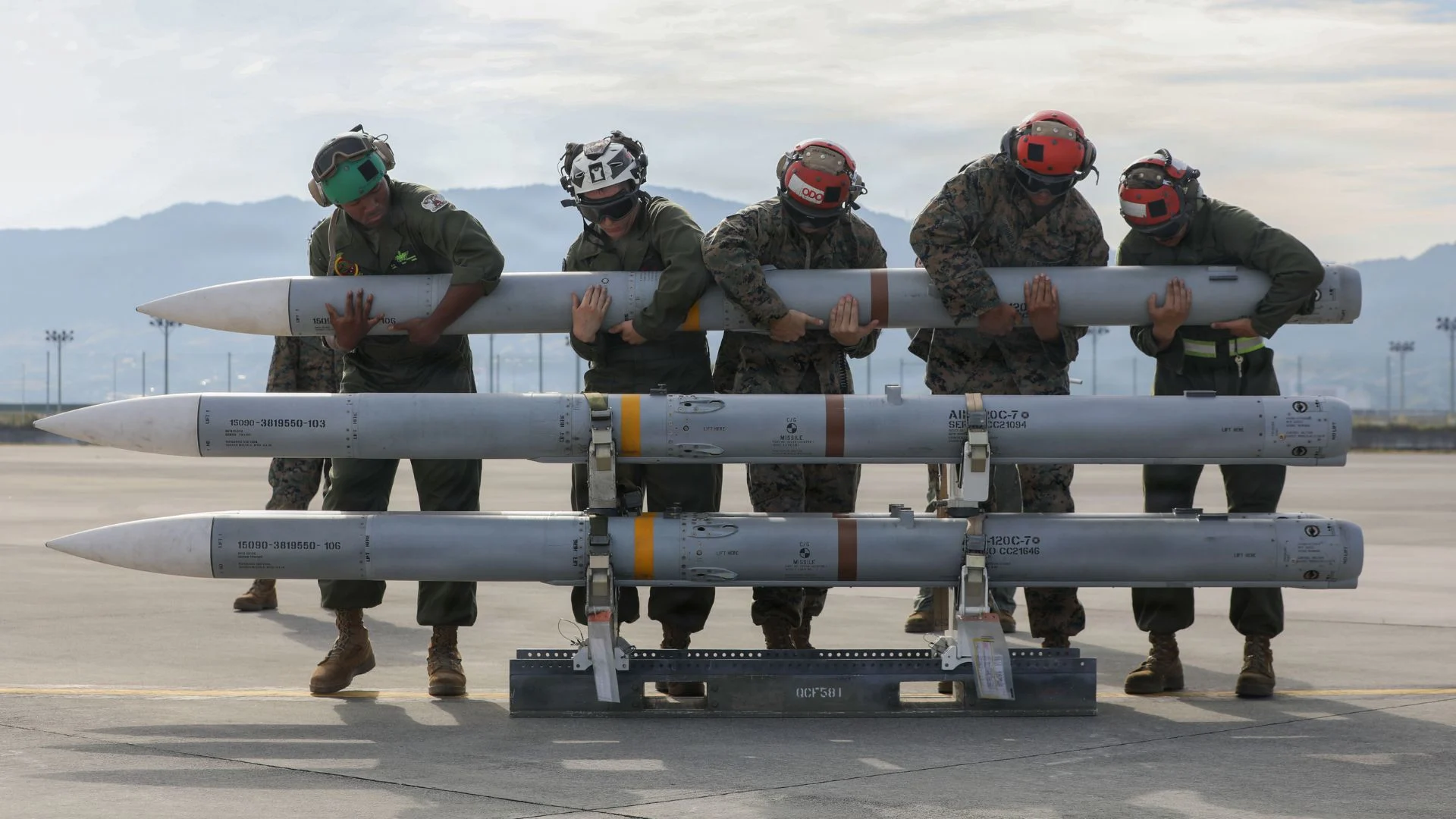
Japan and the United States have agreed to establish a final assembly and inspection facility in Japan for the AIM-120 Advanced Medium-Range Air-to-Air Missile (AMRAAM), Japanese Defense Minister Shinjiro Koizumi announced on October 28, 2026. Koizumi disclosed the decision at a press conference in Cebu, Philippines, after meeting U.S. Secretary of War Pete Hegseth on the sidelines of the 20th ASEAN Defence Ministers’ Meeting (ADMM) and the 13th ADMM-Plus. The site, construction schedule, industrial workshare and annual output have not been disclosed.
The agreement falls under Operation Supercharge, the initiative Koizumi proposed to Hegseth on May 30, 2026, at the Shangri-La Dialogue in Singapore to accelerate co-development and co-production of missiles, including the AMRAAM and the SM-3 Block IIA interceptor. It also lands as Tokyo builds out its long-range strike inventory and looks abroad for ranges to train with it. Days before the Cebu meeting, a Japan Ground Self-Defense Force (JGSDF) delegation inspected potential live-fire sites in India for surface-to-ship missiles and autonomous attack drones. That follows a 10-year arrangement with Australia, announced in August, allowing Japanese forces to test hypersonic and long-range stand-off missiles on Australian soil. In March, the JGSDF deployed the indigenous Type 25 surface-to-ship missile, with a reported range of roughly 1,000 km, to Camp Kengun in Kumamoto.
AMRAAM Final Assembly Moves From Feasibility Study to Commitment
The Cebu decision closes a two-year sequence run through the U.S.-Japan Forum on Defense Industrial Cooperation, Acquisition, and Sustainment (DICAS). At the July 28, 2024, Security Consultative Committee in Tokyo, the allies agreed to pursue co-production of the AMRAAM and the Patriot PAC-3 Missile Segment Enhancement (MSE). On October 7, 2024, DICAS leaders agreed to accelerate a feasibility study covering challenges, lead times and feasible production activities in Japan, and action plans for that study were approved on December 11, 2024.
Mitsubishi Electric held Ministry of Defense study contracts in 2024 and 2025 on domestic AMRAAM production. On April 28, 2026, the company said it would advance discussions with Raytheon, an RTX business, on the scope identified at the fourth DICAS session: circuit card assembly (CCA) work, with a possible future final assembly and check-out (FACO) in Japan. The Cebu announcement converts that possibility into a bilateral commitment. Neither government has said whether Mitsubishi Electric will operate the facility.
The CCA scope is not peripheral. Raytheon’s Form, Fit, Function Refresh (F3R) program redesigned the AMRAAM’s 15 circuit cards, which form the missile’s processing core. A Japanese role in CCA plus FACO would place domestic industry in the electronics and in final integration and acceptance testing. No disclosure so far indicates Japanese production of rocket motors, seekers or warheads.
AIM-120 Guidance, Range, and the Undisclosed Japanese Variant
Publicly available specifications describe the AIM-120 as roughly 3.65 m long and 178 mm in diameter, weighing about 152 kg in its C and D configurations, powered by a solid-propellant rocket motor and carrying a blast-fragmentation warhead. Midcourse guidance is inertial, with datalink updates from the launch aircraft, before an active radar seeker takes over for terminal homing. That architecture lets a pilot engage multiple targets beyond visual range and turn away before impact.
The AIM-120D adds GPS-aided navigation, a two-way datalink, extended reach and improved electronic protection. Open-source estimates place its maximum range at around 160 to 180 km depending on launch altitude and speed; no official figure has been released.
Japan has already committed to the current standard. In January 2025, the U.S. Defense Security Cooperation Agency notified a possible sale of up to 1,200 AIM-120C-8 and AIM-120D-3 missiles to Japan, at an estimated $3.64 billion, with RTX as principal contractor. The Cebu announcement did not specify which variant the Japanese line will assemble. A line built around the F3R-based C-8 and D-3 configurations would align with both Japan Air Self-Defense Force (JASDF) orders and current U.S. production lots. For the JASDF’s F-35A and F-35B fleet, the AMRAAM is the radar-guided beyond-visual-range weapon.
SM-3 Block IIA Data Sharing Widens Operation Supercharge
Koizumi also announced an agreement to share the technical information needed to expand SM-3 Block IIA production. The Block IIA, co-developed by Raytheon and Mitsubishi Heavy Industries, uses a 21-inch (533 mm) airframe for upper-tier ballistic missile defense from Aegis destroyers; the Japan Maritime Self-Defense Force first fired one from JS Maya in November 2022. Neither the additional output nor a delivery schedule was quantified.
Beijing responded the same day. Chinese Foreign Ministry spokesman Guo Jiakun said U.S.-Japan security cooperation “should not target or harm the interests of other countries” and accused Tokyo of using threats as a pretext to breach legal constraints. Japan’s most recent defense white paper describes China’s military build-up as its greatest strategic challenge.
Analysis: The facility addresses magazine depth, not a capability gap. The AMRAAM is the common beyond-visual-range round across U.S. F-35, F-22, F-15, F-16 and F/A-18 fleets and the JASDF F-35 force. A qualified FACO line inside the first island chain could assemble and inspect rounds close to where they would be expended in an East China Sea or Taiwan contingency, reducing reliance on transpacific resupply from Raytheon’s Tucson, Arizona, production base. Final assembly is not supply independence, however. As long as motors, seekers and warheads come from U.S. suppliers, a Japanese line adds throughput only if component output rises in step, and its value will be measured in rounds delivered rather than in the agreement itself.
The next milestones are site selection, designation of a Japanese prime contractor, confirmation of the variant to be assembled, and the U.S. technical assistance agreements needed to transfer FACO processes. Funding signals may surface in Japan’s fiscal 2027 defense budget, which the cabinet typically approves in late December. A subsequent DICAS session is the most likely forum for production targets for both the AMRAAM line and the SM-3 Block IIA expansion.