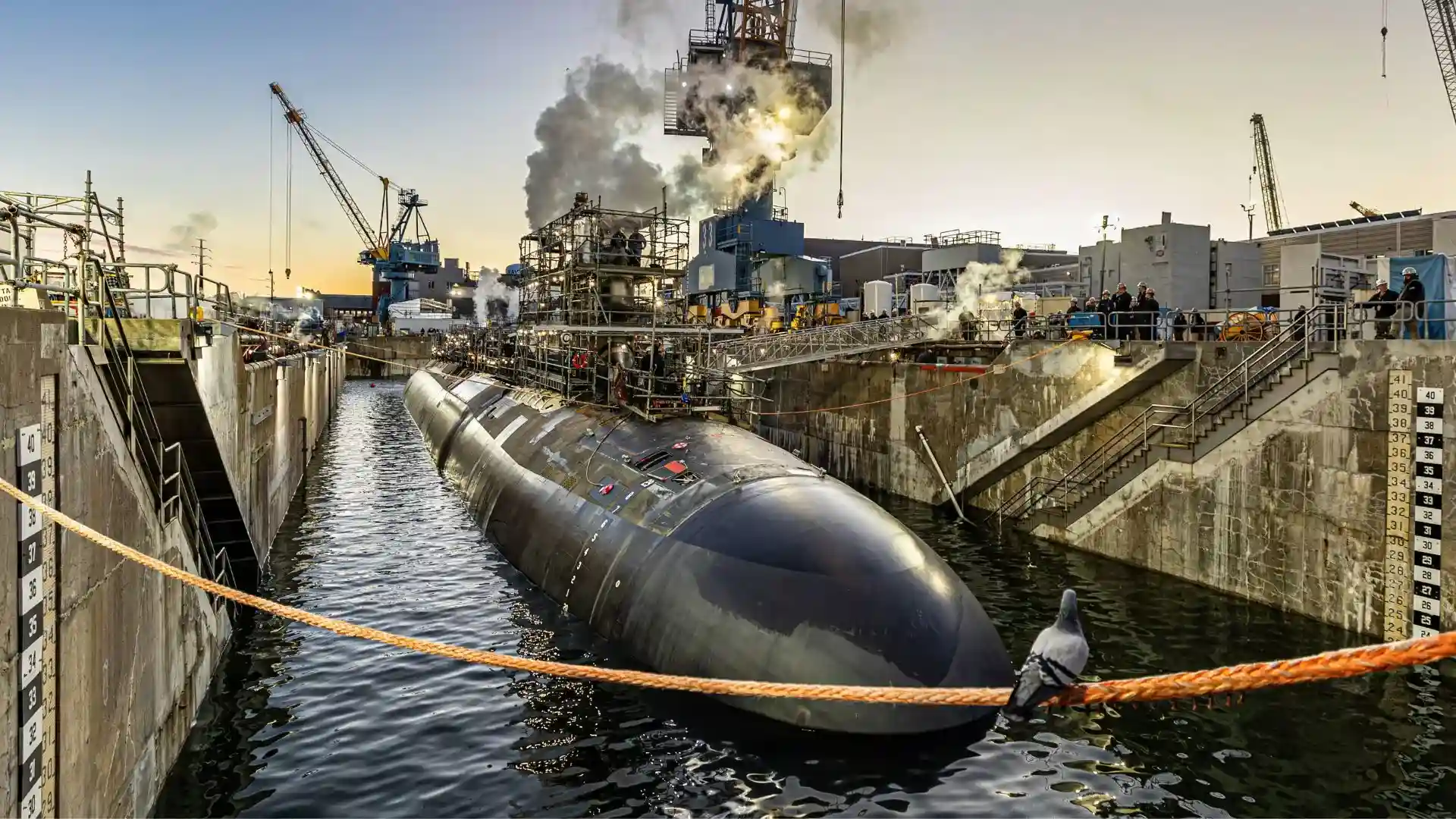
The US Navy undocked the Virginia-class attack submarine USS Washington (SSN 787) at Portsmouth Naval Shipyard (PNSY) in Kittery, Maine, on October 27, 2026, closing the dry-dock phase of a maintenance and modernization availability on schedule. The boat now moves into testing. The Navy has not announced a return-to-service date.
The milestone comes two months after a Government Accountability Office (GAO) report found that depot maintenance delays and idle time cost the attack submarine force more than 15,000 operational days between fiscal years 2016 and 2025. Washington also follows USS North Dakota (SSN 784), whose availability was the shipyard’s first on a Block III Virginia-class boat. How quickly Portsmouth turns Washington around is a direct test of whether lessons from that first Block III package are carrying over.
USS Washington EDSRA Timeline and the Portsmouth Work Package
Washington arrived at Portsmouth on September 27, 2024, for scheduled maintenance and system upgrades, and entered dry dock on November 14, 2024. The undocking closes roughly 23 months in dock and about 25 months since the boat reached the yard. Navy statements issued when Portsmouth zone supervisors toured the Naval Undersea Warfare Center (NUWC) Division Newport to prepare for the job identified the work as an Extended Dry-Docking Selected Restricted Availability (EDSRA), the depot-level period in which Virginia-class boats receive their deepest hull, mechanical, and electrical work.
According to the Navy, the package covered extensive mechanical and electrical upgrades, scheduled maintenance, and structural inspections. Shipyard personnel also used additive manufacturing to support the work.
“Washington’s undocking is an achievement that represents a coordinated effort across the shipyard to return a renewed and combat-ready submarine back to the fleet,” said Capt. Jesse Nice, the shipyard commander.
“I’m proud of the incredible work done between our crew and the project team, whose exceptional collaboration and vigilance led us to this undocking on time,” said Cmdr. Keith Turnbull, Washington’s commanding officer.
Undocking is not delivery. Floating the boat out moves the availability into pierside work, system testing, and crew certification, followed by sea trials. The Navy described completion of the docking period as an initial step toward restoring Washington to fleet operations. For reference, North Dakota left dry dock at Portsmouth in February 2026 and completed its availability on August 29, a post-undocking phase of roughly six months.
Block III Bow, Payload Tubes, and Sonar Architecture on SSN 787
Washington is the 14th Virginia-class submarine and the fourth of eight Block III boats. Huntington Ingalls Industries’ Newport News Shipbuilding built the submarine under the Virginia-class teaming arrangement with General Dynamics Electric Boat. Construction began in September 2011, and the Navy commissioned the boat at Naval Station Norfolk on October 7, 2017, at a reported cost of $2.6 billion.
Block III introduced a redesigned bow that replaced the 12 individual 21-inch vertical launch tubes of Block I and II boats with two 87-inch Virginia Payload Tubes (VPTs), each holding six Tomahawk Land Attack Missiles. The redesign also swapped the spherical bow sonar for a water-backed Large Aperture Bow (LAB) array. The larger tubes cut construction cost and leave room for payloads beyond Tomahawk. They also give maintainers a bow structure, launcher system, and primary sonar that differ substantially from the first ten hulls, which is why Portsmouth’s accumulated Block III experience matters.
Publicly available specifications indicate a length of 377 feet, a beam of 34 feet, and a submerged displacement of about 7,800 tons. An S9G pressurized-water reactor drives a single shaft with a pump-jet propulsor and is designed to run more than 30 years without refueling; the official top speed is listed as more than 25 knots. Four 21-inch torpedo tubes handle Mk 48 Advanced Capability torpedoes, alongside the 12 VPT cells. Non-penetrating photonics masts replace traditional periscopes, and a lock-in/lock-out chamber supports special operations forces. For the Atlantic submarine force, a Block III boat back in rotation restores a 12-cell Tomahawk load while the Ohio-class guided-missile submarines approach retirement.
Portsmouth’s Block III Learning Curve and the GAO Readiness Gap
North Dakota arrived at Portsmouth on April 28, 2023, and returned to the fleet roughly 40 months later, ahead of a rebaselined schedule, after the team executed several first-time technical alterations. Washington reached undocking about 25 months after arrival, compared with roughly 34 months for North Dakota. The work packages differ, so the comparison indicates direction, not proof of a sustained gain.
The broader numbers explain the emphasis on schedule. GAO counted 44 attack submarines, 20 Los Angeles-class and 24 Virginia-class boats, as of fiscal year 2025, and found that the Navy completed only about 11% of attack submarine depot maintenance periods on time at public shipyards over the decade it reviewed. Without mitigation, it projected that 15 attack submarines would enter inactive idle time between fiscal years 2026 and 2030. Virginia-class construction was running at about one boat per year as of mid-2025, half the Navy’s goal of two.
Analysis: With new construction stuck at half rate, maintenance throughput is the fastest lever the Navy has on attack submarine availability. An on-time undocking on Portsmouth’s second Block III job suggests the yard is converting North Dakota’s first-of-class lessons into planning gains. The harder test comes next: North Dakota still spent about six months between undocking and completion, and test-phase slippage has often eroded schedule gains made in dock. A materially faster test phase on Washington would be the clearest evidence yet that Block III depot work at Portsmouth is becoming a repeatable process.
Washington now enters pierside testing, crew certification, and sea trials. The Navy has not released a delivery date, a final cost for the availability, or a full list of modernization items installed. Key indicators are the date Washington departs for sea trials and whether the Navy reports completion against its original schedule.