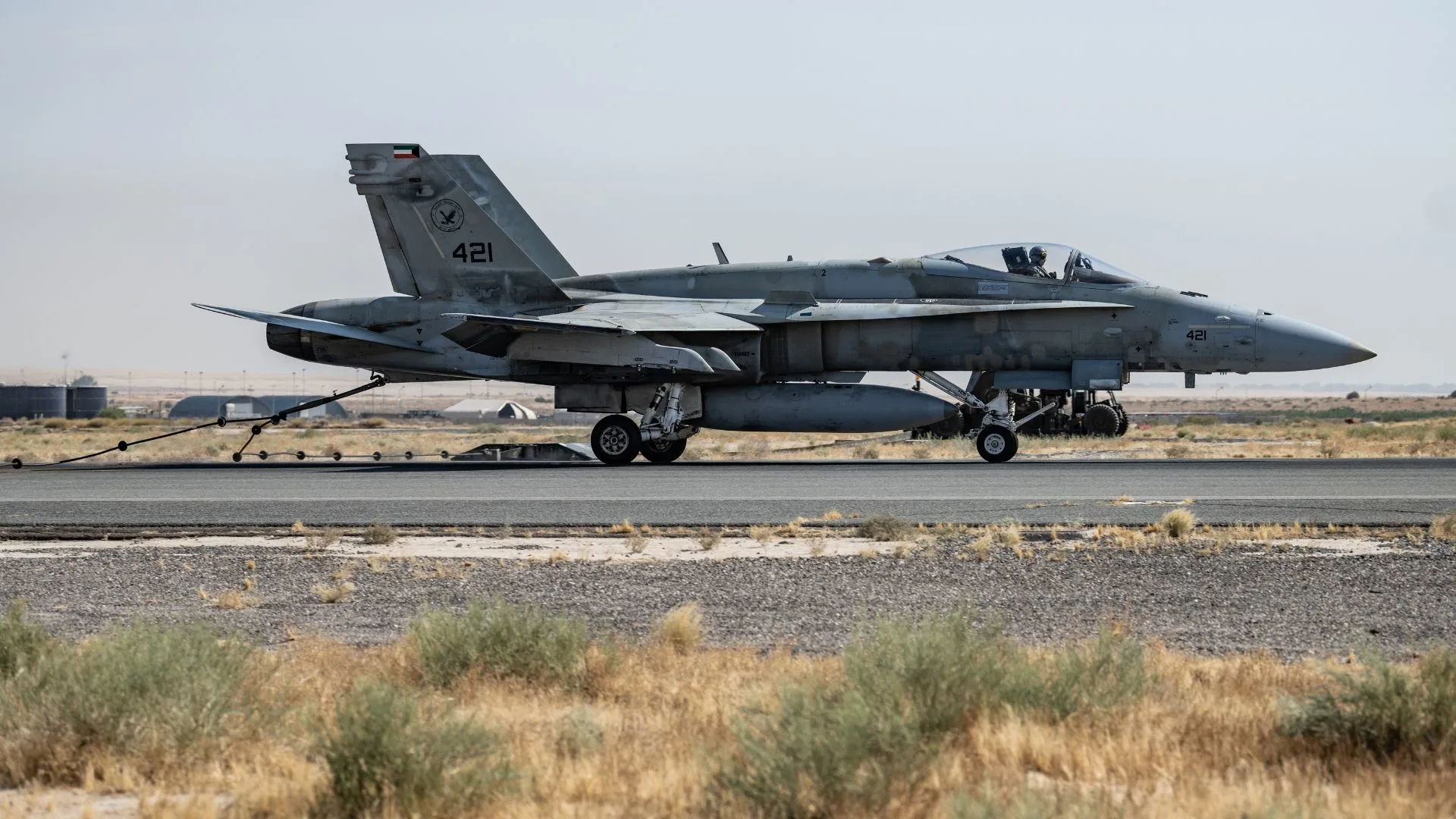
The US Navy has awarded The Boeing Co. an $11,144,746 contract modification to keep F/A-18 instructor pilots and ground-training specialists embedded with the Kuwait Air Force (KAF) at Ahmad al-Jaber Air Base, according to Pentagon contract announcements published October 28, 2026. The modification, designated P00012, funds in-country training and program support through October 2027 and is paid entirely by Kuwait through Foreign Military Sales (FMS).
The award lands in the middle of a fighter transition that has slipped repeatedly. Kuwait ordered 22 single-seat F/A-18Es and six two-seat F/A-18Fs in June 2018 to replace the F/A-18C/D Hornets it acquired after the 1991 Gulf War. Boeing completed all 28 jets in 2021 and transferred them to US Navy custody pending handover, but infrastructure work at Ahmad al-Jaber and pandemic disruption pushed the transfer back, with open-source reporting pointing to arrival in 2026 and full operational capability in 2027. That schedule now runs under fire: Kuwaiti territory has been targeted by Iranian drones and missiles since February 28, 2026.
Inside the Kuwait Air Force Training Contract With Boeing
Naval Air Warfare Center Training Systems Division (NAWCTSD), Orlando, Florida, is the contracting activity. The underlying contract, N61340-23-C-0004, dates from fiscal 2023, and P00012 marks its twelfth modification, consistent with a services vehicle extended in increments. The full $11,144,746 in FMS funds will be obligated at the time of award.
The modification combines firm-fixed-price and cost-plus-fixed-fee terms. That structure typically pairs fixed pricing for recurring instruction with cost reimbursement for less predictable in-country support. The announcement gives no line-item breakdown or instructor headcount.
The work was not competitively procured, and the announcement does not cite the statutory exception used. Sole-source awards are routine in FMS cases where the customer or an international agreement designates the contractor. A separate Boeing contract, N00019-23-C-0008, awarded in March 2023 at $70.7 million, supports the preparation of Kuwaiti pilots for the Super Hornets, mostly from New Orleans, Louisiana. An $11.8 million modification in September 2026 extended that US-based logistics, maintenance, and ferry support to March 2027. The two efforts now overlap: support in the United States ends in March 2027, while the new in-country work at Ahmad al-Jaber runs through October 2027.
Boeing recruitment material for the program describes the scope. Contract instructor pilots deliver a syllabus running from initial qualification to advanced training, including air-to-air gunnery, air-to-ground strike, day and night aerial refueling, and low-level flying. Candidates need at least 800 F/A-18 or equivalent fighter hours and must complete KAF Block III differences training. Ground-training specialists cover academics, simulator instruction, and systems knowledge. The contract text itself does not specify how the effort splits between the legacy Hornet and Super Hornet syllabi.
From Legacy Hornets to Block III Super Hornets at Ahmad al-Jaber
Kuwait’s Super Hornets are built largely to the US Navy’s Block III standard, with some Block II elements reportedly retained. According to The War Zone, Kuwait’s order helped fund parts of Block III development, and its jets receive some of the same upgrades, such as the Elbit Systems wide-area cockpit display. Publicly available specifications indicate the Super Hornet’s AN/APG-79 active electronically scanned array radar and two General Electric F414-GE-400 turbofans, each rated at roughly 22,000 pounds of thrust in afterburner, compared with about 17,700 pounds for the F404 engines on the KAF’s C/D models. The larger airframe also offers 11 weapon stations instead of nine.
For the training pipeline, that makes the Super Hornet a different aircraft, not an upgrade. AESA radar employment, sensor fusion, and a glass cockpit demand new tactics and academics, the gap contractor instructors fill while the KAF builds its own instructor cadre.
Architectural drawings released with a 2021 US Army Corps of Engineers solicitation showed 26 new aircraft shelters at Ahmad al-Jaber alongside 38 existing Hornet shelters. Disposal of the legacy Hornets remains open after Malaysia’s cabinet decided in February 2026 not to acquire up to 33 ex-Kuwaiti F/A-18C/Ds, following a November 2025 inspection in Kuwait.
Analysis: At $11.1 million, the modification is small, but it underwrites the human-capital layer of a multibillion-dollar recapitalization. The KAF cannot generate a new fighter cadre quickly on its own, and 28 Super Hornets deliver no combat value without qualified crews and maintainers. Extending Boeing’s in-country presence through October 2027, at a base within range of Iranian drones, signals that Kuwait and the US Navy treat training continuity as a readiness requirement rather than a discretionary cost. It also anchors the KAF more deeply in US Navy tactics, standards, and interoperability for the next decade.
Key milestones to watch include confirmation of the Super Hornets’ arrival and handover at Ahmad al-Jaber, a KAF declaration of operational capability, reportedly targeted for 2027, and a decision on the legacy Hornet fleet. A follow-on modification or new contract will be needed before the October 2027 completion date. Open sources conflict on how many Super Hornets were physically in Kuwait as of October 2026, and the Pentagon announcement does not clarify the point.